

Cyril Richardson Tifft
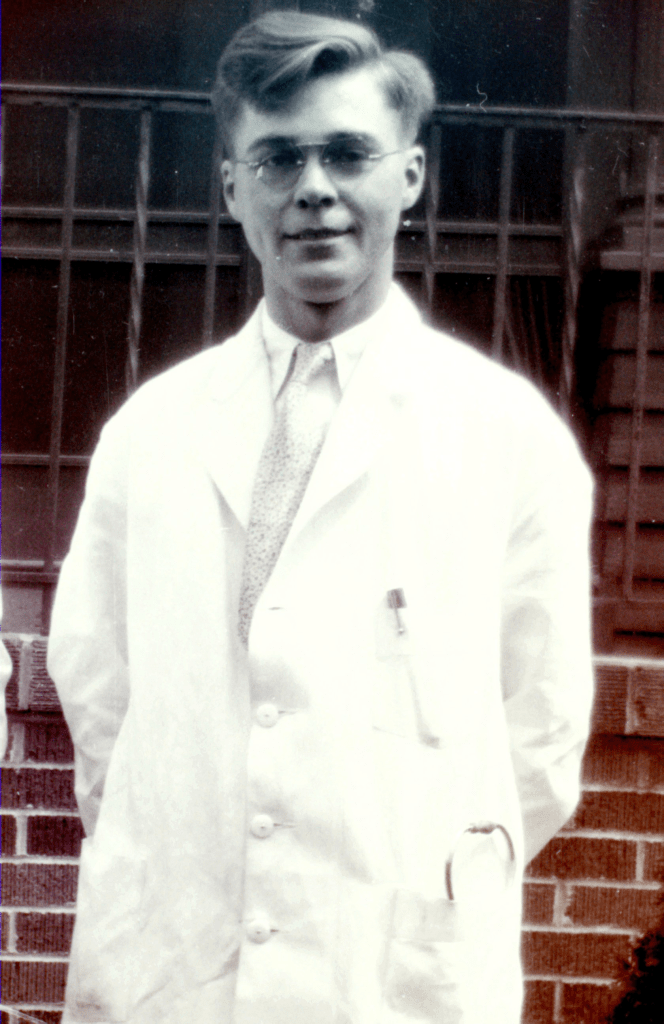
My two half-sisters Elizabeth and Mary, and I are the daughters of Cyril Richardson Tifft (1906-2002). Elizabeth and Mary are the daughters of Cyriland his first wife, Beatrice Anna Matilda Hallberg Tifft. Bea (as she was called) passed away suddenly in 1946. Cyril was married for a second time in August 1947 to my mother, Margaret Jean Goodrich Watson Tifft. I was born in April 1949, about twenty months after Jean (as my mother was called) and Cy (as my father was called) were married. Shortly after I was born, my father adopted my mother’s son, Billy.
Cyril was born at home in Glencoe, Minnesota, on November 27, 1906. He was the youngest of the four children born to Cyril M. Tifft (1865–1937) and Lillian Mae Richardson (Lillie or Lilla) Tifft (1867–1955). Their oldest child, a son, was stillborn on October 2, 1895. Cyril’s older sister, Lydia Lillian Tifft (Lillian), was born on February 3, 1897, and named after her mother Lillian, and her maternal grandmother Lydia Phelps Reed Richardson. Cyril’s brother Samuel Lowell Tifft (Lowell) was born on December 3, 1898. He was named after his paternal grandfather Samuel Lonard Tifft.

Sections
- Early Childhood
- Religion
- Education
- Early Adulthood and Launch of Medical Career
- First Marriage
- World War II Service
- Bea’s Sudden Death
- Beginning to Live Again
- Second Marriage
- Cy’s Special Talents
- A Life Well Lived
Early Childhood

“Little Cyril,” as he was called, was the youngest of the family by nearly eight years. His mother prolonged his babyhood as long as she could, perhaps because she was thirty-nine when he was born and didn’t expect to have more children. Dad told one story that featured his extended infancy, one of very few stories that he told in which he complained, albeit rather gently, about his mother. Apparently Lillie liked to show Cyril off when he was a small child. Until he was three or more, she kept his hair in long curls, and dressed him in dresses, both at home and when she took him with her to ladies’ lunches and teas.
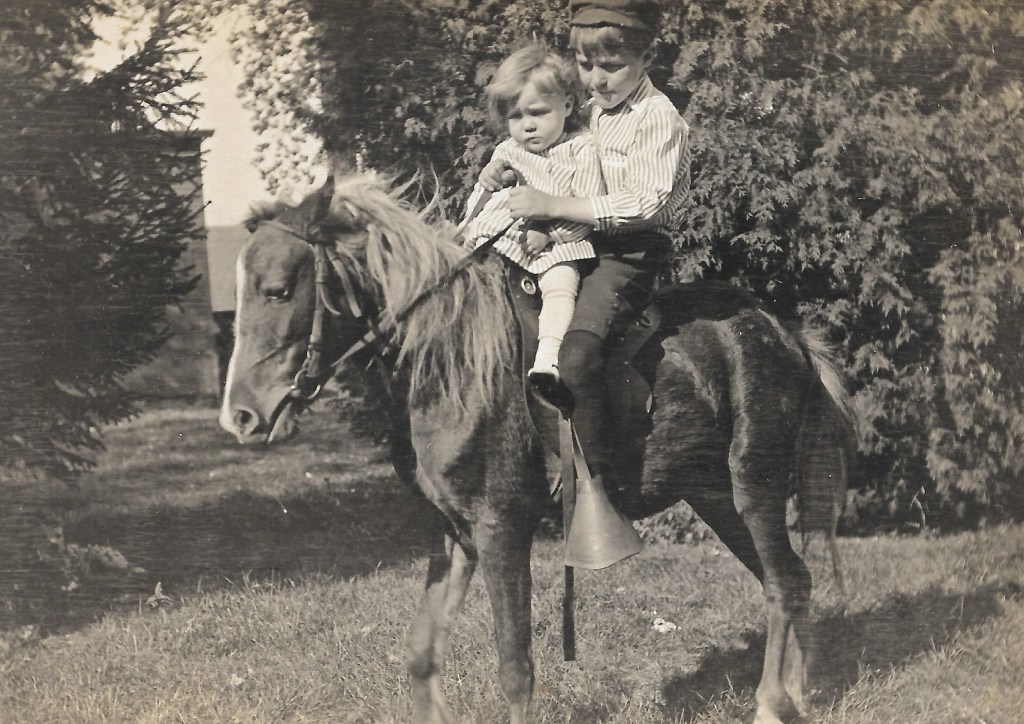
Finally, when he was about four, Cyril threw a fit and refused to go—especially not wearing a dress. Lillie was apparently furious with him but, when she reported Cyril’s misbehavior to his father, Cyril the elder just laughed and told Lillie to quit dressing him like a girl and taking him to ladies’ parties. That ended that. From then on Cyril got to dress as a boy, and stayed home to play while his mother went out to visit her friends.

The family of Cyril M. and Lillie Tifft was solidly middle class. The family lived in a nice Victorian home in Glencoe, a small town in the farming country of south central Minnesota. They had a “hired girl” to do the housework, help Lillie with the cooking, and care for Little Cyril. They had a pony for the children, and as they got older, the children got bicycles. They also went to a family cottage on nearby Lake Marion, where Dad remembered happy, carefree family holidays. These were luxuries in the early 1900s.

Glencoe is the county seat of McLeod County, and Cyril’s father was the district court judge for the south central region of Minnesota. Judge Tifft was a highly respected man who ruled and was revered at the county courthouse. I always had the feeling that, although Little Cyril’s father thought he ruled at home too, Lillie was the power behind the throne and the real influence in Little Cyril’s life.
Lillie was a sweet, genteel lady who had lost much of her hearing as a child. She was an excellent artist, as the few examples of her paintings we have in the family indicate. Her side of the family, the Richardsons, was a large and important one in Glencoe. Her father Joseph Richardson had gone into partnership with his brother-in-law, Axel Reed to operate the local “mercantile,” a general store and feed store, but according to family lore, there was quite a rivalry between them. Ultimately, Joseph Richardson started a new store and grain business in nearby Bird Island. His younger son, Axel Richardson ran it for him. I always think of the two old gentlemen as big frogs in a small pond.

Though Little Cyril’s grandparents had all passed away by the time he was born, his extended family was large and close. Surrounded by his parents and siblings, uncles and aunts, great uncles and great aunts, and first, second and third cousins, Little Cyril’s world was secure. His extended family was a major influence on him during his childhood and throughout his life. The Tifft family was particularly close to Lillie’s three sisters and two brothers and their families.
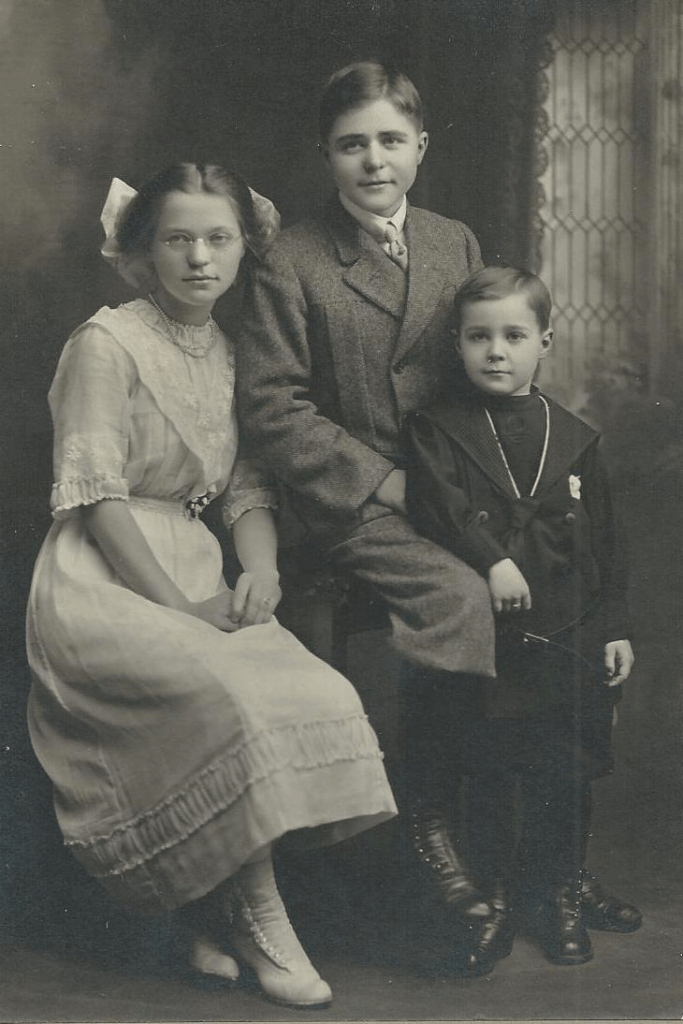
Cyril’s childhood diary, which he wrote in a small notebook when he was about nine, gives us a glimpse of his personality as it was emerging. It shows him to have been a curious and busy little boy who loved inventions and figuring out how to make his own machines, including a printing press and a radio. Though he was not above getting into trouble, often because his curiosity led him astray, Cyril seems to have been a serious, obedient, and studious child who was devoted to his mother and siblings and in awe of his father, the judge. Though Cyril respected and loved his father immensely, as a young child it doesn’t seem as though Cyril had much of a relationship with him. His mother continued to be very important to him until her death in 1955.
Religion
Religion was important to the Tifft family, and particularly to Lillie. The family’s religious leanings are well-known; they were Protestant and strait-laced. But exactly which church they attended, and which denomination they identified with, has been a point of some confusion in the family.
When Cyril was about thirteen and one-half he expressed an interest in joining the Methodist Episcopal (M.E.) Church, but apparently there was no Methodist Episcopal Church in town. His mother took the somewhat unusual step of writing to the pastor of the M.E. Church in Litchfield, a town forty-five minutes from Glencoe even on today’s roads. The pastor replied on March 14, 1920:
Dear Mrs. Tifft,
I received your card yesterday. I am glad to know that Cyril wants to join the Church. By virtue of his baptism [emphasis mine], he is a member of the Methodist Episcopal Church on probation and now that he wishes to identify himself with the church I shall enter his name on my record as such. When summer comes he can come over here by car or I shall run over to Glencoe and receive him into full membership. In the meantime I would recommend that he take an active part in the work of the Congregational Church. At any time he may wish I will give him a certificate of transfer to my church…
Yours cordially,
R. P. Cummings
This brief note tells us something about Cyril’s religious upbringing, as well as the history of the Glencoe. He was baptized in the Methodist Episcopal Church, probably as an infant in 1906 or early 1907, most likely in the Glencoe church. Yet in March 1920 when this note was written, there was no Methodist Episcopal church in Glencoe for him to join. Reverend Cummings encouraged Cyril to “take an active part in the work of the Congregational Church” implying that the family was attending Glencoe’s Congregational Church. Regardless of how or where it happened, Cyril became a Methodist and so did his sister Lillian, whose husband, Ray Overmire, became a Methodist minister later in life. Cyril’s brother Lowell and his family, however, remained Congregational.
Information gleaned from the archives of the McLeod County Historical Society and Museum indicates that the congregation of the Glencoe Methodist Episcopal Church was formed in the 1850s, shortly after the town was founded. The first minister served there in 1856–57 and the church and parsonage were built in 1886–87 but “eventually the majority of these members [of the Glencoe M.E. Church] joined the First Congregational Church.”
The obituary for Lillie’s father, Joseph Richardson, published in the Glencoe Leader shortly after his death on June 5, 1906, provides some hints to help us sort this out. “The deceased had always been a prominent factor in social and church circles, particularly in the M.E. Church of which he was a lifelong member” and the obituary goes on to say, the funeral service will be conducted by the current pastor of the Glencoe Methodist Episcopal Church. There is no doubt that Lillie and her siblings, who moved to Glencoe from Brighton, New York in 1872, when Lillie was about five, were raised in the Glencoe Methodist Episcopal Church and little doubt, based on the Litchfield pastor’s note that it was still in existence later in 1906 or early 1907 when Little Cyril was baptized. But, according to the McLeod County Historical Society’s records, the Glencoe Methodist Episcopal Church apparently shuttered its doors sometime between the end of 1906 and March of 1919. It’s likely that Cyril and Lillie Tifft and their children were among those who joined the Congregational Church when the Methodist Episcopal congregation folded.
My father Cyril maintained his affiliation with the Methodist Episcopal Church (ultimately to join with other denominations to become the United Methodist Church) for the rest of his life. Beatrice Hallberg, his first wife, was raised in the Swedish Lutheran Church, but became a Methodist when she married Cyril. And Jean Goodrich Watson, his second wife, was raised in the Congregational Church, but became a Methodist when she married Cyril. Apparently this was a non-negotiable issue in Cyril R. Tifft’s household.
When Cyril set up his medical practice on St. Paul’s East Side and married Bea, they joined Holman Methodist Church. Cy and Bea, and later Jean, continued to attend Holman until after my birth in April 1949. I was baptized there, but sometime soon thereafter, Cy and Jean moved their membership to Arlington Hills Methodist Church—now Path of Grace United Methodist Church—which was closer to their Arcade Street home in suburban St. Paul. Jean and Cy remained loyal members and regular church attendees there until their deaths in the early 2000s.
To the men in Cyril’s life—especially his father Judge Tifft, a politician at heart—being Republican, Lincoln’s kind of Republican, was nearly as important to them as their religion.
Education

Cyril graduated from Stevens Seminary in the spring of 1924, when he was seventeen. In the fall he attended Hamline College (now Hamline University) in St. Paul. Among Dad’s papers, I found a savings account passbook showing that by the time he started college, his father had saved over five thousand dollars to pay for Cyril’s education—almost $90,000 in today’s dollars. Clearly, Cyril inherited his penchant for financial responsibility and security from his parents and owed his college education to their generosity, especially after the Great Depression started in the fall of 1929 in the middle of his medical studies.

After two years at Hamline, Cyril transferred to the University of Minnesota to start the pre-medicine program. One summer during college, Cyril had a summer job as a camp counselor at a camp near Glencoe. When one of the boys got sick, Cyril was given the job of driving him home—and contracted polio from the boy. Fortunately for Cyril, his case was mild, but he was left with weakness in one leg. Though he eventually recovered, he was still walking with a cane at his college graduation. For the rest of his life, he was occasionally bothered by a weak and aching leg, especially after standing for long periods while performing surgery.
Cyril earned a Bachelor of Arts degree from the University of Minnesota in June 1928.By attending medical school year-round, he earned his Bachelor of Medicine degree in December 1930. Following a one-year internship at St. Mary’s Hospital in Duluth, Minnesota, he earned his Doctor of Medicine degree in December 1931, when he was barely twenty-five. Doctors of today might find it hard to believe that he was ready to start his own practice at such a young age, but he did so in January 1932.
Early Adulthood and Launch of His Medical Career
The very young Dr. Cyril R. Tifft (known by then as Cy) opened his own general medical practice in St. Paul on January 18, 1932. Opening a practice with virtually no money was not an easy proposition in 1932 at the height of the Great Depression. Cy did a bit of wheeling and dealing to do so. He bought out the practice of a retiring general practitioner, Dr. Harry Cannon, for $800, probably with some help from his parents. With the practice, located on St. Paul’s East Side near the intersection of Arcade and Seventh Street, came Dr. Cannon’s office and equipment, his household furnishings, and the promise to introduce Cy to some of his patients. At the time, according to Dad’s 1994 memoir, “The Geneology [sic] of the Cyril M. Tifft Family,” an office visit cost $2.00; a house call, $3.00; and having a baby, including prenatal visits, delivery, postnatal visits, and six months of baby visits, totaled $35.00. Dad always maintained that his willingness to make house calls at all times of the day and night—unlike more established doctors—gave him his financial start.
Cy continued to make house calls well into the 1950s. If he wasn’t going to be too late, we kids went with him—staying in the car with Mom or Liz while he went in to see his patients—in order to have a little time with our Dad before bedtime. We didn’t see much of him during the week otherwise. Because he’d started his life as a doctor making housecalls, he always carried his well-stocked, handsome medical bag with him to and from work. It saved a lot of people at one time or another—including me, when I had my first severe allergic reaction and he raced for his medical bag to give me a shot of epinepherine.

After Cy opened his medical practice, he affiliated himself with St. John’s Hospital, which was a few blocks away from his office. He became the protégée of the highly respected and well-known general surgeon Dr. Frederick Plondke to learn the art of general surgery. Unlike today, when a multi-year residency is required before a doctor can claim that he is a specialist of any kind, Cy got his basic surgical training over the next few years through his affiliation with Dr. Plondke.
First Marriage
During the summer of 1929, while Cy was still in medical school, he met Beatrice Anna Mathilda Hallberg (Bea). It didn’t take them very long to fall in love, but Bea was off in the fall for her first teaching job in New Glarus, Wisconsin. It was the beginning of the Great Depression. Being practical young people, Bea and Cy delayed marriage for four years. After Cy had been practicing medicine for about two and one-half years, they were married at Bea’s parents’ home on June 23, 1933.
After their marriage, Cy and Bea lived in a small apartment at the back of his office. It had a small kitchen, and a combined bedroom and living room where they slept on a couch that converted to a bed. They shared their bathroom with Cy’s patients. The rent was thirty-five dollars per month. When their landlord tried to raise the rent to forty-five dollars, they moved to a larger apartment and office on the second floor of a nearby building located at the corner of 7th and Arcade Streets, still on St. Paul’s East Side. Their new accommodations had an office with two examining rooms, a small laboratory, and a business office. Across the hall, Cy and Bea’s new apartment had a very large kitchen, complete with a dumbwaiter—a small, hand-operated elevator which had been used to move food from the kitchen to the saloon that had originally occupied the main floor. Cy and Bea’s most prized possession in this second and much roomier apartment was a hand-carved oak dining room set including a large table, six chairs, a china cabinet, and a buffet. Cy and Bea purchased the set using a five-hundred dollar bequest from Ole Krogstad, an old Norwegian bachelor who had been a man-of-all-work at the general store owned by Cyril’s grandfather, Joseph Richardson. When “Grandpa Richardson” died, Ole switched his loyalty and affection to the Tifft family. Dad remembered him fondly. Most of this furniture, afforded thanks to the generosity of Ole Krogstad, is still in the family today, nearly ninety years later.
Bea and Cy’s first child, Elizabeth Ann (Liz) was born on January 18,1937. Shortly thereafter, Bea and Cy bought a building lot at 2195 Arcade Street in Little Canada (now Maplewood) in suburban St. Paul, and started to design their dream home, a four-bedroom, one and a half bath home on three-quarters of an acre of wooded land, with a two-car garage and a separate “office” where Cy could see patients—though it’s not clear that he ever used it for that purpose. The backyard even had an Indian footpath through it, where Cy found arrowheads in his early years of living on the property. They hired Cy’s cousin, George Crosby, an architect and the son of one of Cy’s maternal aunts, to design their home. Bea, Cy, and Elizabeth moved into their finished dream home on Halloween Day, 1939.
World War II Service
In the late 1930s and early 1940s, war was on the horizon. By then, Cy’s practice was growing and the Tifft family was thriving. Bea and Cy expected that Cy would eventually have to join the service and close his medical practice, and that their income would be drastically reduced. They began to pay off their mortgage as quickly as they could, a feat that they accomplished by the time Cy was called up in October 1943, less than two months before their second child was born. They knew Cy’s military service would be a huge personal and financial sacrifice for both of them—a sacrifice far from unique during World War II.
By 1943, the shortage of doctors in the U.S. military was severe. Even though he was in his late thirties, Cy, like many other established doctors, volunteered. In the fall of 1943, he received an officer’s commission as a First Lieutenant in the Medical Corps of the United States Army Air Forces, the predecessor to the U.S. Air Force. He was paid one hundred sixty-six dollars and sixty-six cents per month. Cy started his basic training—the same training that young conscripts went through—at Carlisle Barracks in Pennsylvania. He was nearly thirty-seven. At least one of his fellow doctors, probably even older and more out of shape than Cy, died due to the physical exertion of basic training.
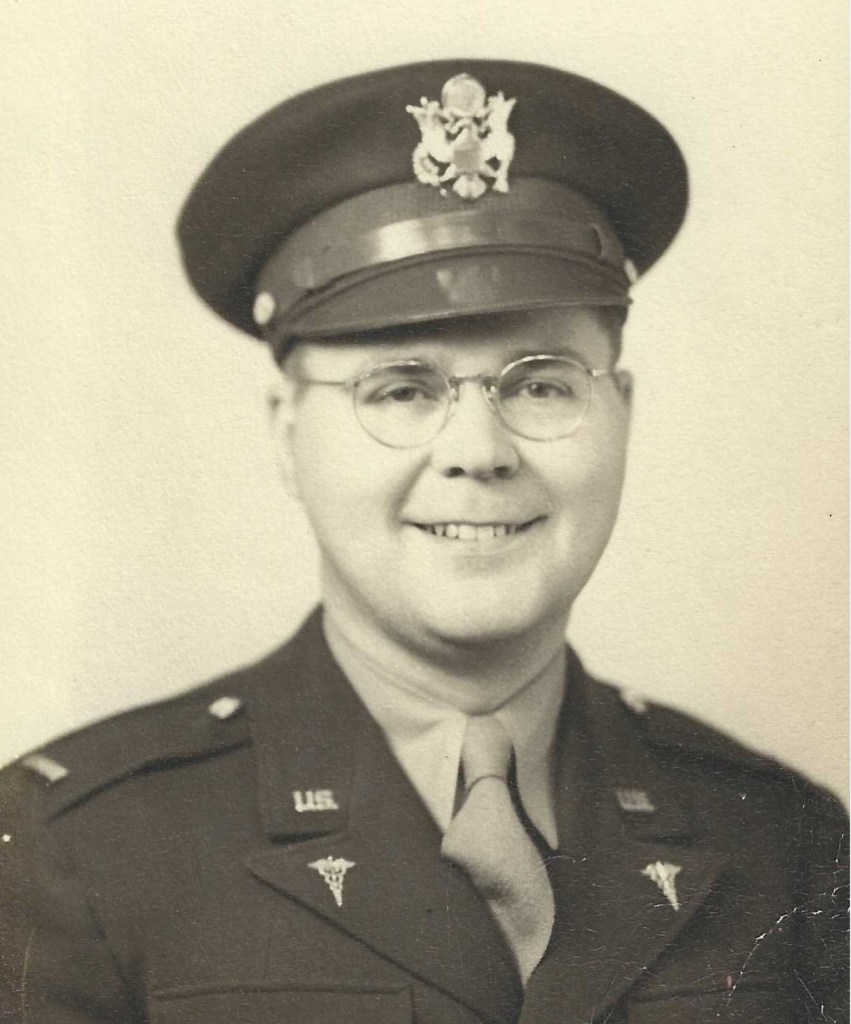
Cy and Bea’s second daughter, Beatrice Mary (Mary), was born on December 10, 1943, while Cy was at Carlisle Barracks. After basic training he was sent to Portland, Oregon, and then to an army camp in Washington to serve as a member of the medical team with a unit of eight hundred Black troops—a new cultural experience for Cy, the boy from all-white Glencoe, Minnesota. Bea and their two little girls joined Cy on the West Coast, living in a rented house in Portland for a few months. After his stint in Oregon and Washington, Cy was sent to Maine by train, his point of departure for his “overseas” posting at the joint U.S. and Canadian air base at Goose Bay, Labrador. He arrived at Goose Bay in May 1944.

The joint air base at Goose Bay was built in Labrador’s undeveloped wilderness and became home to the largest airfield in the Western Hemisphere. The Goose Bay air base was built as a strategic asset to provide North America with protection from German invasion. From Goose Bay, U.S. and Canadian reconnaissance and search-and-rescue aircraft could fly further into the North Atlantic than from any other base. Goose Bay also provided a refueling stop for planes being ferried to Great Britain and was a stopover for troops and planes flying to and from Great Britain and Europe. By the end of 1942 there were three thousand civilian workers and five thousand military personnel housed at the base, including three hundred twenty-five U.S. personnel.
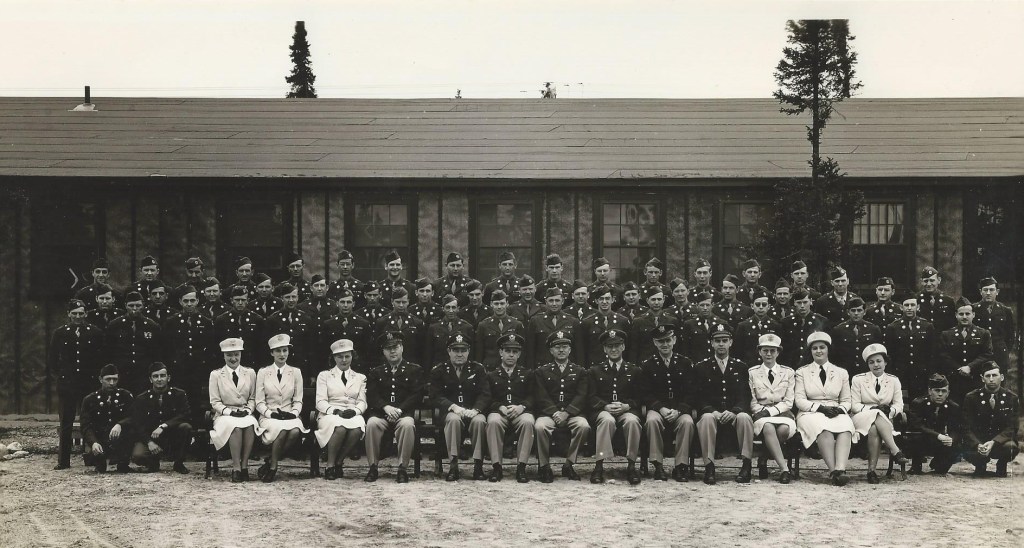
Cy was the chief surgeon at the U.S. hospital. When he arrived at Goose Bay, one of the first people he met was his soon-to-be best friend Dr. Dave Traub, who greeted Cy with, “Where the hell have you been? We’ve needed you.” The one hundred fifty bed U.S. hospital at Goose Bay was constructed in mid-1942 and staffed by about seventy U.S. military personnel. It was vastly oversized and overstaffed to serve only the three hundred twenty-five USAF personnel on the base. Though I have found very little information regarding the mission of the U.S. hospital, I believe, based on Dad’s recollections, that another, and perhaps much more important mission of the hospital and its staff was to provide emergency treatment for the wounded from the European theater. If that was the case, after major battles, the hospital—and especially its chief surgeon—would have been very busy indeed, just as Dr. Traub had implied. Dad rarely talked about his medical duties at Goose Bay, and wrote even less in his 1994 memoir.

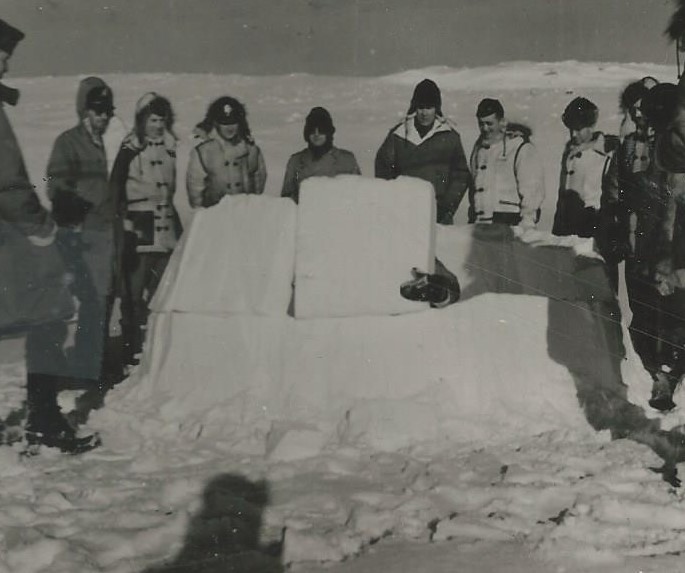
Between major European battles, the medical staff seems to have had a lot of down time. Cy talked often about his leisure time while stationed at Goose Bay. He played a lot of chess with the other doctors, and he smoked his pipe with Dave Traub, often enjoying the excellent tobacco that Dave’s wife sent from their home in Louisville, Kentucky. Judging from his photos of that time, when he wasn’t working he particularly enjoyed skiing cross country in the winter and fishing in the summer. He told of going out with other doctors and dentists to nearby villages to provide medical and dental care to the local Inuit people. He also recalled his amazement that the local Inuit knew to head to the base on dogsleds to meet the cargo planes arriving with supplies, even before the base personnel knew that supply planes were coming in.

One of Cy’s favorite stories from his time at Goose Bay illustrated how close the German submarines were coming to the Labrador coast and to Goose Bay. Because the Goose Bay air base was shared by Canada and U.S., the officers routinely hosted each other for dinners in the officers’ mess halls. On the day of these joint dinners, the hosts would radio the menu to the guests from the other side of the base. Once in a while, radio operators who were monitoring German radio traffic would hear the German submariners rebroadcasting the dinner menu from the host mess—just to rattle the allies and to make sure they knew how close the German subs were to them.
Victory in Europe was declared on May 8, 1945. By then end of 1945 the need for the U.S. Air Force presence in Labrador and Newfoundland was winding down. Cy was given leave to go home for Christmas that year. When he got home, he learned from Bea that she had fainted while listening to the Cedric Adams show on the radio one evening. The cardiologist she’d been seeing had died, and Cy could get no information on her condition. Cy tried to extend his leave to take care of Bea, but his request was denied by his commanding officer. Instead, he was ordered back to Goose Bay, and then on to the base at Stephenville, Newfoundland, where the hospital commander claimed he needed Cy but, in Cy’s words, “When I got there, there was very little to do.”
Bea’s Sudden Death
Bea died suddenly in her sleep during the night of February 8–9, 1946. She was barely thirty-eight. When Cy received the phone call from their minister in St. Paul, telling Cy of Bea’s heartbreaking death, he returned home as quickly as possible on emergency leave. After burying his wife, he requested a military discharge on compassionate grounds so that he could take care of his young daughters Liz, who was just nine, and Mary, who was barely two. His commanding officer refused to grant his discharge. I believe, based on clues in the correspondence Dad kept, that the commanding officer was trying to keep the doctors under his command from being discharged, so that he could keep his command, even though the war was all but over. Thanks to the machinations of a neighboring family that was powerful in Minnesota political circles and their lawyer—none other than Warren Burger, the future Chief Justice of the Supreme Court—Cyril was finally discharged from the Army in early March 1946 with the rank of major.
There is no doubt that Cy enjoyed his time in the service. He never saw a battlefield, but he saw the human devastation of war, and he learned a lot from his service as a military surgeon which set him up to be an excellent general surgeon in peacetime. From a personal standpoint, he had many new experiences; it was the first time he’d had any significant contact with people of color, and the first time he’d traveled out of the Midwest. He enjoyed new experiences like skiing and dog-sledding—and making igloos, which he taught us kids to do back in Minnesota—and he gained a friend for life in Dave Traub. But the separation from his family was extremely hard for both Bea and Cy. And having to fight to be discharged after Bea had died even though his medical skills were no longer needed by the military, always cast a pall over his memories of his time in the military.
Beginning to Live Again
Once he was discharged from military service, Cy began to restructure his home life around caring for his motherless girls. For some period Cy’s widowed mother lived with them to provide stability at home, and he relied heavily on Bea’s parents, Carl and Anna Hallberg, for help. He also tried to hire a housekeeper to take care of Elizabeth and Mary and the house, but that proved difficult. Most of the women he tried out had some problem (drinking, emotional instability, etc.), and only stayed a few days or a few weeks. Nevetheless, he re-opened his medical practice in May 1946 in the office he’d left when he went into the service. Finally, in the summer of 1946, he hired Emma Sauter, to whom he refers in the letter below, who would stay with the family until several years after Cy had married his second wife Jean in August 1947.
In a letter dated Sunday, June 23, 1946 that Cy wrote to his sister, Lillian, while on vacation with Elizabeth and Mary, he provides a glimpse of how hard this period of adjustment was for him:
Dear Lillian,
When we arrived up here [in northern Minnesota] we were put into the same cabin which we [Bea and Cy] had in 1943. If I let myself think too much it isn’t good.
We have engaged the cabin through Saturday—but I’m considering leaving Friday. I think grandma [Bea’s mother Anna Hallberg] is getting weary with caring for Mary or else she is lonesome for home. It is difficult for me to tell—but she seemed to want to go Saturday [the previous day] but I talked her out of it because I thought E.A. [Elizabeth Ann] and I would have to go too.
I wonder if I’ll ever be any good any more. It seems that Bea was just too big a part of me. I’m afraid now—where I always had courage with her at my side. I don’t dare to go about my work the way we had planned. If only Emma [one of several housekeepers Cy had engaged to provide childcare and the only one who was reliable and stable] will come back and stay with us, I think I can manage.
When you have to make every decision yourself and for 13 years you’ve always talked every move over with someone—gee—it just seems too much for me.
I need someone to help me and yet I don’t know anyone. I used to feel so proud to go out with Bea—I always bragged about her—and I still do. Having her with me always gave me confidence and strength. I could pity and help those less fortunate than me, now to be on the receiving end of the pity lowers my ego and self-confidence.
Guess this trip was good for me as well as E.A. I’m not so sure about Mary. Golly, how much she needs her mom. Some little traits she has though make me think she will be a little like Bea—and I’m very happy. E.A. is very much like Bea—thank goodness.
Well, if I can keep going until they are both through high school—and make enough to pay my bills—guess that will be my job from now until I’m with Bea once more.
Cyril
Second Marriage
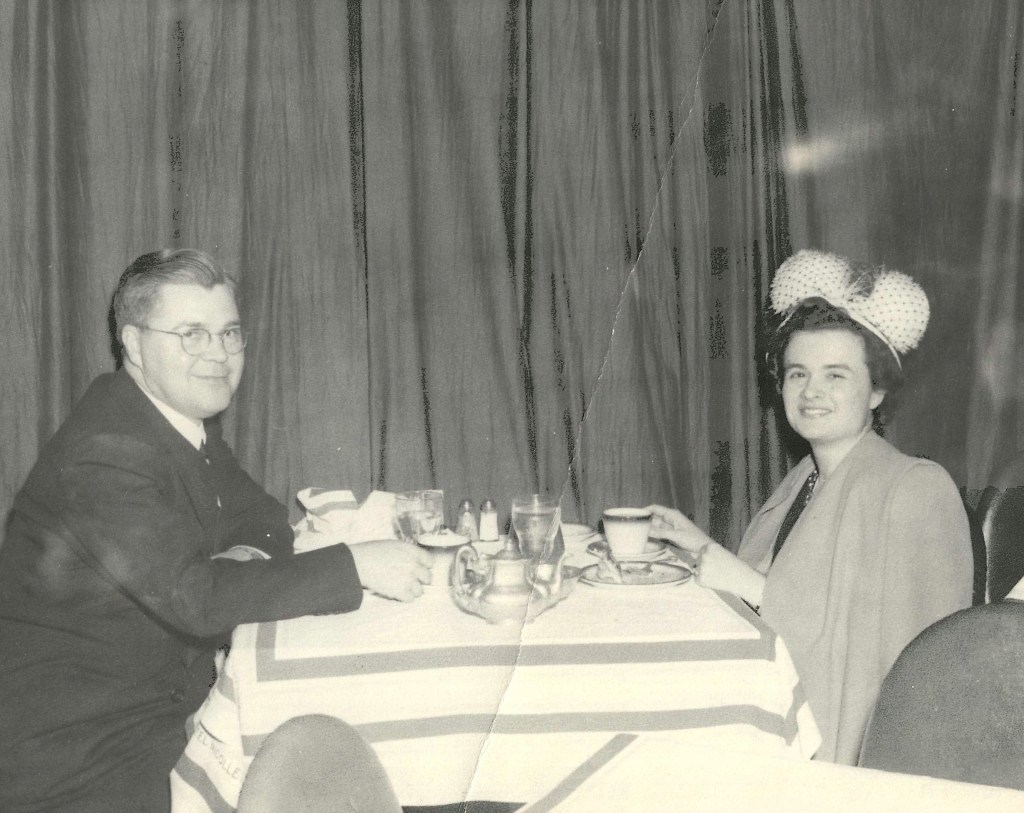
Cy met Margaret Jean Goodrich Watson (Jean) on a blind date in May 1947, just sixteen months after Bea had passed away, and almost three years after Jean’s first husband Bill had died in a plane crash while on his way to Chunking, China, to become the Naval Attaché at the U.S. embassy, at the height of the Allied war with Japan.
Jean and Cy’s mutual friends, Margaret and Matt Sarnecki, arranged their first date. Margaret was Jean’s sorority sister, and Matt was a fellow doctor who worked at St. John’s Hospital with Cy. While it was not love at first sight—both of them were still mourning their first spouses whom they had loved deeply—it was pretty close. By early June they had taken Cy’s daughters, Liz and Mary, and Jean’s son Billy on a picnic so they could all get acquainted, and Liz, a romantic ten-year-old, was already hearing wedding bells. In August it was a done deal. Cy and Jean were married on August 27, 1947, at Jean’s parents’ home in Minneapolis. In less than two years, I was born, Jean and Cy adopted each others’ children, and we became one big blended family of four kids, two living parents, two parents who had passed away—but who were still an important presence in all of our lives—seven living grandparents, and countless aunts, uncles, and cousins representing several generations.
While Cy and Jean’s marriage was not all bliss, they were a team and they were solid. They were the rocks that we kids depended on, and they gave us all a wonderful childhood—even though we all felt the grief that was part of the foundation of our family. Education was paramount in their values, but they made sure we had fun, great travel experiences, and a chance to pursue our interests, hobbies, and dreams. They allowed us to go to the colleges of our choice, and study what we were interested in. There was no pressure to go to their alma maters, or to follow in their footsteps.
Together, Cy and Jean had a lot of fun. They loved to dress up, Dad in his tux (black dinner jacket for winter and a white dinner jacket for summer) and Mom in one of a number of beautiful cocktail dresses, to go out to dinner dances with their friends. They loved to travel—all over the United States, Canada, Mexico, and Europe, and even to South Africa. They loved to entertain and frequently hosted lovely dinner parties. Mary and I would often be tapped to make the canapés and “pass them” like little caterers-in-training. In their later years they enjoyed hosting foreign students, two of whom remain part of our family today. Most of all, they loved to get the family together, particularly in our backyard in the summer. Once or twice a summer we’d have fifteen or twenty or maybe more relatives for a backyard barbeque.
Cy and Jean did quiet things together too. They gardened, went to concerts and plays, read and discussed the same books and magazines, read the newspaper front to back, listened to music, and watched the nightly news together. They worried about the stock market together too. The daily ups and downs of the market caused them both great anxiety because it was where they’d invested all of their savings. And they watched The Tonight Show almost nightly, howling with laughter, for most of the thirty years (1962–1992) that Johnny Carson hosted it.
Jean, who had a great head for business, took over Cy’s medical practice finances and put the practice on a sound financial footing. For years she would periodically go to the office and pick up his accounting ledgers from his “office girl” to go over them. While I’m sure she was watching expenses, she focused most intently on overdue patient accounts. In those days no one had medical insurance to cover medical office visits, and patients were likely to run a tab at the doctor’s office. I’m quite sure Jean put policies in place to get patients to pay at the time of service, but even so, my very first summer job in about 1964 was typing collection letters to the patients whose overdue accounts had reached Jean and Cy’s tolerance level. This was the last step before turning the accounts over to a collection agency which Cy was loath to do.
Over the next twenty-eight years in private practice, Cy moved several times to larger offices to accommodate more doctors and services, but he always stayed in East St. Paul, within a few blocks of the intersection of Arcade and East Seventh Street where he got his start. Though he could send patients to several St. Paul hospitals, he was most closely associated with St. John’s Hospital. In 1964–1965 he served as Chief of Staff of St. John’s, a largely honorary position awarded to him by his fellow physicians. When Cyril retired from private practice in 1974, he worked for several years as a part-time medical consultant before retiring completely.
By all accounts Cyril was an excellent, empathetic general practitioner (roughly the equivalent of a family practitioner today) and a highly skilled general surgeon. Perhaps his signature skill as a doctor was to take time to get to know his patients and their families as individuals, listen to their symptoms and complaints, and then put all the information together to correctly diagnose and treat their ailments.
Ultimately, after delivering his share of babies, Cyril turned the “baby business” over to his younger associates. He concentrated on internal medicine and performed most of the general surgery for his practice of six doctors. He stopped short of open heart surgery and brain surgery, but tackled nearly everything else except orthopedics. We remember Dad going to our “library” (aka the TV room, which had originally been designated as his home medical office) to “study” his surgical textbooks the night before he was scheduled to do a complex surgery. He never felt that he knew everything there was to know about a particular surgery, and was never above refreshing his memory. Jean joked that it wasn’t called medical “practice” for nothing; he was always honing his skills and never felt overconfident about them. It’s one of the things that made him great doctor.
Cy’s Special Talents
Cyril was a renaissance man and a gentle man. Outside of the practice of medicine, at which he excelled, Cy had several other talents which emerged in adulthood.
The first was music. He’d learned the piano and violin while growing up, and kept his violin—though he never played, that I recall—for the rest of his life. When he and Bea moved into their new home in 1939, he invested in a Steinway grand piano, a massive ebony instrument that stood in our living room until the house was sold in 1986, almost fifty years later. Jean made sure it was always in tune, and Cy would sit down and play most evenings when he came home from work, delighting in making music. It relaxed him after long days at the office and in surgery. While he could certainly read music, he often just played—many times something he composed on the spot in the style of one of the greats—Beethoven, Mozart, Debussy, Handel, Bach or another of his favorite composers.
In about 1960, Cy bought an electric organ, which sat in our sunroom. He gave up the piano in favor of the organ, because he could do so much more with the sound effects, and the volume—oh, how he loved the volume! We’d tease him about wanting to be E. Power Biggs, a famous organist who would give concerts that would shake the rafters. Cy did a pretty good job of shaking the rafters at our house. He could sit for hours and improvise on his organ, but Jean would eventually request that he stop playing quite so loud.
He also loved to play his stereo. He had a good collection of classical music and almost every Rodgers and Hammerstein musical, to which he introduced us at a young age. He also had speakers set up outside the front door so that at Christmas he could entertain the whole neighborhood with his favorite Christmas carols. That sometimes proved to be a bit much for the neighbors to take.
Cy also had significant artistic talent. He was a talented sketcher, particularly of portraits. In later years he took up watercolor and acrylic painting, and after he retired he took painting lessons. As far as we know, he had no art lessons as a child, but his mother had been a talented painter before she became a wife and mother, so perhaps she taught him a thing or two, and encouraged his hobby. Apparently Lillie’s talent has been passed down through the generations. Cy and Bea’s daughters, Mary and Liz, both have artistic talent, and Liz has been an artist her whole life. (I didn’t get a lick of Grandma and Dad’s artistic talent.) One of Liz’s granddaughters is now a professional sculptor.
Cy was also a skilled gardener. While Jean planted the flower beds, Cy grew fruit and vegetables—rhubarb, plums, grapes, tomatoes, and sometimes strawberries—all in the rich black soil at our Arcade Street home. His medical practice kept him too busy to tend his garden except on his one day off in the middle of the work week. He’d often go out to the garden and spend the whole day digging, planting, mulching, and harvesting—and get horribly sunburned in the process. In later years he set up a compost pile where he disposed of leaves and grass clippings. He loved to “turn” the pile and use the product to mulch his garden, even though it smelled to high heaven. After he retired, he and Jean grew prizewinning roses for a number of years. He also loved helping his children and grandchildren dig up angleworms and nightcrawlers from his garden so they could go fishing across the street at the neighborhood lake. And, for a few years after his retirement he set up growing tables and lights in the basement so he could propagate his own plants. That hobby didn’t last long
And he was a rock collector. In a little room, hidden behind door in the basement pantry where Mom kept all of her canned jam, fruits, and vegetables, Dad kept his rock collection. It was housed in crumbling cardboard boxes that had sat there in the damp for decades. We loved to go in and look at the assembled rocks every so often. Then in his retirement he bought a rock polisher and tried to polish some of his collection as well as rocks he’d pick up here and there. The hobby didn’t last long either, but Mom was always happy that he had something to putter with, so that he didn’t notice that she’d gone out to play bridge.
While he was growing up, Cy was exposed to the many languages and cultures of the newer immigrants, mostly farmworkers, who had moved to McLeod County. There were Swedes, Norwegians, and Germans, of course, but also Bohemians from what is now the Czech Republic, and Silesians from the corner of Poland that abuts Germany and the Czech Republic. From those encounters he picked up a smattering of several European languages. Then during college and medical school, Cy had to learn German because many medical textbooks were in German at the time. German became his second language. Mary, Bill, and I all studied German in high school, and in my case, through college, probably because of Dad’s influence. Cy was naturally outgoing and interested in people, so his experience with languages served him well. He could learn just enough of any European language to make friends wherever he went, and to relate to his patients, many of whom were immigrants. In fact, we always joked that Dad was able to talk to anyone, anywhere, about almost anything—and for hours!
Dad also loved to take pictures—movies, slides, and still—he loved them all. He shot copious movies when we were kids, mostly of scenery. Once in a while we’d have a movie night. Dad would set up the projector and screen in the living room and we’d watch home movies while chomping on Dad’s homemade hot, buttered popcorn. If it was scenery interspersed with a few shots of people, we got pretty bored, but our boredom was often broken up when the film got stuck in the projector and melted, which was great fun to watch on the big screen. Then Dad would do a quick fix so that we could move on. Later he got a fancy carousel slide projector, and Mom and Dad organized all the slides, which Dad also showed on movie nights.
Cyril enjoyed watching professional baseball and football games with Jean, but he wasn’t interested in playing sports himself. Fishing was the exception. He took fishing very seriously during our annual two-week summer vacation in northern Minnesota, and on his annual men’s fishing trip with the Aidian Club—a club which I recall having one mission only: organizing the annual men-only fishing trip. His only “toys” were his fishing and photography gear, and his riding mower, which he absolutely loved.
Cyril didn’t cook much, but after Jean had prepared the midday Sunday dinner he often took responsibility for preparing supper in the evening. On Sundays we broke the rule that we all sat down at the table together for the evening meal; instead, we had Sunday supper on TV trays in the library while we watched The Ed Sullivan Show. Dad’s favorite Sunday supper, which he made with great gusto, was popcorn, which he popped in an electric popcorn popper, and then buttered liberally and ate in milk—a culinary treat that our Tifft great-grandparents brought from Illinois to Minnesota in the 1870s. The rest of us had ours without the milk. Sunday night popcorn was often accompanied by Dad’s homemade fudge. He didn’t use a recipe, and the results were spotty, sometimes hard as a rock, and sometimes as gooey as fudge sauce, but we loved it anyway. Dad also loved ice cream. He loved it plain, with chocolate sauce (preferably homemade), in a root beer float, in a chocolate soda, or in a malt. He loved chocolate malts so much that he had an electric malted milk machine. We loved it when Dad cooked!
A Life Well Lived
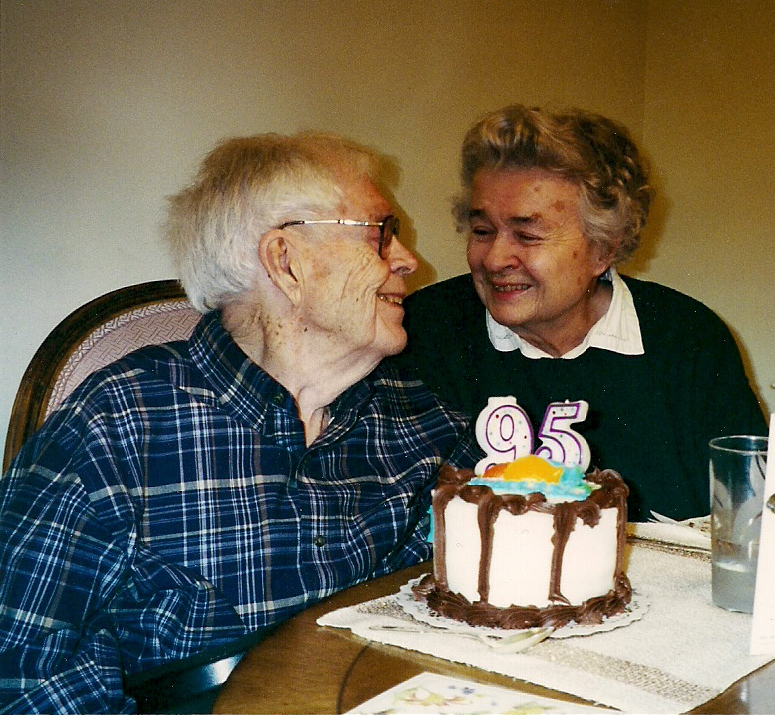
Cy was blessed with remarkably good health until he was well into his nineties. Finally, at the age of ninety-five years and four months, his body gave out. He passed away on April 2, 2002, at the Pillars Hospice in Oakdale, Minnesota, of congestive heart failure (not, however, due to his popcorn, fudge or ice cream habit). His beloved “Jeannie,” his wife of fifty-five years, was at his side when he passed. Cy and Jean’s ashes are interred together in a columbarium at Sunset Memorial Park in Minneapolis.
Visit our Ancestry.com family tree here.