

Kiddie Capers
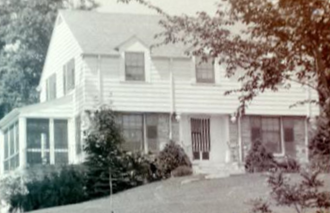
Our neighbors two houses to the south on Arcade Street had three boys. Richard, the eldest, was my sister Elizabeth’s (Liz) best neighborhood friend. Johnny, the youngest, was about six months younger than me (Mary) and my best little neighbor buddy. In those days, even two- and three-year-olds were allowed to run fairly freely in our neighborhood—with the mothers knowing that each of them would be “on guard” when the little ones were in their yard. But I didn’t have a mother. My mother, Beatrice Anna Mathilda Hallberg Tifft, had died in February 1946, just two months after I turned two, so unlike my neighborhood friends my mother wasn’t there to diligently keep tabs on my whereabouts, or what my friends and I were doing when we were at our house. Instead, I had a revolving door of temporary housekeepers and baby sitters, most of whom didn’t stay long enough to learn the unspoken rules of the neighborhood.
Child care was big headache for Dad (Cyril Richardson Tifft). His first priority after my momma’s death, was to hire a woman to take care of my sister and me and our house while he got his medical practice reopened after being released from military service after World War II, but none of the women he hired stayed more than a few weeks or even a few days. I’ve been told that there were at least six housekeepers in the first six months after my mother’s death. By early May, Dad had reopened his medical practice, so he was gone ten or twelve hours a day, and Elizabeth, who was nine, was in school. I was left in the care of an ever-changing parade of women, until “Emma” arrived during the summer of 1946 and brought a measure of much-needed stability to the household and to my young life. I’ve drawn a blank about how things were during that time, but once Emma arrived to live with us I have some memories. A poignant letter written by Dad to his sister Lillian in June 1946 about the woes of being a single father, indicates that he hoped Emma would stay to stop the revolving door of caregivers. Emma did stay but by the time she joined our family, I was already used to playing more or less unsupervised and continued to do so, getting into lots of trouble along the way.
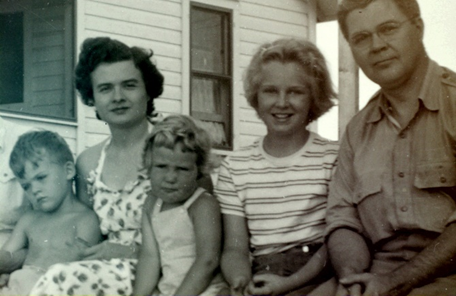
After our new mother, Jean (Margaret Jean Goodrich Watson Tifft), and Dad were married in August 1947, Emma stayed with us and helped with us kids and the cooking and housework for our new blended family for several more years. You might think that with both my new mother (I called her “Mom”) and Emma taking care of us, I would have settled down a bit, but Jean brought with her a new playmate for me, her son, and my new brother, Billy, who was only six weeks younger than me—a willing co-conspirator in my plans. More about Billy and my antics later, but first, some stories about the trouble I got into when I was two and three.
One time, Johnny and I were playing a two- or three-year-old’s version of hide-and-seek like the big kids did. It seems that there was a discarded refrigerator in our Arcade Street garage for a time. Of course, Johnny and I were intrigued by it and decided it would be a dandy place to hide. I crawled into the fridge, Johnny closed the door and when I wasn’t there to play anymore, he apparently went on home! Sometime later, Emma went looking for me and luckily opened that refrigerator door to find me curled up in there in tears.
When Johnny and I heard that my daddy was going to be married again, we set to work! Mind you we were barely three and one-half at the time. We found a can of white house paint and a brush in the garage. Apparently we had heard that the car of newlyweds gets decorated. So, we painted Dad’s blue Chevy with white house paint in honor of the upcoming wedding! I’m not sure how Dad got the car cleaned up in time for the wedding and honeymoon road trip to Colorado, but he did.
On another occasion, Johnny and I were in the primary bedroom upstairs playing doctor. I went to the medicine closet (because our Dad was a doctor, we had a medicine closet rather than a cabinet, and it was full of cool stuff that might have gotten us into a world of trouble) and found the mercurochrome. I had Johnny lie on the big bed and I painted the lovely orange liquid all over his tummy. Of course, a good portion of the liquid dribbled onto the bed linens, mattress, and even the carpet at the bedside! Those stains were still there years later when Mom was finally able to change the carpet.
More adventures ensued when my new stepbrother Billy Watson moved in after his Mommy and my Daddy got married. We were three and one-half at the time. Being only six weeks apart in age, Billy and I functioned like twins from the beginning. Mom has said that I immediately showed Billy everything interesting in the big house, demonstrating just how loose the spoke in the railing upstairs was, the way one could unscrew the caps on the legs under the bathroom sink, and how much fun it was to throw stuff down the laundry chute from the upstairs or the main floor to the basement. We later devised a game of catch through the laundry chute. One day we took each and every piece of freshly laundered and ironed clothes that Mrs. Larson, the lovely Swedish lady who helped with the laundry, had carefully laid on Mom and Dad’s bed, and dropped it back down the chute!
By the time we were seven or eight, Bill and I had developed more sophisticated forms of entertainment. One time after supper we went to the garage, climbed onto the hood of the car, and learned how windshield wipers worked from the outside. I can’t remember if we actually broke them, but we definitely put them through their range-of-motion!!
Every year in the fall, there was an abundance of beautiful maple and oak leaves and acorns on the ground in our backyard. One time we gathered at least two quarts of acorns, leaves, and twigs and took them to the back steps. Lo and behold, we found a vertical pipe about ten inches tall next to the house. What better storage place could there be for our stash? We stuffed as much as we could right into that perfect receptacle! Some days later, the oil truck pulled up into our driveway. A loud knock came at the back door and when Mom opened it the oil man said, “Lady, you’re gonna have to whup your kids!” Why? “Well, they’ve stuffed leaves into the oil pipe and I can’t fill your tank!” Our punishment was to sit across from each other in the living room for a couple of hours—no talking, books, color crayons, toys, music, or games allowed. We really didn’t know we were being “bad.” In retrospect, the one who may have suffered the most from our little caper was Elizabeth, who got to be the “monitor” of our imposed silence!!!
The public school system had no kindergarten class, so Mom and Dad enrolled Bill and me in the Cross Lutheran School kindergarten in September of 1948. We were both four years old, with me turning five that December and Bill turning five in late January. I’m sure Mom was ready for us to disappear for a half day by that time and must have persuaded the school that we were ready too! It was during that winter, while idly waiting for the miniature school bus to arrive in the morning, that I tasted my first yellow snow (wastewater seepage from the old fashioned “cesspools” in all of our front yards) from the ditch at the end of our driveway. Apparently the taste didn’t deter me, but it took Mom and Dad awhile to discover the cause of my repeated peri-oral impetigo infections!
As preschoolers and grade-schoolers, Bill and I never tired of hearing Mom tell her childhood stories. As she was tucking us in for the night, we’d beg her to tell them. One was about the baby squirrel she found when she was a little girl while walking with her parents in a Minneapolis park. They took it home to nurse it back to health, made a bed in a shoebox, and fed it milk from an eyedropper. As it grew stronger, Grandpa Goodrich would carry it around the house in his pocket. They fed it walnuts and it became rather tame. Sometimes it scampered up and down the living room drapes, and even climbed Grandma Goodrich’s legs via her stockings. Eventually, they returned it to the “wilds” of the park, where it lived happily ever after. Our other favorite story was about her kitten who fell into a bucket of oil. They had to scrub and scrub that kitten to get the oil off, or it would die! But they succeeded and the kitten lived happily ever after.
We had some favorite books as youngsters too: Willie’s Walk to Grandmama’s; The Train to Timbuktu; The Chipmunk Story; lots of Little Golden Books like Nurse Nancy and Doctor Dan; and nursery rhymes including one favorite called “The Tale of Custard the Dragon,” and so many more that we asked to have read to us over and over. How lucky we were!
Most of us kids in the Arcade Street neighborhood spent considerable time climbing the tall oak and maple trees in our yard. Even some of the smaller fruit trees—plum and apple—didn’t escape our grip. Sometimes we’d create whole play worlds in and below the trees—good guys/bad guys, fairy princess and gorilla, cops and robbers. After dinner in the summer, the whole neighborhood of kids—often a dozen of us—would play Red Rover, Hide-and-Seek, or Capture the Flag until dark. It was absolutely thrilling!
For many years, when comic books were popular, one of the neighborhood boys, Roger, was our supplier, because we didn’t typically buy them at our house. Roger didn’t buy them either, but his mother worked at a drugstore and would bring home comic books for Roger to look at and then return them nearly-new! Well, Roger shared his stash with us as long as we abided by the no-tearing or folding rule.
Roger also had access to fireworks when July Fourth came around. Dad usually was on-call for his medical practice on the Fourth and often had to triage and care for someone who went to the emergency room or came to our back door for help after he burned his hand using firecrackers. Because of the implicit danger, as a family we didn’t purchase any fireworks. However, one July Fourth, when we were about nine or ten, Roger brought some of his more innocent wares to our backyard to share with Bill and me. There were little “snakes” that puffed up then shriveled when lit; coils that sat on the ground where they made tiny sparks; and, little hand-held torches (sparklers) on metal wires. When I saw Bill and Roger tossing the torches in the air and catching the wire handle, I tried it too. My vigorous torch-toss went over and behind me though, landing on the cloth awning near the back steps. Soon the awning was in flames! Being resourceful, we ran for the hose, but it wouldn’t reach; we tried throwing sand from the sandbox but we couldn’t toss it high enough. After not too long, I went inside to the library where Mom and Dad were and told my scary, sad tale. Dad leapt up and somehow the fire got extinguished. I can’t remember whether they called the fire department or not. Not only was the awning damaged; the wood house siding around the area was very singed too. It was so scary and I felt so horrible for damaging our house that the folks must have figured that was enough “punishment” for me. Bill and I had learned a real-life lesson about how dangerous fireworks can be! There was a little pond below the property behind ours. It was always an intriguing place for us kids. One time we gathered thin logs and boards and brought nails and tools from home to craft a raft for ourselves down by the pond. This was a good example of how the process is more fun than the product! We worked and worked on our raft each afternoon after school. I recall that we got it afloat one day, but we were never brave enough to get aboard ourselves!
In those days, a neighborhood milkman named Dick brought milk, butter, eggs, and later orange juice to all the houses. On hot summer days when Dick was making his rounds, he usually had a trail of kids approach his truck begging him to chop off a piece of ice for us to suck on. We usually had the best luck if he was at the end of his route because then he didn’t need the ice to keep the dairy products cold! Back then, way out in the suburbs where we lived, the modern “ice cream truck” with music blaring didn’t exist yet.
Another favorite memory is of little sister Margaret who is five years younger than Bill and me. By the time Margaret was two or three, Bill and I were well into grade school and Liz was in senior high. So, if Mom had to go out for the day, Margaret would be left in the care of a dear older lady who helped with the cleaning, Mrs. Bell. Sometimes we’d come home from school to find her entertaining our curly-headed little sister by singing and humming “Here Comes the Bride” as Margaret made her entrance into the upstairs hallway and walked slowly down the stairs wearing a lovely white dishtowel or curtain on her head as a veil. Cutest darn thing!