

Beatrice Anna Matilda Hallberg
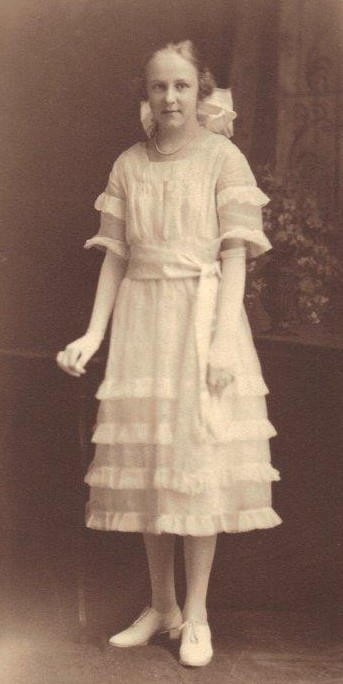
Beatrice Anna Mathilda Hallberg, Cyril Richardson Tifft’s first wife, was born prematurely in North Minneapolis on January 8, 1908. At the time of her birth, her father Karl Hjalmar Hallberg (he later changed the spelling to Carl) and mother Anna Elisabet Jonsdotter Hallberg were both twenty-six years old. Beatrice was baptized at Bethlehem Lutheran Church in North Minneapolis on March 29, 1908.
Beatrice (always called Bea) was the second of two children. Her older sister Mable Elsa Hallberg (always called Elsa) was born in Minneapolis on June 29, 1905. Karl and Anna grew up in the same village of Utterbyn, near Torsby in Varmland, in west-central Sweden near the Norwegian border. Karl and Anna were part of the large emigration from Varmland to the United States. Though already sweethearts in Utterbyn, they immigrated separately. Karl immigrated first in 1902 and Anna followed in 1903.

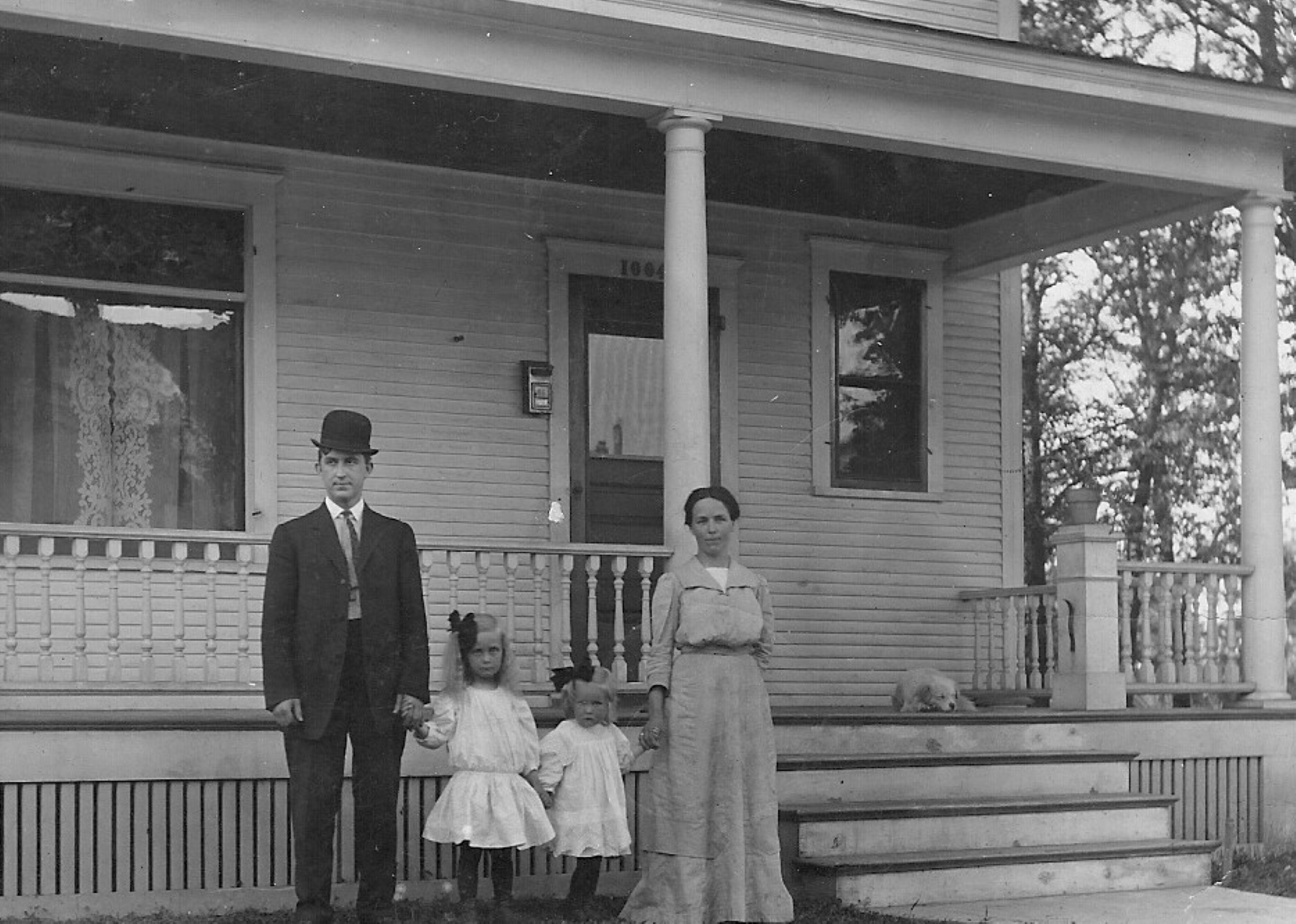
According to the Minneapolis City Directory and Beatrice’s birth certificate, the young Hallberg family lived at 2635 Colfax Avenue, North Minneapolis, when Bea was born in 1908. But the City Directory of 1910 indicates that they had moved to 1004 31st Avenue North, a home they owned, and remained in until about 1937. Judging from photos taken during that time, their clothing, toys, and home indicate that they were living a middle-class life less than ten years after arriving in the United States. By that time, Karl was an experienced shoemaker, and Anna was a homemaker.

According to a letter from Elsa written years ago describing their neighborhood in North Minneapolis, “It was a lively neighborhood with other young families including many with a Swedish heritage.” They “went to Sunday school and church at Bethlehem Lutheran Church every Sunday. Mother was very religious and taught Sunday School.” Both girls attended local public schools and graduated from North High School. There is also some evidence that the Hallbergs lived in two other homes before they moved to Edina, Minnesota, in 1939: at 5515 Columbus Avenue, Minneapolis, and on Park Avenue, where their first granddaughter Paula (Elsa’s daughter) recalled that she recovered on her grandparents’ porch from her tonsillectomy, which her uncle Cyril R. Tifft, MD, performed.
Beatrice graduated from Minneapolis North High School in 1925 and went on to the University of Minnesota in Minneapolis, where she majored in German and Education. Elsa chose marriage over finishing her college education, so Beatrice’s father refused to pay for her higher education. Not to be stopped, Bea put herself through the University while living with her parents to save money. Beatrice was a member of Kappa Kappa Lambda Sorority and graduated in 1929 with a bachelor of arts degree, cum laude. In 1927, during her junior year in college, Bea’s paternal grandmother Matilda Olofsdotter Hallberg arrived for a visit. She died two years later while still in Minneapolis.

After graduating from the University in June 1929, Beatrice went to a dance where she met Cyril Tifft (later known as “Cy”). Cyril was two years older than Beatrice and was attending the University of Minnesota Medical School. They danced together and Cyril was enchanted by Bea. But that night when he asked for her phone number, she coyly declined. Later she must have relented, as that summer they did have several dates before she left for her first teaching job in the fall.

Beatrice left Minneapolis and traveled by train to New Glaris, Wisconsin, for her first job at the New Glaris High School. She lived with other young female teachers in a rooming house overseen by a dentist and his wife. The young women were energetic and frequently went by bus to Madison for a show or other fun. She taught German, civics, and music, and she was the orchestra and band director as well. She played both the piano and violin, and borrowed her father’s violin to take with her to New Glaris. In letters to Cyril, she told of her teaching experiences, her aspirations and, despite being optimistic, often told him of being very tired and losing weight.
That fall of 1929, Cyril gave Beatrice his fraternity pin, and by the winter holidays he wanted to introduce her to his parents. For that occasion, he drove not only Beatrice but her parents to Glencoe. Thus Swedish “middle-class” immigrants who had only been in the United States for twenty-six years and their thoroughly assimilated and well-educated daughter were about to meet the Tifft-Richardson family who had been well-established in America for generations. It must have been an interesting meeting for all concerned.

During the two years Bea taught in New Glaris as a twenty-one to twenty-three-year-old, she and Cyril corresponded in frequent letters and saw each other during vacations. Cyril was deep into his medical studies at the time, but their relationship was getting serious despite the long-distance courtship. In one letter she shares which silverware pattern she likes and asks, what he thinks about it? She also writes that she is negotiating with the University of Minnesota regarding earning a master’s degree in German. Following her years in New Glaris, she got another teaching job at the newly formed University High School in Minneapolis and began studies for her master’s degree. Bea was fluent in English, German, and Swedish.

Cyril finished his medical degree and completed his internship in December 1931 and started his private medical practice as a physician and surgeon in January 1932. After what proved to be a long courtship, Beatrice and Cyril were finally married on June 23, 1933, at the Hallberg’s home in North Minneapolis.
Bea and Cyril had lived through the Depression. They were broke, but of necessity had both learned to be responsible and practical. After their marriage Bea continued to teach at the University High School and worked on her master’s degree. According to a story Cyril told about that time, in frustration one evening, Bea threw down her books and declared that she wanted motherhood more than another degree, so she never completed her studies. Four years into their marriage on January 18, 1937, their first daughter Elizabeth was born. Until Elizabeth was two and three-quarters years old, the Tifft family lived in an apartment above Swanson’s Drug on the corner of Arcade and Seventh Street, on St. Paul’s East Side.

During the 1930s and early 1940s Cyril built a thriving medical practice while Bea became a full-time mother and homemaker. In the late 1930s they purchased a wooded three-quarter-acre lot in a nice neighborhood in Little Canada (now Maplewood), a suburb north of St. Paul, and together built their dream home—a stately colonial designed by Cy’s cousin, architect George Crosby, at a cost of $12,000. The family of three moved into their new home at 2195 Arcade Street at the intersection of Arcade Street and Highway 36 on Halloween Day, October 31, 1939.
Though the United States joined World War II in December 1941, Cy was not required to enter the military until almost two years later, when there was an urgent need for more doctors. But Bea and Cy, being financially conservative, anticipated that eventually he would be called up to serve, so they had increased their mortgage payments so that their mortgage would be paid off when the time came for him to volunteer. In early November 1943, Cyril left his family and medical practice to begin basic training in the US Army Air Corps. Cy was almost thirty-seven and Bea was thirty-five and in her third trimester of pregnancy. The morning of December 10, 1943, Bea went into labor and, as prearranged, phoned the next door neighbors who took her to the hospital. That day, while Cy was stationed on the West Coast, Bea and Cy’s second daughter, Beatrice Mary (Mary) was born. Elizabeth was almost seven.

While Cyril was away, Bea held her head high. She was resourceful and thrifty in using her war ration coupons, and was supportive and a true comfort to her husband-doctor-soldier. She corresponded with, hosted, and visited her widowed mother-in-law and Cyril’s extended family as well as her own, took full responsibility for managing the home and yard, children, family finances, and automobile, attended church, planted a “Victory Garden,” and kept in touch with her friends and neighbors.

Beatrice kept up with the daily news on the radio, and in the newspaper and she read many books, enjoying mysteries in particular. She regularly took Elizabeth to the public library and read countless books to her children. She loved the music of Chopin and played his music on the phonograph and the piano. She enjoyed going to the movies with friends, and at the close of every day they were apart, she wrote a letter to her husband. Perhaps the most touching thing about Cyril and Bea’s nearly two-and-one-half year separation during the war was their devoted, virtually daily correspondence while apart—an estimated one- to two-thousand lovingly hand-written letters. Bea’s letters demonstrate a devoted, loving, and uncomplaining relationship from a wife and mother who “soldiered on” while on the home front during the war.
Cyril was home on leave for Christmas 1945. Instead of kissing Cy’s photograph on the piano, his wife and two little girls could kiss him in person. According to Cy’s stories, toward the end of his visit, Beatrice told him she had fainted and found herself on the floor a time or two earlier that month. Cy implored her to see a doctor, but had to return to the Base Hospital in Labrador before she was seen. According to the last letter Bea ever wrote to Cy, dated February 8, 1946, that evening she’d had a lovely time shopping, having dinner, and seeing the movie “Spellbound” with a college friend. When she returned home, as was her custom, Bea wrote her nightly letter to Cy before going to bed. Sometime during the night or early morning she died in bed from a heart condition she had likely had since birth. Her death came a month after she had turned thirty-eight. According to Cy’s memoir, on February 9th he got a “radiophone” message in Newfoundland from his minister back in St. Paul telling him that “Mrs. Tifft has died.” His first thought was that his mother had died, but then he realized it was his beloved wife Beatrice. On a cold February day, after he had returned home and the funeral service was over, Beatrice was buried at Sunset Memorial Cemetery in St. Paul, leaving Cyril alone to raise his two little girls without his beloved Bea.
Visit our Ancestry.com family tree here.