
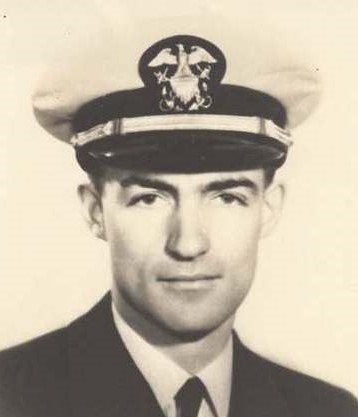
William Wallace Watson II

William Wallace Watson II (1911–1944) was the father of my half-brother Bill, and the first husband of our mother Margaret Jean Goodrich (1916–2002), or Jean, as she was always called. Jean and Bill were married in May 1941, and in February 1942, Bill was called up to serve in the United States Navy as an intelligence officer. In the fall of 1943, Bill was sent to New Delhi, India, to work for naval intelligence in Asia. In June 1944, having just returned to New Delhi from leave in Minnesota where he had visited with his family, Bill was reassigned to the U.S. Embassy in Chungking, China to take up his new post as an assistant naval attaché. On June 16, 1944, he was traveling to Chungking when his plane crashed in southern China. Bill was the only passenger, and the only person killed in the crash. He was not quite thirty-three, and Jean, his wife of barely three years, was twenty-eight. His son Billy was only four months old.
Sections
Family Background
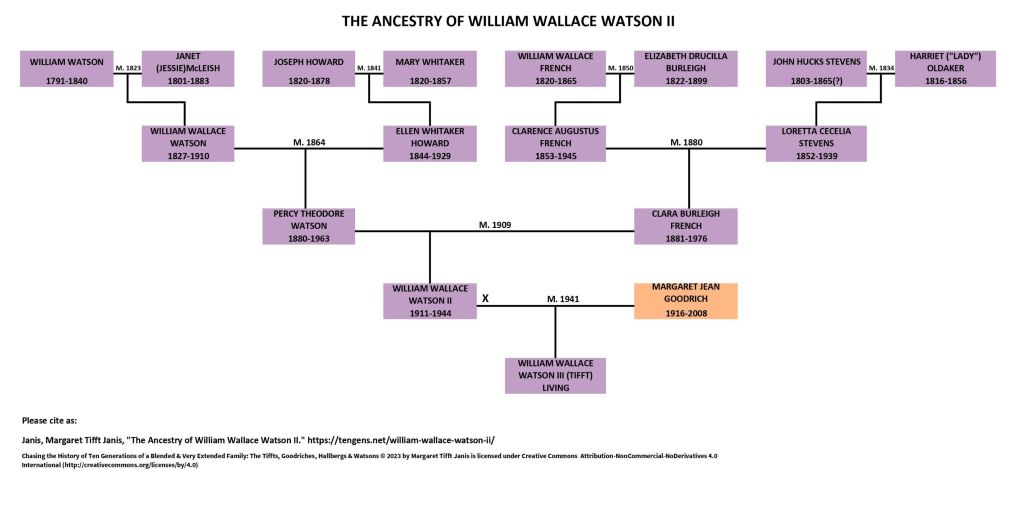
William Wallace Watson II, called Bill by his siblings and friends, was born to Percy Theodore Watson (1880–1963), a physician, and Clara Burleigh French Watson (1881–1986), a teacher, on July 16, 1911, at Yutaohe, the summer outpost of the American mission in Fenchow (now Fenyang), Shansi (now Shanxi) Province, China. Bill was the second of five children in the Watson family. The others were Edith McLeish (1911–2002); Ruth Janet (Janet, 1913–1969); Percy Theodore (Ted, 1918–2002); and Margery Ellen (1921–1984). All of the children were born in China and learned to speak Mandarin Chinese, as did their parents.
Percy Watson and Clara French met in 1899 when they began their first year at Carleton College in Northfield, Minnesota, Percy’s hometown. Carleton was affiliated with the Congregational Church, which had a robust mission program that actively recruited from Congregational colleges, including Carleton and Oberlin. Percy and Clara had become interested in world affairs. China, in particular, intrigued them as it did many other Carleton students in the early 1900s. When they graduated in 1903, Percy and Clara made a pact with two of their classmates, Watts Pye and Gertrude Chaney, that they would meet again—in China.
Watts Pye was headed to divinity school, and Percy Watson to the Johns Hopkins School of Medicine, at the time considered one of the premier, if not the premier medical school in the country. Not to be outdone, Clara earned a master’s degree in Latin, then took a job teaching high school in Anoka, Minnesota, not far from her parents’ home in Monticello, Minnesota. Clara was in for a long wait. Percy did not complete his medical studies until the end of 1908, having spent most of the four and one-half years at Hopkins, and then doing a brief internship or residency at the Mayo Clinic in Rochester, Minnesota.
Percy and Clara finally married at Clara’s family home in Monticello on January 1, 1909. No family records or photos of their wedding have survived. In March 1909, Percy and Clara boarded a ship bound for China. With them they took the medical equipment and supplies needed to set up a Western medical clinic, as well as the household goods necessary to furnish a Western home in a remote outpost of China.
The Watson family lived in China for the next twenty-five years, leaving finally in 1934, only a couple of years before Japan invaded China, and eventually occupied Fenchow and Shansi Province. They took trips back to the United States every few years on furlough, and once for an extended leave of absence while Percy pursued a Master of Public Health degree at Harvard but, for the most part, they stayed in China.
Suffice it to say here that both Percy and Clara made significant contributions to the mission and to the lives of the Chinese people they served. But, I’m quite certain that the Watson family, including the generations that followed Percy, Clara, and their children have gained a lot too. The “Chinese connection” has enriched all of our lives in some way.
At first Percy was the only western doctor for a population of hundreds of thousands of people. He became known throughout China for his skill in combatting the plague, which struck every few years. He began to train Chinese doctors and nurses almost immediately after the Watsons’ arrival in China, and over the ensuing years, established a nursing school and built the first Western-style hospital in the region. Oddly enough, in 1921 Percy was called upon to supervise construction of several hundred kilometers of road between Fenchow, Taiyuan, the provincial capital, and Pinyao, the international banking center of the region. Roads were desperately needed to allow food to be delivered to the area during frequent famines and to open up the area to commerce. Percy wrote a memoir shortly before his death in 1963 which provides a treasure trove of details about many of the Watsons’ experiences in China. Many of Grandpa Percy’s stories will be discussed in more detail in future posts.
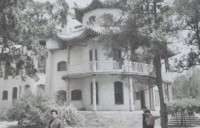
In China, Clara’s primary responsibilities were running her household and raising and educating her children. My impression is that she got little help from Percy, who was preoccupied with his work, but she did have a cook, a nanny, and other household servants to help her. Clara also had official duties including serving as a spokeswoman for the mission among the local Chinese women, editing the mission’s newsletter, writing official reports for the American Board of Commissioners for Foreign Missions—the primary sponsor of the Fenchow mission—and starting a variety of educational programs for girls and women. When the time came to plan for a modern hospital in 1916, Clara and Percy both raised funds in China, Europe, and North America. World War I interfered with construction of the hospital, but it was finally completed in 1921 and today still serves as a staff facility and museum for the modern regional medical center.
Childhood
Because the Watson children lived for the most part in Fenchow, only coming home for occasional visits, we know relatively little about their day-to-day lives, although we can gather a few things from stories they told their own children. One was that Clara was a stern taskmaster with her children. She expected, and for the most part apparently got, perfection, particularly in their schoolwork. One of Clara’s grandchildren related that her mother “talked a lot about how hard it was to be her [Clara’s] child, and how hard she was on them. Late in life, our grandmother realized that she had not been a very good mother, and she talked with my Mom about it.”
Another story told by one of the Watson children was how stringent Clara was about cleanliness—particularly among the servants. Each day, Clara required them to change into clean clothes when they arrived for work. She would inspect their hands to make sure that they were clean. I imagine she had strict rules about handling food safely, boiling water for cooking and drinking, and other household tasks as well. Clara’s rules and Percy’s medical care must have had a good effect: of all of the Western families in Fenchow in those early years, only the Watson children all survived childhood, though in one letter home Percy expressed some concern about Janet’s failure to thrive as a small child.
From comments my mother made, as well as reminiscences by my Watson cousins, it seems that Bill, or William as he was called by his parents, was the most favored child. But that could well have become the perception after he was killed during World War II; once he had died he may have become a saint in everyone’s memory. Jean remembered that Bill and his parents had some rip-roaring arguments about the morality of World War II; by then Percy and Clara, who had nominally been Congregational, were leaning toward (or perhaps practicing) Quakerism and had moral misgivings about the war even though their two sons served in the Navy.

Bill did get some special treatment from his parents, perhaps because he was the oldest boy, and because he was healthy, athletic, and intellectually curious. When he was a young teenager, he was allowed to accompany his father on a business trip into the hinterlands—possibly a plague-fighting trip. I can only imagine the argument between Clara and Percy about allowing William to accompany his father on that undertaking!
One of the more colorful, and undoubtedly terrifying experiences that the young Watson family endured was being evacuated to Korea along with all of the other missionary families when communist forces invaded Fenchow in 1927. There had been other invasions when the missionaries were required to evacuate, but 1927 was different; Percy did not go with them. Clara bundled up her children and evacuated in an open railcar. Percy stayed behind to care for the wounded on both sides. As Percy said in his memoir, Recollections, written in 1962–1963:
The situation became very tense. The communists got a suit of my clothes and burned me in effigy. They put a sign at the hospital gate that they were going to kill me. I spent every night in the hospital. About 1800 soldiers marched past the hospital gate, singing and carrying slogans. The hospital staff did not leave. They said, “If they kill you Wan Taifu, we want to die too.”…The communist army sent their sick and wounded to the hospital and many came with gangrene of the feet and all kinds of contagious diseases: typhus, relapsing fever, typhoid fever…many of the hospital staff got these diseases while taking care of the men…Sometime later, after many of the soldiers and their officers had been healed at the hospital, the communists became more friendly.
It is unfortunate that Clara didn’t write her memoir. Her recollections would have been of the terror of traveling through war torn country with young children, while leaving her husband behind to confront the unruly communist army.
Education
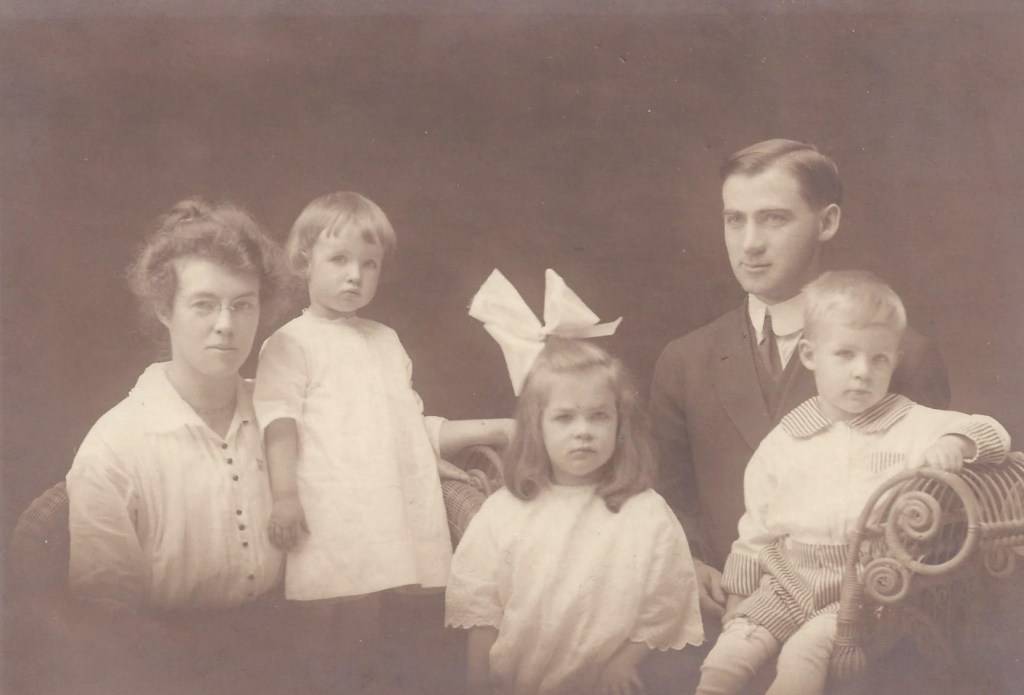
Bill and his siblings were home-schooled by their mother until they were ready for high school. She based their home-schooling on the syllabus from the Minneapolis public schools. The five children must have presented quite a challenge, considering that the eldest, Edith, born in 1909, was more than twelve years older than the youngest, Margery, born in 1921. The eldest three Watson children—Edith, Bill, and Janet—with only a little more than three years between them, formed a threesome in school and at play. Clara had a rule that as each child finished the work she had set out for them for the day, they were free for the rest of the day. Bill always finished his work quickly, then went out to play with the Chinese children in the town. According to some stories, he would sometimes finish his schoolwork for the week in a single day, and then be free for the rest of the week. He made good friends, learned Mandarin, and came to appreciate Chinese life and culture.
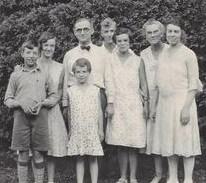
An important part of the Watson children’s education was world travel. The family seemed to come back to the States on furlough for at least a summer about every nine or ten years—perhaps more frequently. There are immigration records documenting the family traveling back to the United States in 1915 and 1924 with all of the children, and according to Bill’s application for the Naval Reserve, he had travelled “four times [two round trips to the United States?] across the Pacific; once across the Atlantic [when he came back in 1928 to finish high school and attend Carleton?]; [and] once around the world.” The trip “around the world” may have been an exageration—Bill may have been referring to his trip by train across China to Russia, Europe, England, and then by ship to the United States when he came back for school in 1928—the same trip during which he crossed the Atlantic.

The trip in 1924 may have been the trip when Percy took a two-year sabbatical to attend Harvard to earn his master’s degree in public health or they may have come back a couple of years later for that. When Percy was at Harvard, the family lived in Newton, Massachusetts, for two years. There, Edith, the eldest child, attended high school and graduated at age sixteen. Bill undoubtedly attended high school with her. Edith then went on to Carleton rather than going back to China, while Bill and the other children went back to China with their parents.
In the summer of 1928, when he turned seventeen, Bill was sent back to Northfield to finish high school and attend Carleton College. He left China in June, traveling with an adult companion (I think)—but not his mother, as some newspaper obituaries later suggested. His train trip took him through China, Russia, and Europe to Southampton, England, where, on August 18, he boarded the ship Berengaria bound for New York. During his cross-Eurasia train trip, he wrote many letters and postcards to his family about the sights he was seeing, all of which they kept. (One copy was given to Bill’s son in 1997) Bill arrived in New York on August 24, 1928, and traveled on to Northfield by train.
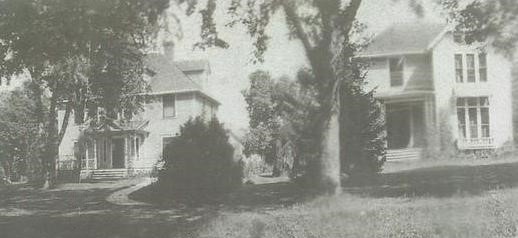
It is unclear where Bill lived while finishing high school. Though Percy Watson owned his family home in Northfield, it seems to have been rented out much of the time the family was in China. Bill could have stayed with his father’s cousin Isabella Watson in her family home, next door to Percy and Clara’s house, or boarded somewhere in Northfield or on the Carleton campus. Once Bill started college, he undoubtedly lived on campus during the school year, and probably stayed with “Cousin Isabella” during vacations.
Percy and Clara had been earning a good living as missionaries, and could live cheaply and well in China, so they had been able to save for their children’s college educations. They left their savings in the hands of an investor for the Congregational Church’s American Board of Foreign Missions. In 1929 when the stock market crashed, they lost all of their savings. They already had two children attending Carleton College—Edith and Bill—and no funds with which to support them. According to Jean, it was Isabella Watson, Percy’s cousin and a member of the Carleton faculty, who paid for Edith’s remaining two years at Carleton, while Bill financed his own Carleton education through scholarships and work. Jean also said that Sarah Seamer, who was, I believe, Bill’s great-aunt—his paternal grandmother Ellen Howard Watson’s sister—loaned Bill the money to pay for law school. According to Jean, Sarah Seamer was the “original women’s libber.”
Bill graduated from Carleton in 1933, having majored in chemistry. For a future lawyer, a chemistry major seems to have been an odd choice. It’s possible that he had originally planned to become a doctor, but then changed his mind when it was too late to change his course of study. At Carleton, he wrestled and played hockey, joined the Cosmopolitan Club, an organization for students who had lived abroad for a substantial part of their lives, and played in the band, all while working to support himself and earning excellent grades. He went on to Harvard where he earned a law degree in January 1936, finishing law school in two and one-half years. According to family lore, Bill finished second in his Harvard Law School class, though this is unconfirmed and improbable.
Apparently Clara’s home schooling had been successful: Edith, Bill, and Janet all became members of Phi Beta Kappa while students at Carleton, and all went on to earn advanced degrees. Edith earned a PhD in philosophy and taught at the university level her entire career. Bill became a successful lawyer, and Janet became a research physician and professor of medicine. Ted, too, became a highly respected physician. Family lore has it that Ted changed his major mid-course in order to get into medical school, and his grades slipped a bit as a result; otherwise, it is assumed, he too would have been Phi Beta Kappa. Margery started college at Carleton but transferred to Antioch College where she too joined Phi Beta Kappa. The lives of Bill’s accomplished siblings will be discussed in future posts.
When Edith was working on her doctorate in philosophy from Radcliffe and Bill was attending Harvard Law School, they lived together to save money. Edith’s daughter tells a story of that time, “The Best Thanksgiving Ever”:
[Edith] and Bill were sharing an apartment in graduate school in Cambridge, he in law school and of course my mom was at Radcliffe working on her PhD [in philosophy]. It was during the depression, not to mention prohibition [soon to be repealed], and they were often [broke] and hungry. They had in their cupboard one potato and a can of sardines. My dad [Gerrit Schipper—also a PhD student in philosophy] arrived for Thanksgiving dinner carrying a bottle of bootlegged wine. That was the Best Thanksgiving Ever!
Career
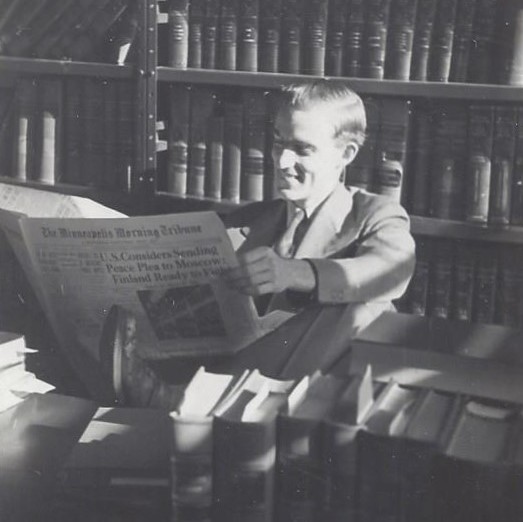
Following law school and admission to the Minnesota bar, Bill worked for four years at the Minneapolis law firm, Stinchfield, Mackall, Crounse, McNally & Moore. During that time, he was admitted to practice before the Minnesota Supreme Court. In January 1940, Bill was recruited by former Governor Joseph A. A. Burnquist, then Attorney General of Minnesota, as an assistant attorney general. Interestingly, according to the 1940 census, in April when the census was taken, Bill was a lodger at 1776 Fremont Avenue South in Minneapolis—the Burnquist home. Mrs. Burnquist had been Clara Watson’s roommate at Carleton, and the families had been friendly for years. Such a close personal relationship between an attorney general and one of his hand-picked assistants is almost unthinkable today.
According to a letter of recommendation written by Mr. Burnquist in support of Bill’s application for a commission in the U.S. Naval Reserve, Bill’s work in the Attorney General’s office was focused primarily on tax and social security issues for state agencies. Bill worked in the Attorney General’s office for about two years before being called up for active duty in the Navy in February 1942. During Bill’s short career, he proved himself to be an able attorney with a great law career in his future.
Marriage
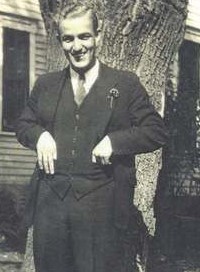
Bill met Margaret Jean Goodrich (1916–2002) on a blind date in 1939, set up by mutual friends—Floyd Nelson, Bill’s fellow attorney at Stinchfield, Mackall, and Floyd’s wife Doris Hagensick Nelson, Jean’s sorority sister and best friend. Though it was seemingly love at first sight, Bill waited a long time to propose. After he finally proposed, Jean asked him why he had waited so long, and Bill said he had to be sure because once he’d decided, he would never change his mind.

In reality, the reason he’d waited to propose was probably more financial than emotional. Bill was still broke when he met Jean. She said he was still wearing suits he’d gotten in China—though it’s hard to believe he could still fit into suits that had been made for him when he was seventeen—and the creases pressed into his trousers were almost worn through. He’d been paid $50 a month at his law firm, and then got a raise to $175 a month when he became an assistant attorney general. Once he’d paid off his debts, he used his next paycheck to buy Jean an engagement ring.
Bill and Jean were married on May 24, 1941, and were extremely happy together. They were married only three years before Bill’s tragic death during World War II and together only a little more than two years before Bill left Jean to go overseas as a naval intelligence officer. They had one son, Bill’s namesake, William Wallace Watson III, called Billy.

According to Jean, it was Bill’s dream to live in San Francisco after the war and work as a lawyer on trade negotiations with China. He always wanted to reconnect with China. Sadly, he did not live to see his plans come to fruition, nor could he have foreseen that China would become Communist in 1948, making his post-war dreams unrealistic.
Military Service
According to Bill’s service record, in March 1941, he joined the Minnesota Defense Force (the predecessor to the National Guard) as a private. In July 1941, only two months after his marriage, Bill applied to become a “Lieutenant (JG) Volunteer Naval Reserve, Special Service, Intelligence Dept.” By February 1, 1942 he was serving at the Great Lakes Naval Training Station in Chicago as a naval intelligence officer. Jean and Bill rented an apartment in downtown Chicago and Jean landed a job as an executive secretary for the Encyclopedia Britannica Company. They loved living in Chicago—a big metropolitan city in comparison to Minneapolis.
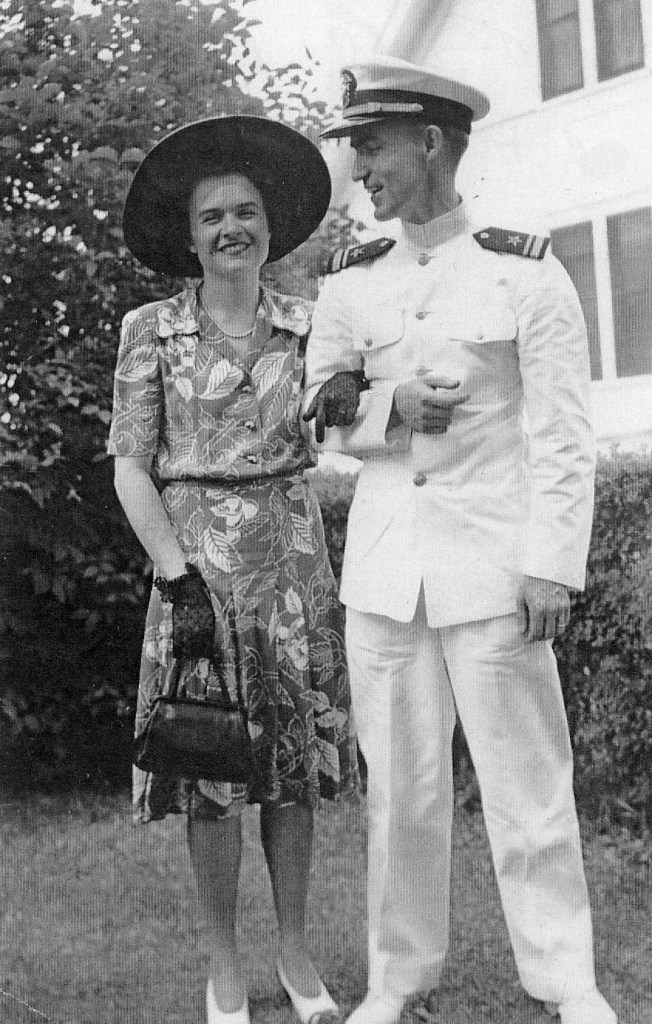
In late April 1943, Bill made the decision that would forever change their lives: he requested a transfer to foreign duty in order to use his Mandarin language skills. His application implies that he had been recruited by the Far Eastern Section, Foreign Branch, Office of Naval Intelligence, because of his fluency in Mandarin Chinese. Jean once said that he didn’t have to go overseas; he could have stayed in the U.S. as a naval intelligence officer, but he was eager to get back to China.
By mid-July 1943, Bill was on the move. He was sent to Maryland for basic naval intelligence training and then to New York City for advanced naval intelligence training. From New York, Bill was ordered to report for duty in New Delhi, India, where he joined the joint Army-Navy Intelligence Collection Agency for China, India, and Burma (JICA/CBI) as a naval intelligence officer in late September or early October 1943.
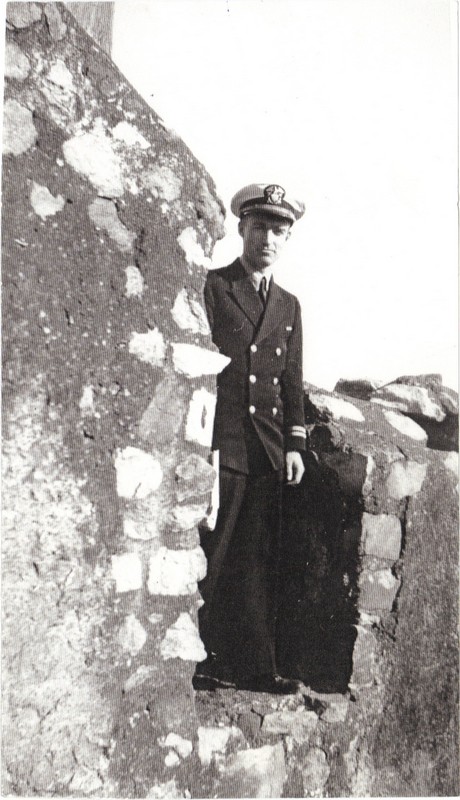
Once Bill left Chicago, Jean, then pregnant for the first time, moved back to Minneapolis to live with her parents in her childhood home in North Minneapolis, while she waited for the birth of their baby. Jean and Bill’s son, William Wallace Watson III (Billy) was born on January 26, 1944, in Minneapolis.
Due to the secret nature of Bill’s work with JICA/CBI, neither Jean nor his parents had any idea what he was doing or where he was being sent once he arrived in India. We do know, thanks to the caption on this photograph, that sometime between his arrival in New Delhi in the fall, and his trip back to Washington, D.C. in late April, Bill had travelled to China and visited the Great Wall of China. His visit to the Great Wall took him at least nine hundred miles beyond Chungking, the capital of Nationalist China and the home of the U.S.–supported Chinese Nationalist Army. According to a report by the U.S. Center for Military History entitled China Offensive — 1942–1945: “The U.S. Army’s main role in China was to keep China in the war through the provision of advice and materiel assistance. As long as China stayed in the war, hundreds of thousands of imperial Japanese Army soldiers could be tied down on the Asian mainland.” It would be so interesting to learn what Bill was doing, but we’ll never know.
According to orders Bill received in New Delhi in late April, he was to proceed from New Delhi to Washington, D.C. as a courier on temporary duty on April 27, 1944. According to these same orders, he was to return to New Delhi upon completion of his temporary duty and resume his regular duties with JICA/CBI. According to Jean, it was routine for officers at JICA in New Delhi to rotate courier duty, so that they could all get back to the United States to see their families, and men with new babies jumped to the head of the line. So, at the end of April 1944—just three and one-half months after Billy was born—it was Bill’s turn.
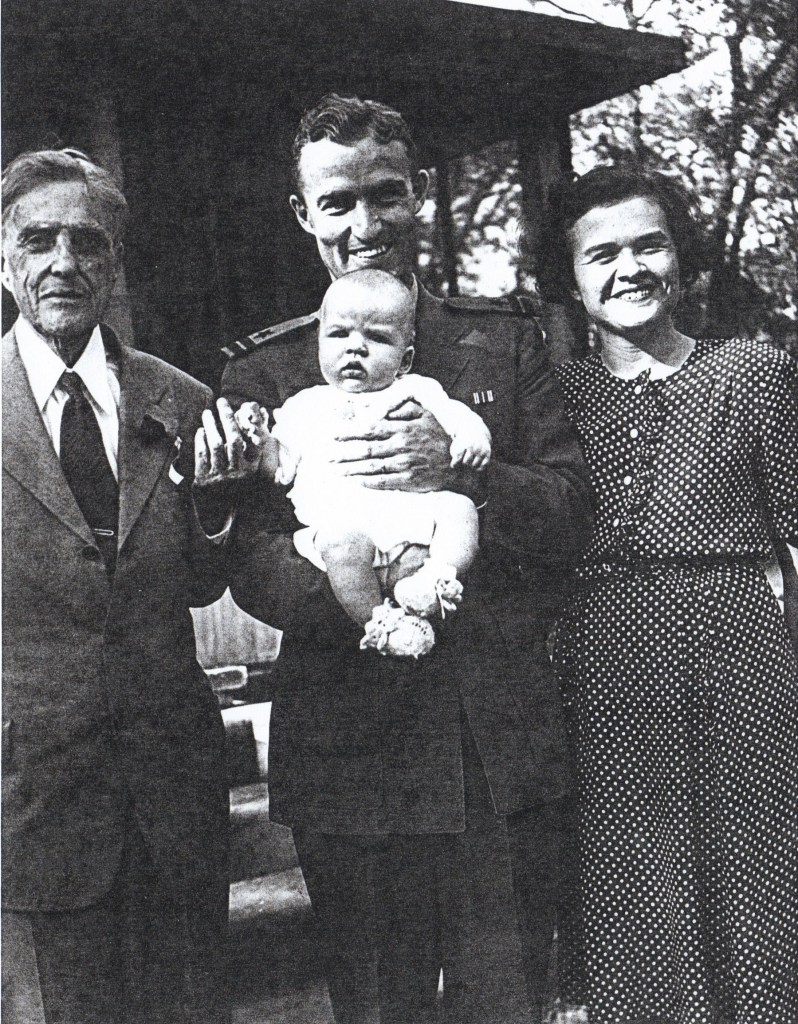
Jean met Bill in New York, his point of entry to the United States. When he arrived, according to Jean, Bill had a briefcase containing classified diplomatic or military documents manacled to his wrist. Jean and Bill spent their first night together traveling by train to Washington with a briefcase as a chaperone. When Bill arrived in Washington, D.C., the next day, he reported to the Vice Chief of Naval Operations, where the briefcase was removed from his wrist. After a few days in Washington, Jean and Bill took the train home to Minneapolis, where Bill met his son and namesake William Wallace Watson III (Billy). He spent about two weeks with Jean and Billy and Art and Cora Goodrich, and saw his parents, his last surviving grandparent—his mother’s father, Clarence French—and his brother Ted, Ted’s wife Jeanne and baby daughter Janet. In total, Bill spent close to a month in the United States—ten days or so on duty, and the rest on leave.
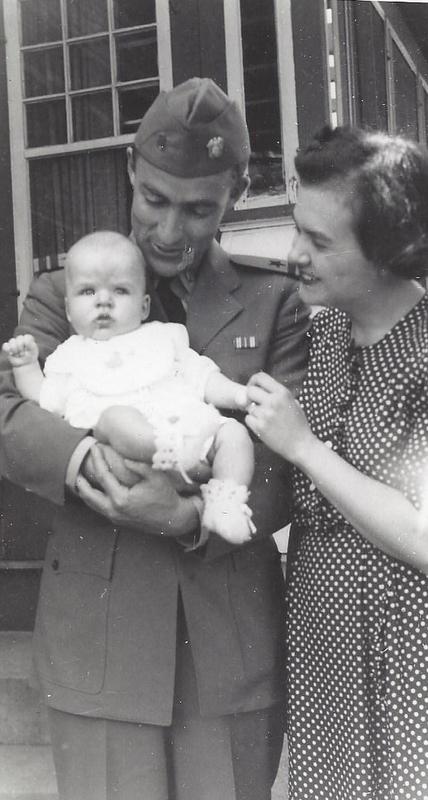
In accordance with his orders of April 1944, Bill was to begin his return journey to New Delhi by the end of May. On his return trip, he apparently had to pick up flights from one military airport to the next as best he could—always traveling east towards New Delhi but on a circuitous route. Traveling in this catch-as-catch-can manner would have taken many days, and was probably uncomfortable and arduous.
Jean once said that his return route took him from the United States to somewhere in South America, then to the [west] coast of Africa, and on to New Delhi. But thanks to a condolence letter written to Jean by Lieutenant Henry Nichol, a fellow naval intelligence officer stationed in New Delhi, we have much more detail about his trip. According to his letter, Lt. Nichol ran into Bill at the Cairo airport when they were both traveling back to New Delhi. They were both headed to Karachi—now in Pakistan, but before the 1947 partition in northwestern India. The trip by air from Cairo to Karachi is almost 2,500 miles. Bill’s itinerary called for a stop in Abadan, Iran, on the border of Iran and Iraq. Abadan in the Iranian oil fields had been held by the British since 1941, and was a key stop on the British supply route to the Middle East and there was an American presence as well. It would have been a logical stop to refuel, drop off passengers or cargo, or change planes.
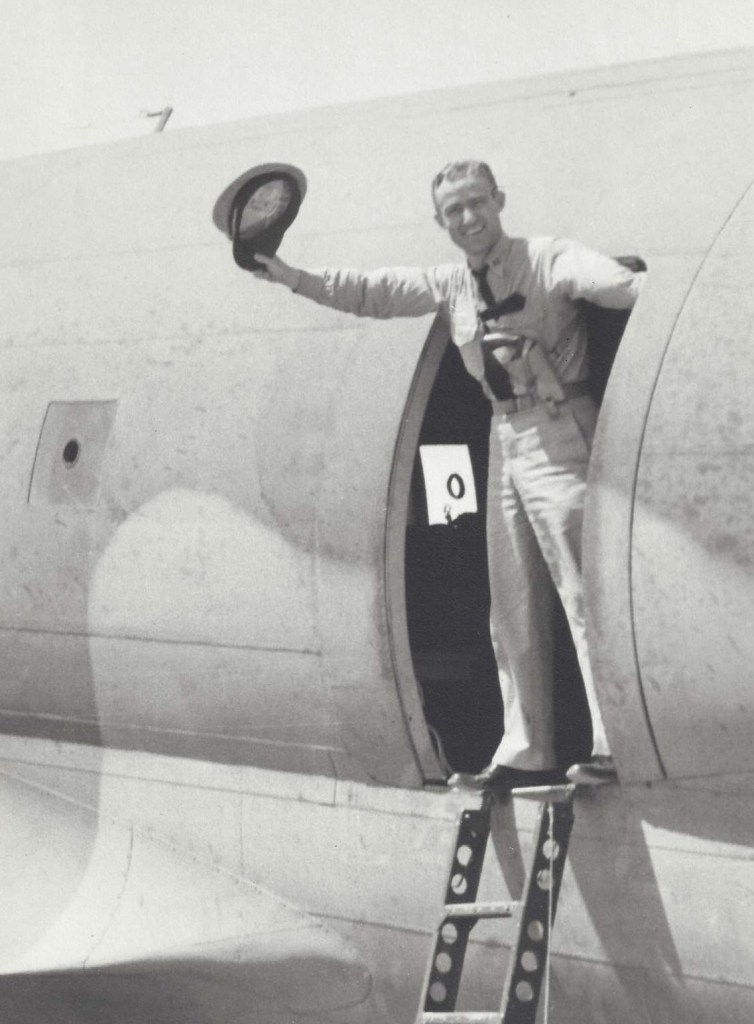
According to Lt. Nichol, he and Bill could not get on the same flight from Cairo to Karachi. Lt. Nichols’ itinerary did not include a stop in Abadan. But his flight had mechanical problems and had to make an unplanned landing there. About an hour later, Bill’s flight from Cairo to Karachi arrived in Abadan as scheduled. Lt. Nichol appears to have been able to join Bill on the next leg of his flight, and took this photo of Bill on his incoming flight or before the plane took off for Karachi. He included the photo with his condolence letter.
For some time, the Watson family believed that this flight from Abadan was the fatal flight—the one that crashed on its way to Chungking. In fact, someone, perhaps Bill’s father Percy, wrote on the back of a copy of the photo that Bill was waving “goodbye to all” before flying over the Hump to his death. But the date of the photo was June 4, twelve days before Bill was killed. Instead, we now know, thanks to the condolence letter from Lt. Nichol, that this was a stop on Bill’s trip back to New Delhi.
Bill’s Death
Sometime during April or May, Bill had been reassigned from New Delhi to the U.S. Embassy in Chungking (now Chongqing), China (a JICA branch during WWII), as an assistant naval attaché—probably a cover for his naval intelligence duties. By June 1944, when Bill was to transfer to Chungking, the route via the Low Hump—a much safer route across the Himalayas—had been opened. Until then, the Japanese had held the airfield at Myitkyina in northern Burma, from which they could launch fighter planes to shoot down transports across the lower Himalayas from India to Chungking. But in May 1944, the Allies had recaptured the airfield, and the Lower Hump route from Calcutta via Kunming, China to Chungking became passable. This is the route we now know that Bill took. It was a trip of about 1,300 miles, with a refueling stop at Kunming, about 400 miles from Chungking.
There was no reason to think anything would go wrong on a routine flight on the Lower Hump route. This is evidenced by a letter Bill wrote to his parents while on this fateful flight, after it had left Kunming and before the pilot had encountered any trouble.
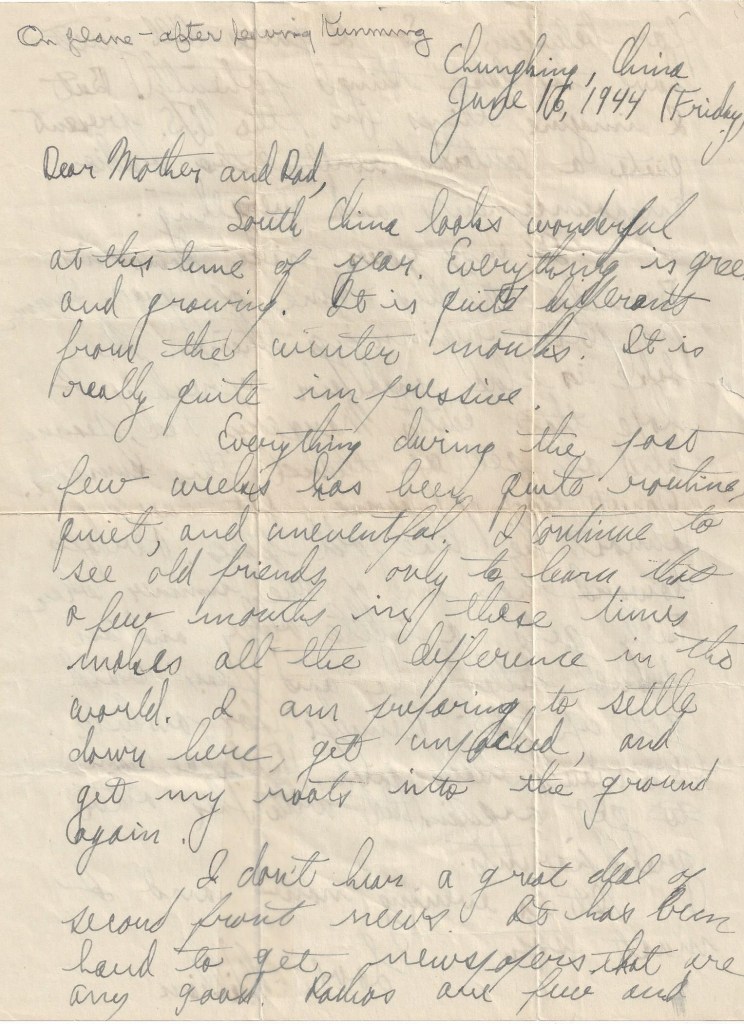
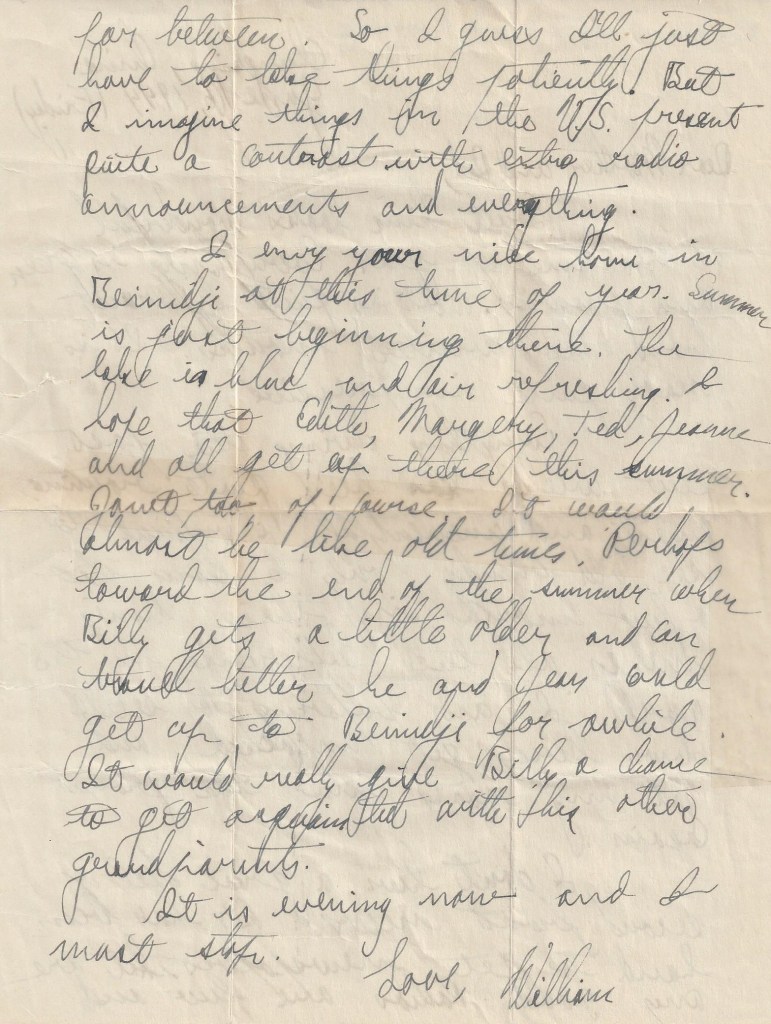
After sixteen years away from China, Bill was obviously excited about his new duties and his arrival in Chungking, only a couple of hundred miles ahead of him. The letter gives one a sense of how deeply Bill cared about China, and how thrilled he was to be returning—but also how much he yearned to be home with his family. The letter reads:
On plane — after leaving Kunming
Chungking, China
June 16, 1944 (Friday)
Dear Mother and Dad,
South China looks wonderful at this time of year. Everything is green and growing. It is quite different from the winter months. It is really quite impressive.
Everything during the past few weeks has been quite routine, quiet and uneventful. I continue to see old friends only to leave them. A few months in these times makes all the difference in the world. I am preparing to settle down here, get unpacked, and get my roots into the ground again.
I don’t have a great deal of second (Pacific) front news. It has been hard to get newspapers that are any good. Radios are few and far between. So I guess I’ll just have to take things patiently. But I imagine things in the U.S. present quite a contrast with extra radio announcements and everything.
I envy your nice home in Bemidgi at this time of year. Summer is just beginning there. The lake is blue and air refreshing. I love taht Edith, Margery, Ted, Jeanne and all get up ther this summer. Janet too of course. It would almost be like old times. Perhaps toward the end of the summer when Billy gets a little older and can tavel better he and jean could get up to Bemidji for awhile. It would really give Billy a chance to get to know his other grandparents.
It is evening now and I must stop.
Love,
William
Bill was the only passenger on a plane chartered by the Navy from the China National Aviation Corporation. According to the official report of the crash, dated August 5, 1944, Bill Watson died on June 16, 1944, at about 10:00 p.m. as a result of the plane crash landing. The report gives exact location of the crash; Jui Li Hsiang village, in Jungkiang District, Kweichow (now Guizhou), China, about 300 miles from Chungking. (Without detailed maps providing both the old and the new names for Chinese places, it is now impossible to determine where exactly this village is located.) Bill was travelling as “an officially-designated officer courier.” As such, he was probably carrying another briefcase manacled to his wrist, but the report doesn’t mention that detail. From a typed message on the back of an official photo of the crash site, we know that the plane was carrying 5,000 pounds of cargo—cargo which Jean many years later suggested was decoding equipment. But again, we have no confirmation of that information. Bill died at age thirty-two, a month short of his thirty-third birthday. He was only person killed in the crash. The American civilian pilot and navigator, and the Chinese co-pilot were injured. How and when they got out of Kweichow is unknown. But we know that the pilot was able to get word to Chungking about the crash and that he filed an official report.
The report says that the pilot directed the local villagers to bury Bill on a hill in the village and that “the coffin was sited [sic] by Lieutenant Commander Phillips Talbot (LCDR), Assistant Naval Attaché in this office [the office of the Naval Attaché in Chungking].” Phillips Talbot had been Bill’s best friend in New Delhi, and was to become his commanding officer in Chungking when Bill joined him there. LCDR Talbot was sent out from Chungking to investigate the crash and recover what was salvageable.
The only other written source of information that we have is an officially-sanctioned but personal letter to Jean from LCDR Talbot describing the recovery mission that he had led from Chungking to the site of the plane crash. Talbot also mentions that Bill had visited Talbot’s wife in Calcutta while he was waiting there for a flight to Chungking—evidence that the two men were, indeed, close friends. Talbot’s letter is dated August 4, 1944, three and one-half weeks after the plane crash on June 16. Talbot’s description of the trip from Chungking to the crash site is dramatic. He says:
After I last wrote you [we do not have a previous letter], my associates and I travelled for three and one-half weeks to visit the plane and return to our base. Besides myself, the party consisted of one other naval officer, a Chinese representative of the airline, the necessary coolies, and for the section which we did on foot, a squad of armed policemen intended to warn off reported (but never seen) bandit bands. To reach the place, we traveled one day by train, eighty miles by jeep, seven days in little river boats that were pulled, poled and rowed upstream, and a day and a half walking 40 miles over hill trails.
While the Navy report provided an exact location for Bill’s grave, Talbot added details saying: “When we had worked out his [the pilot’s] direction of flight and the circumstances of the fall and landing, we were unable to understand how any person in the plane had survived. The ship was completely smashed; one engine had torn itself out of the wing, and the wing and fuselage had split apart.”
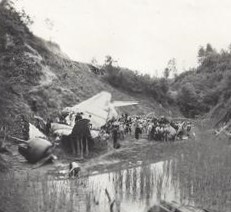

Before leaving the area, LCDR Talbot arranged for a stone grave marker to be erected. “It will show Bill’s name and rank in English and Chinese, and, in English, the dates of his birth and death.” Talbot’s letter continued on a very personal note:
I was led up on a knoll to the right of the path. Shaded by young pines and enriched by a covering of needles and ferns, this knoll commands a view of the countryside in three directions. Bill lies there. As the new sun made vivid their different shades of green, I looked at the panorama of upthrusting hills and paddy-clothed valleys, and felt you might be glad that when your husband was returned to the land which saw his birth he should lie in a place of such close communion with the natural forces.

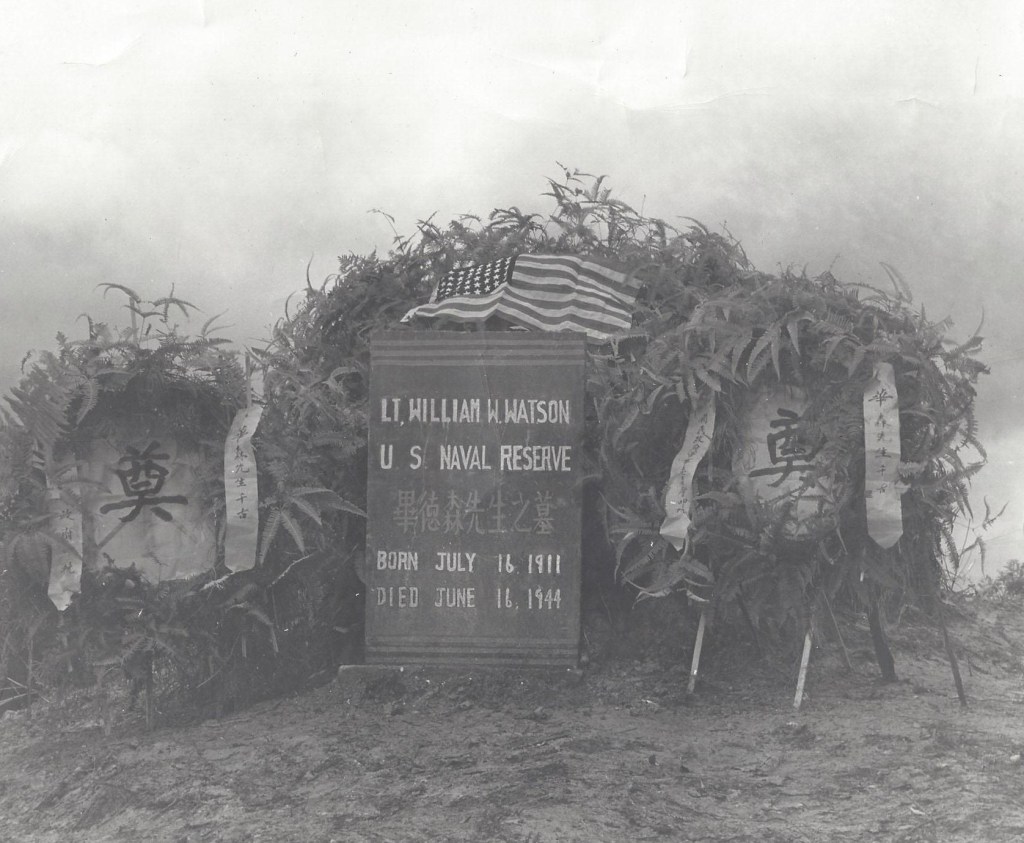
Jean did not learn of Bill’s death until June 30—two weeks after the fact—when she received the official telegram from the Navy. Undoubtedly, the Navy waited until it had confirmation of Bill’s death from LCDR Talbot. In the meantime, Jean had been writing letters to Bill every day or two, starting on June 2. Jean’s letters were waiting in Chungking when Talbot returned from the recovery mission and were returned to Jean with the few personal effects Talbot had found at the crash site.
Many of the details related to the plane crash that killed Bill Watson have remained elusive, making it difficult to tell a cohesive story about it. We believe that the plane crash was due to failure of the landing beacon in Chungking, compounded by darkness and bad weather. There is no evidence in any of the official documents that we have that the Japanese tampered with the airplane or the Chungking landing beacon or attempted to recover the cargo. But it appears that a second investigative team went to the crash site which seems excessive if the cargo was ordinary materiel and Bill was a simple courier, when so many planes crashed flying over the Hump during World War II. It also seems likely that Jean got more information from someone else after the war. We know she received many condolence letters from his colleagues, as well as post-war visits from Phillips Talbot, the pilot, and possibly others with first hand information. Unfortunately, she didn’t document what, if anything, she learned about the crash after the war—she only mentioned intriguing details like, “the Japanese killed the landing beacon,” or “the cargo was decoding equipment.” Now, having gotten the official reports, we know that Mom’s stories didn’t jibe with the official reports which causes us to wonder if someone gave Jean information that was considered to be sensitive during the war, but could be informally communicated to her after the war. A future post will cover the plane crash in more detail.
Sometime after LCDR Talbot visited the site, Bill’s remains were moved, first to Chungking (or possibly Kunming), then to Honolulu and, finally, in November 1947, to Northfield, Minnesota. Jean learned that Bill’s remains had been repatriated from the newspaper. She had remarried, thereby losing her right to be notified by the Navy—a fact that always irritated her. Bill’s funeral was held on November 6, 1947, in Northfield. Jean was accompanied by her husband of two months, Cyril Tifft. They were listed in various obituaries as “guests.” That she was his widow was not mentioned. That also probably irritated her. Many years later Jean said that she would have preferred that Bill’s remains be left in China. I believe that his parents felt the same way.
While helping my mother clean out their Arcade Street home in 1986 before she and my father moved to an apartment, I found a letter that Bill had written to Jean, after the one to his parents. It was clearly written after the pilot had told him to prepare for a crash landing—which the pilot later reported he had done when he knew he was not going to find Chungking—while the plane was lost and aimlessly circling. In the letter, Bill told Jean how much he loved her and Billy, and that if she ever saw the letter, he had died thinking of her and loving her. It was heart-wrenching and foretold the tragedy that was to devastate the family. The letter was returned to Jean with Bill’s personal effects after his death, but it has now been lost. After reading the letter with Mom’s permission, I asked her why she rarely talked about Bill. She said: “I’ve always been afraid that if I start talking about him, I’ll start crying and I won’t be able to stop.”
In life, Bill was the golden child. He was extremely intelligent, handsome, personable, athletic, and successful in everything he had tackled. Despite Clara’s harshness as a mother, and Percy’s aloofness as a father, they adored him, as did his four siblings, his wife of three years, and his in-laws. His mother-in-law, my grandmother, Cora Goodrich, even kept a portrait of Bill on her dressing table until she died. But, as my mother Jean once said, “We’ll never know what kind of a man he would have become. He didn’t live long enough.”
Visit our Ancestry.com family tree here.