

Sara Tefft: A Life Etched in Stone
The Sara Tefft Gravestone: A Historical Puzzle or a Record of a Life?
On the edge of the Brown University campus in Providence, Rhode Island, stands the Museum at the John Brown House, a property of the Rhode Island Historical Society (RIHS). Beneath the museum, in a sealed basement room off an arched brick passageway, a dust-covered gravestone rests on a table. The gravestone is a crudely carved granite boulder that once marked the grave of Sara Tefft.
The stone was believed to be dated 1642 for almost 150 years, causing historians and antiquarians to proclaim it the oldest surviving inscribed gravestone in Rhode Island and perhaps in all of New England. Then in the 1990s, historian A. Craig Anthony and colonial gravestone expert John E. Sterling challenged the traditional date, arguing that the stone actually dates to 1672. Although Anthony and Sterling assembled compelling physical and historical evidence to support their position, they stopped short of making a case strong enough to dispel the dispute. It would take new evidence and one determined descendant to finally settle it.
For all those years, the Sara Tefft gravestone was treated as little more than a historical curiosity—a crudely carved rock, tucked away in museum storage, worth arguing over only for its date. But it is more than that. It is a record of a life: a life that has been obscured since the mid-nineteenth century by the misdating of the stone and the subsequent misidentification of the woman it commemorates. Yet the surviving evidence tells a different story, one that restores Sara to her family, her place, and her time in seventeenth-century Rhode Island.
The gravestone dates to 1672, not 1642, and it marks the grave of Sara (or Sarah) Tefft, wife of Joshua Tefft and mother of Peter Tefft. The evidence had been sitting in the Society’s own collection all along. The pieces just needed someone to find them and put them together. That someone turned out to be me.
The Artifacts
The Original Sara Tefft Gravestone
Many seventeenth-century graves went unmarked, or were marked with wooden markers that have long since disintegrated. Those with something more permanent usually had a rough, uninscribed boulder. That makes the crude inscription on Sara Tefft’s gravestone both unusual and historically significant. Yet weathering, breakage, and later recutting have obscured portions of the text, leaving historians to debate both its date and the identity of the person it commemorates.
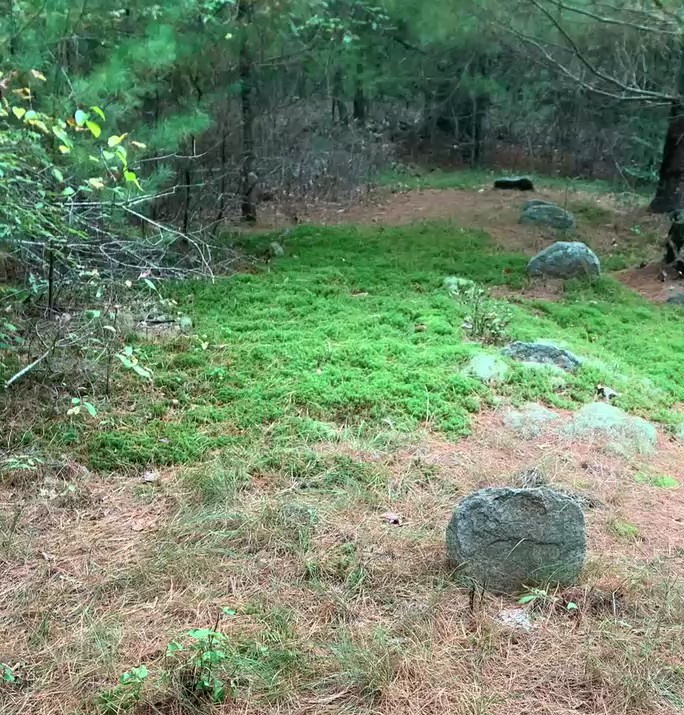
The Sara Tefft Gravesite
The Sara Tefft gravesite is located on land purchased by the English settler John Greene, Sr. (ca. 1597–1658) from the Narragansett, and ratified by a deed dated October 1, 1642. Greene passed the land down to his eldest son and namesake, John Greene, Jr. (1620–1708), upon his death in late 1658 or early 1659. The Greene land surrounded Occupessatuxet Cove, off Narragansett Bay.
Greene, the first English purchaser in the area, bought his land for a family farm, but his purchase also marked the first step in a broader plan to build a new settlement, Mill Creek, located just south of Greene’s property. In the late 1640s, the settlement was renamed Warwick, and John Greene’s property became part of the incorporated town.
Broken and Recut
The original Sara Tefft gravestone remained in the Greene family graveyard for nearly two centuries until 1868, when it was removed and donated to the RIHS. When I asked the museum collection manager about the stone’s condition on arrival, he told me he was confident it came in as it is now, broken and recut. However, no documentation of its condition on arrival has come to light.
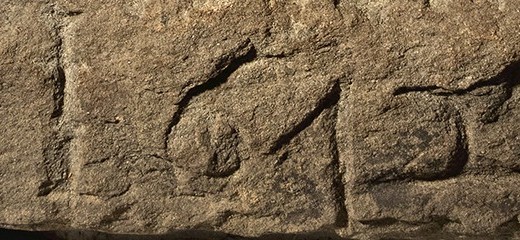
At some point before the stone reached the RIHS, a large fragment broke from its right edge and was lost. With it went part of the deceased’s given name, the burial day, and the rest of the burial month. Only “ᴤA” and “MA” survive, but “ᴤA” could represent Sara, Sally, or Samantha, and “MA” could represent March or May. Two words, “BoDY” and “IᴎThE,” appear to be the product of recutting, making the insciption even harder to read.
The surviving inscription is brief and fragmentary. Of its key identifying elements, only the surname “TEffT” and the year remain intact and apparently unaltered, which leaves an already crude inscription open to conflicting interpretations.


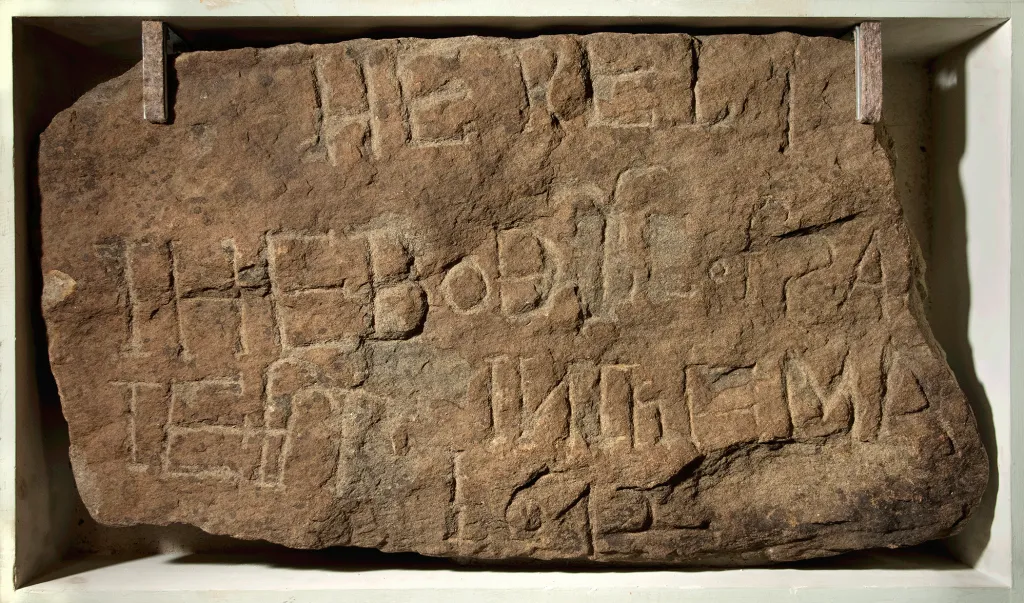
As this twentieth-century RIHS photograph shows, the steeply sloped top line of the year’s third digit could easily lead the casual viewer to see a “4,” and indeed, nineteenth-century historians and antiquarians, and even some twentieth-century historians, accepted 1642 as the carved date. Only a close physical examination aided by magnification shows that there is no horizontal stroke. Anthony and Sterling were, as far as I can tell, the first to publish the results of such an examination.
The Replacement Stone
The man behind removing the original Sara Tefft gravestone was Rufus Greene (1806–1871), a Providence businessman and antiquarian (Greene 1903, Kindle loc. 14936). In 1868, he erected an upright slate slab bearing a lengthy inscription in place of the original gravestone. Though the slab is now broken and lies flat on the ground, the full inscription remains clear.
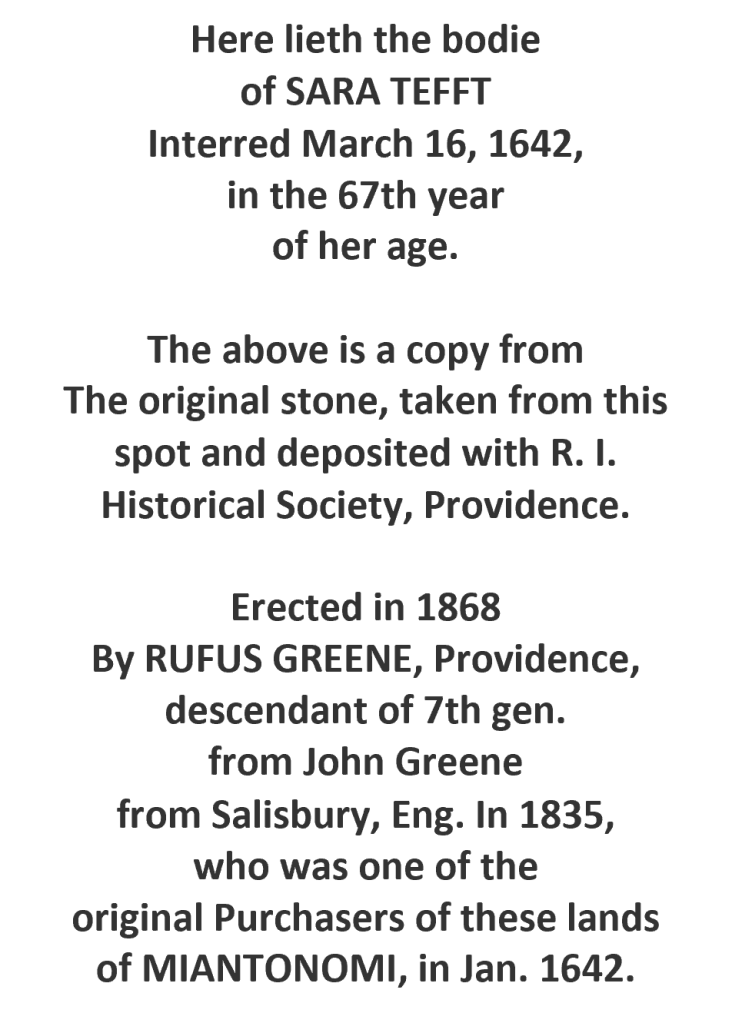
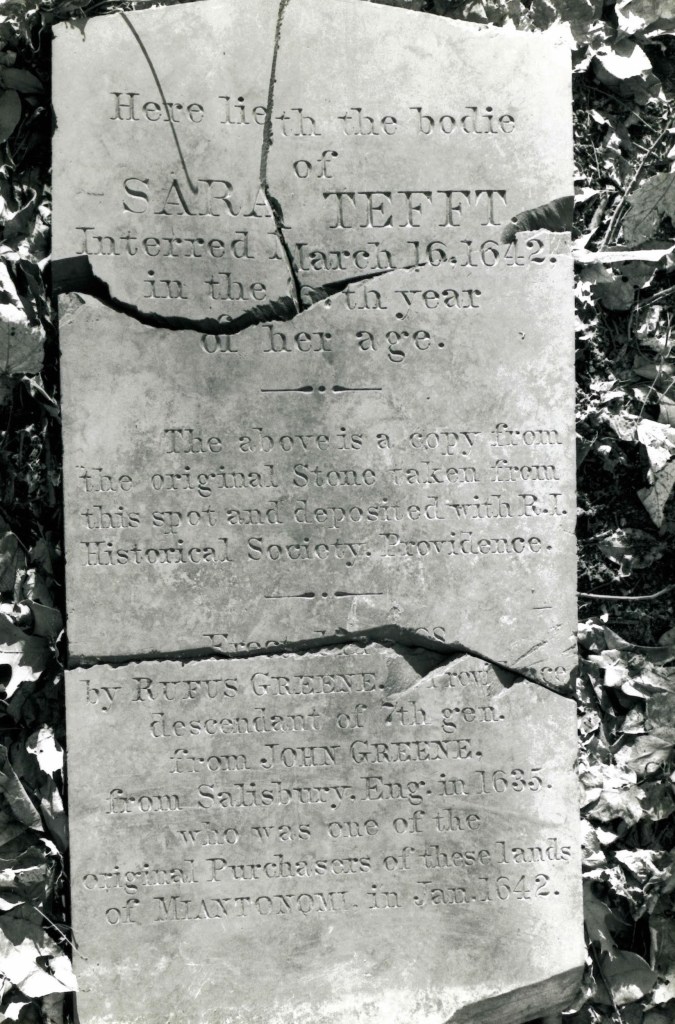
It appears that Greene intended his replacement stone to conform to mid-nineteenth-century expectations rather than faithfully reproducing the seventeenth-century original, despite referring to his epitaph as a “copy.” He made the stone look familiar: he used a slab of dressed slate, stood it upright on a plinth rather than using a rough boulder, and had it inscribed by an expert carver who made the inscription legible and corrected the backward “N” and “S.”
The wording was another matter. The first four lines of Greene’s inscription follow the original stone, but his version also includes details the damaged stone does not show. Where the stone has “BoDY,” his reads “bodie,” and where it has “IᴎThE,” his reads “Interred.” More importantly, his version provides a full given name, “Sara,” and a full date, “March 16, 1642.” Finally, Greene added the phrase “in the 67th year of her age,” a common convention on nineteenth-century gravestones. No vestige of the phrase appears on the original stone below the year, where Greene placed it, and it is unlikely to have been on the missing shard, where it would have had to be written vertically. Nor is there any supporting historical evidence for the phrase, or for an elderly woman in Warwick in its very earliest days, particularly not one named Tefft.
So where did Greene get his information?
Carving 1642 in Stone
The Traditional Lore
By the last quarter of the nineteenth century, 1642 became the accepted year for the Sara Tefft gravestone. References to the inscribed stone characterizing it as the oldest in New England, the oldest in Rhode Island, and the oldest in Warwick began to appear mid-century and persist today. Though there may be others, four sources stand out.
The earliest dated mention of the Sara(h) Tefft gravestone predates Rufus Greene’s replacement stone by more than a decade. In an 1857 letter addressed to the editor of the New England Historical and Genealogical Register, Israel Keech Tefft (1794–1862), a descendant of the Rhode Island Tefft family and corresponding secretary of the Georgia Historical Society (Hacussler 1982, 142), wrote that “the oldest tombstone in Rhode Island is of granite and erected to the memory of Sarah Tefft” (Trask 1868, 203–205). The letter, however, was not published in the Register until 1868. Rufus Greene may have seen the letter before publication and been inspired to remove and replace the original stone, or it may have played no role at all; we have no way of knowing. In his 1980 article in the RIHS journal Rhode Island History, Robert P. Emlen cited the Tefft letter without discussing its significance.
Over the next few decades, two other antiquarians made the year 1642 a lasting part of the Sara Tefft gravestone lore. In 1875, Oliver Payson Fuller (1832–1893), a Warwick clergyman and educator, published his extensive History of Warwick, Rhode Island, where he wrote that the Sara Tefft stone was “probably the earliest evidence of human mortality … that the Warwick settlers left to their posterity” (Fuller 1875, 141). He quoted Greene’s replacement stone verbatim and accepted the inscribed date, March 16, 1642, without question, though his own exhaustive account of the founding of Warwick might have prompted him to question it. In 1890, James Newell Arnold (1844–1927), another well-respected Rhode Island antiquarian, published the full inscription from Greene’s replacement stone in The Narragansett Historical Register without comment (Arnold 1890, 302). Still, he titled the piece “The Oldest Marked Grave in the State,” leaving no doubt that he believed the gravestone was dated 1642.
Almost a century later, in 1980, Robert P. Emlen published his article “From the Collections: Rhode Island History Carved in Stone” in Rhode Island History, where he introduced notable gravestones in the RIHS collection. Emlen made the strongest claims of any for the Sara Tefft gravestone’s antiquity, writing that “Sara Tefft died the same year that Samuel Gorton and his followers settled Warwick, and her memorial bears the earliest date of any gravestone known in New England” (Emlen 1980, 37). However, as historians now agree, the Gortonites arrived in November 1642, months after the date on Greene’s replacement stone. Later in his article, Emlen went even further, saying: “Without a doubt, the antiquarian collector who brought the Sara Tefft marker to the Rhode Island Historical Society saved the oldest gravestone in New England from obliteration” (Emlen 1980, 38).
When he wrote the article, Emlen was an associate curator of the RIHS collection, uniquely positioned to evaluate earlier assertions about the year on the Sara Tefft gravestone. He had direct access to the stone itself, and he used the RIHS photograph of the original to preface his article. While the photo is somewhat ambiguous, close examination of the original stone would have shown the year to be 1672. Yet his analysis quotes the inscription on Greene’s replacement stone, as Fuller’s and Arnold’s had, and does not address how it differs from the original. The given name, the full date, and the age at death appear only on the replacement, and their source was still unexplained.
The Forgotten Skeptic
In 1919, Providence journalist and art historian George L. Miner (1875–1966) became the first to question the date on the original stone. His article “Types of Early New England Gravestones” appeared in RIHS’s own journal, Rhode Island Historical Society Collections. In the article, he cited a birth record for Peter Tefft and the absence of Teffts in Warwick in the 1640s as reasons to doubt the accuracy of the year 1642 (Miner 1919, 33-41).
After viewing the stone in an RIHS exhibit, Miner wrote:
The Sarah Tefft stone, now among the exhibits of the Rhode Island Historical Society has been considered the earliest Warwick stone known. It is a rather crude slab of unfinished local stone, presumably granite, and bears an inscription plainly recut, ending with the date 1642. Generally speaking, recut inscriptions must be scrutinized carefully and with suspicion. The restorer’s chisel is likely to jump at conclusions; a half obliterated date may easily lead him a couple of decades astray. So in the case of this famous Sarah Tefft stone, if the 1642 were the original date, this would be one of the earliest marked stones in New England. But Warwick was not settled until 1642 and we find no record of Teffts there so early. We do, however, find the record of a Sarah Tefft, wife of Joshua Tefft. The birth of their son Peter is recorded on March 14, 1672. May we not suspect a slip of the chisel in the restoration of this early stone and again restore the inscription to read “died March 16, 1672,” instead of “March 16, 1642?” (Miner 1919, 40)
Even Miner, the lone skeptic, read the year as 1642. Because historical records contradicted that date, he blamed a slip of the restorer’s chisel for the discrepancy. His reasoning was sound. His reading of the stone was not. The date on the stone had never been altered.
Fuller and Arnold had repeated the inscription on Greene’s replacement stone, and Emlen would do the same six decades later. I know of no earlier reading of the year from the original stone than Miner’s, and I have found no earlier published link between the stone and Peter Tefft’s birth record.
Miner’s theory apparently gained no traction. Emlen, Anthony, and Sterling, the later scholars who wrote about the stone, did not mention Miner or his article, and he does not appear in modern online discussions. His contribution to the stone’s historiography has gone unrecognized until now.
A Challenge to the Traditional Reading of the Year
Another Record for Sara Tefft
While researching the Tefft family for his 1998 monograph, The Tefft Family and the Narragansett Controversy, historian A. Craig Anthony came across the Warwick birth record for “Peeter Tifft” in the Record of Marriages—Warwick 1649, in which most vital records, not only marriages, were recorded at the time. In the birth record, Peter’s parents are identified as “Josua [Joshua] Tiff by Sarah hi[s] wife.” (Given name and surname spellings varied widely in this period. Tefft, Tifft, and Tiff all appear in the records. Standardized spellings came into common use in New England during the eighteenth and nineteenth centuries.)
The birth record states:
Peeter Tifft Sonn of Josua Tiff by Sarah hi(s) wife, was borne ye 14th of march ye yeer 1671/2 in Warwicke (Town of Warwick n.d., A1:15)
The double date here, 1671/2, reflects the overlap of the Old Style and New Style calendars. The year is 1672 by modern reckoning.
In correspondence with me in February 2019, Anthony explained how he’d learned about the Sara Tefft gravestone, saying: “RI History magazine had an article about the Sara Tefft stone in the 1980s stating that it was the oldest inscribed stone in the NE and I was researching Joshua Tefft and knew he had a wife and son from the Warwick town records” (Anthony 2019). I soon tracked the article to the February 1980 volume of Rhode Island History. It was the Robert P. Emlen article discussed previously.
Noting the similarity between the birth record date, March 14, 1672, and the stone’s purported date, March 16, 1642, Anthony was intrigued. He saw a distinct possibility that the Sara Tefft gravestone was actually dated 1672 and marked the grave of this Sara(h) Tefft, the new mother named in the birth record, rather than an unknown Sara who had died thirty years earlier.
The record itself was not a new discovery. Miner had cited it nearly eighty years earlier in the 1919 article discussed above.
Examining the Evidence
According to Anthony, he enlisted gravestone expert John E. Sterling to help him conduct a physical examination of the original stone at the RIHS. Using “a bright light and a magnifying glass” (Sterling 1997), they concluded that it was indeed dated 1672, rather than 1642 (Anthony 1998, 3; Sterling 1997). Sterling explained the steep slant of the top stroke: “From this study [Anthony and Sterling’s physical examination] it seemed clear that the carver intended to engrave a seven, albeit the carver was no master in the craft. While this type of ‘lazy seven’ is unusual, it is certainly not unique. Several other examples can be found throughout Rhode Island and New England on crudely inscribed fieldstones” (Sterling 1997).
A Mysterious Transcription
At the RIHS, Anthony and Sterling also found a copy of a handwritten transcription of the Tefft gravestone. To my knowledge, they are the first to mention the transcription in more than a century of published literature related to the Sara Tefft gravestone.

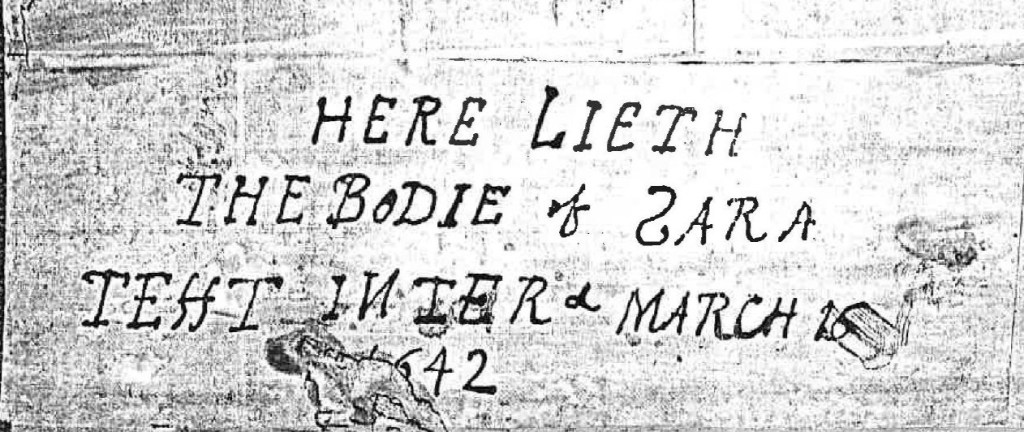
The transcription, reproduced on the first page of Anthony’s monograph (Anthony 1998, 3), preserves details that no longer appear on the stone itself: the deceased’s given name, the burial day and month, and the words “Lieth,” “Bodie,” and “Inter’d” in their older forms. It includes nothing about Sara’s age at death.
It seems clear that Greene’s 1868 epitaph reflects this transcription rather than the damaged stone. The transcriber, not Greene, appears to have misread the year first. The transcription is the earliest surviving source I know of that gives the year 1642. It appears to have introduced the misreading into the record. Greene then played a major role in perpetuating the mistake by having the same erroneous year inscribed on his replacement stone. He likely added the age at death, which appears in neither the transcription nor on the original stone, to match nineteenth-century convention.
The transcription, which predates the damage to the stone, supplied what the stone had lost: the given name and the day and month of burial. These fit the birth record of Peter Tefft, born two days and thirty years later. Together with their finding that the carving read 1672, not 1642, Anthony and Sterling concluded that the original stone commemorated Sara(h) Tefft, the new mother who died during or shortly after childbirth, rather than an unknown, elderly Tefft who was thought to have died thirty years earlier.
Though the transcription is unsigned and undated, Anthony and Sterling attributed it to Usher Parsons (1788–1868), a Providence physician and antiquarian, without providing a basis for that attribution. Their citations, published separately, differ. Anthony introduced the transcription on the first page of his 1998 monograph saying: “The first mention of this gravestone is found in a manuscript of Dr. Usher Parsons” (Anthony 1998, 3). In his notes (Anthony 1998, 35), he cited his source as “Parsons, Usher. MS [manuscript]. (Providence: RI Historical Society. Circa 1850)” . Sterling, in his 1997 book Warwick, Rhode Island Historical Cemeteries, told a similar but not identical story: “The earliest mention of this gravestone is found in the papers of Dr. Usher Parsons at the Rhode Island Historical Society. It was probably recorded about 1840” (Sterling 1997).
Anthony and Sterling differed on the type of document in which the transcription was found (a manuscript versus papers) and on its date (about 1850 versus about 1840). Yet both implied that they had inferred the author’s identity from the transcription’s place among Parsons’s materials at the RIHS.
A Paper Trail Gone Cold
I was working with an academic researcher and editor located near Boston when I began my research on the Sara Tefft gravestone. On my behalf, she requested a search of the Parsons papers held in the RIHS archives to locate the transcription, but the reference staff found no mention of it. My investigation had reached an impasse.
Without Anthony and Sterling’s work, I would never have known the transcription existed. They deserve credit for finding it and putting it in print. But the sources they cited did not turn it up. How could anyone rely on the authenticity of a transcription that couldn’t be found?
A Mysterious Photocopy
It was apparent that someone would have to visit the RIHS to resolve the impasse. In December 2021, RIHS reopened its doors to researchers as the pandemic appeared to be subsiding, but I was unable to travel from my home in Minneapolis to Rhode Island. My colleague offered to go in my place. She first conducted another search of the Parsons papers to confirm that there was no mention of the transcription. Then she viewed the stone in museum storage with the museum collection manager. Finally, she looked through a museum file of documents and letters about the Sara Tefft gravestone (Sara Tefft gravestone record file, uncataloged, John Brown House Museum, Rhode Island Historical Society; viewed December 2021 and October 2024).
My colleague viewed the stone by the light of her phone, without magnification. Expecting 1672, she read the year as 1642. Her search of the museum file was more productive. There she found a photocopy of the transcription, the same image pictured in Anthony’s monograph. While the transcription is unsigned and undated, the page also includes a handwritten note beside it. The note attributes the transcription to Usher Parsons. It too is unsigned and undated. The note reads: “Copy of an inscription/on a grave Stone taken/Some years ago by Dr./Parsons from Cole’s in/Warwick[.] Mr. Rufus [Greene]/was at the expense of/removing the stone to the Historical Cabinet[.]” (Slashes mark line breaks, and bracketed text is mine.) My colleague had made a major find: the handwritten note was very likely the source of Anthony and Sterling’s attribution of the transcription to Usher Parsons. Their citations, however, do not mention the note.
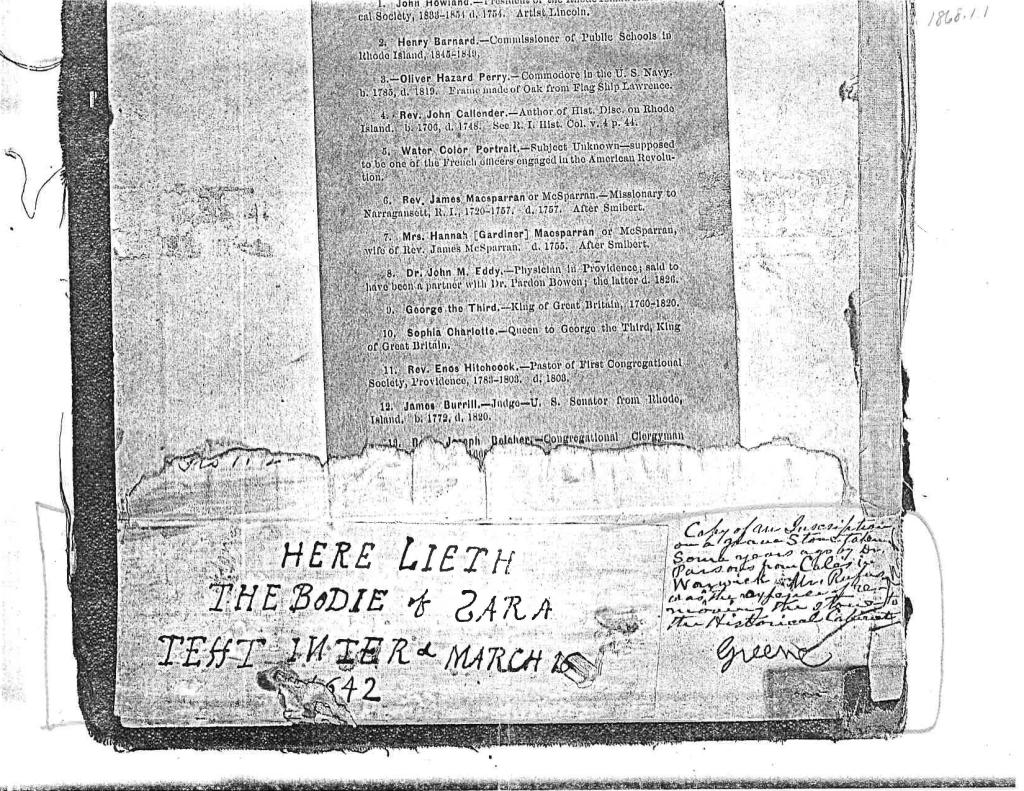
The note says only that the transcription was taken “some years ago,” which provides no factual basis for Anthony and Sterling’s estimates of when it was made. The transcription must predate the breakage and recutting of the stone, but it could have been made any time before 1868, the year Parsons died and Greene removed the stone from the cemetery.
Neither Anthony nor Sterling mentioned the museum file or a photocopy like this one. It seems very likely that it, and not the Usher Parsons papers or a manuscript bearing his name, was their source for the transcription and for its attribution to Parsons, since the note is the only link between Parsons and the transcription that I have found.
Curiously, the transcription and note are superimposed on an undated and apparently unrelated list of portraits. This photocopy shows a dark edge with a pebbled texture, suggesting the original had been kept in a leather folio or book. But where was that? Was it even at RIHS? The location of the original transcription remained a mystery.
Reading the Stone
I had pondered the mysteries of the Sara Tefft gravestone for four years, since the beginning of the pandemic. Even with the available research materials, my colleague’s observation of the stone, and her discovery of the photocopy of the transcription and the previously undocumented note, I still had questions. Why had the transcription proven so hard to pin down, and why had Anthony and Sterling not persuaded the RIHS that the stone was dated 1672?
Pieces of the puzzle were still missing. The only way to satisfy myself about the date on the stone and the authenticity of the transcription was to visit the RIHS myself. In October 2024, my husband and I finally made the trip. Our first stop was Occupessatuxet Cove, now part of Warwick, to view Sara Tefft’s gravesite and the replacement stone.
The Sara Tefft Gravesite Today

The Greene family sold the southern portion of their land on Occupessatuxet Cove, the land on which the original stone was placed, to the Cole family in 1784. By the late nineteenth century, the area had become a summer resort of modest cottages. The cottages have since become year-round homes (Kernan 2014). The old family burial ground, which held several graves when Arnold saw it (Arnold 1890), is down to one grave: Sara Tefft’s. Though no longer intact, the replacement stone has survived the ravages of time and development and now sits in a shady clearing where visitors can easily find it. The plinth on which it originally stood lies behind it. A stout railing and cement posts protect the replacement stone from further damage.
Examining the Original Sara Tefft Gravestone
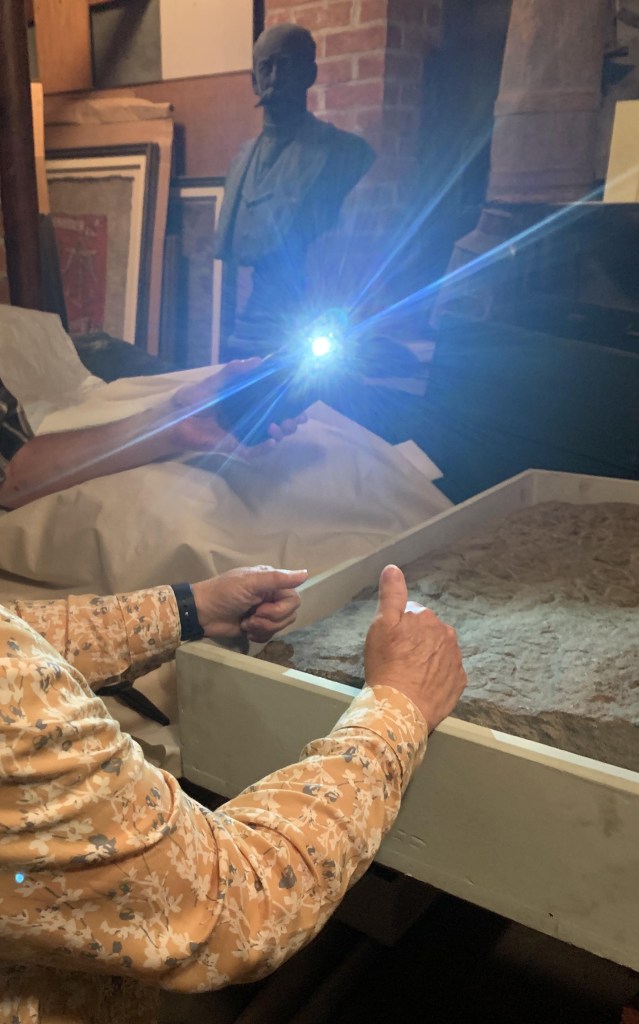
The next day, we visited the John Brown House, first stopping in a basement storage room where the museum collection manager proudly showed us the Sara Tefft gravestone. It was sitting on a crowded table, in dim light, with the broken edge facing us—not an ideal situation for a close examination of the carving on the stone. My husband and the collection manager lit the stone with their cell phones, while I brought out my magnifying glass to get a closer look at the carving. Under magnification, there was no carved horizontal stroke connecting the slanted top stroke to the vertical one—nothing to make a four. There was only a faint line of minuscule black pits roughly where such a line might have been.
My background in archaeology taught me that touch can reveal details the eye misses. With the collection manager’s permission, I read the year as if it were in Braille. I found that the vertical and the steeply slanted top strokes of the third numeral were clear, deep, and quite uniform, but there was no similar horizontal stroke. What I did feel was a minute natural horizontal ridge in the stone near the black pits. Taken together, the ridge, the pits, and the steeply slanted top stroke might fool a viewer, even skeptics like Miner and my colleague. I agreed with Anthony and Sterling: the date was 1672.
The collection manager had walked into that storage room believing the stone read 1642—something he stated as we began our examination. Now he traced the numeral himself and finally spoke: 1672. The RIHS’s own recorded date, which had stood for 156 years, had just been overturned in the John Brown House museum basement. Now came the task of getting the official date revised, and Sara’s history restored.
Filling the Gaps in the Paper Trail
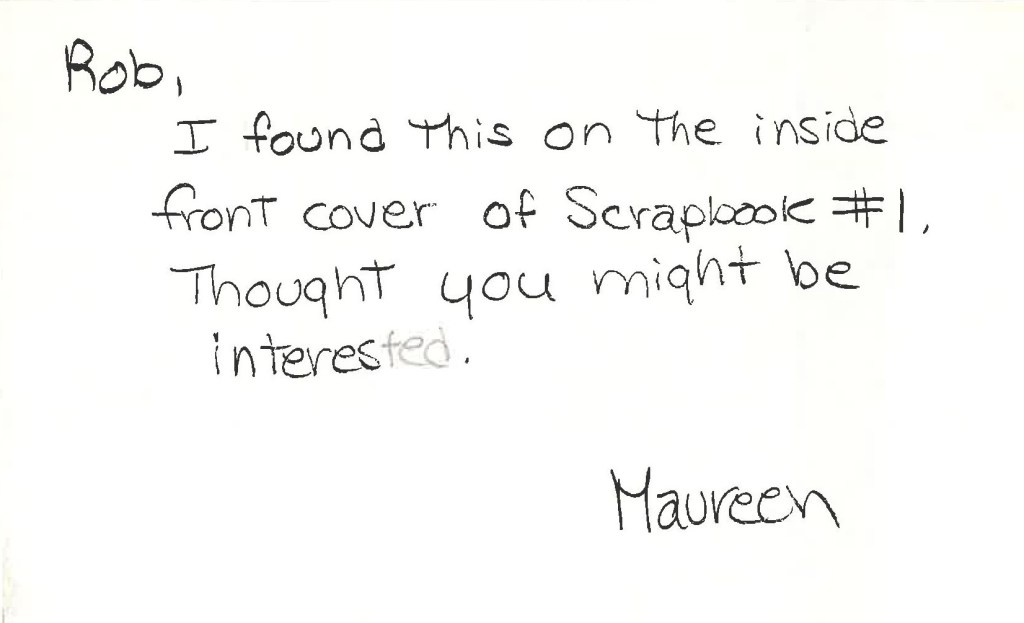
After we had viewed the stone, we climbed to the top floor of the John Brown House, where the staff offices are housed. There, the collection manager pulled out the same file that my colleague had viewed almost three years earlier. The file had obviously absorbed decades of loosely related paperwork: letters, an outdated accession card, and the same transcription photocopy that my colleague had found. But as I turned the photocopy over, I saw something that apparently no one had noticed before: a transmittal note written in pencil and block letters. It was the missing link in the paper trail.
From the transmittal note, I learned that the original transcription came from “Scrapbook #1,” but at the moment of discovery, I didn’t yet realize exactly what I had found. I asked where Scrapbook #1 might be located, but our host didn’t know. Our time was short, and we were hungry after several hours at the John Brown House, so we went to lunch instead of tracking down the scrapbook. The next day, we were on a plane back to Minneapolis.
Later, the museum collection manager confirmed that the transmittal note I’d seen was the original. He wrote: “The presence of lead from the pencil is evidential proof that these entries were made on the old Xerox copy we keep here in the record file folder” (Vasquez, email to author, August 11, 2026).
Tracking Down the Original Transcription
It took a few weeks to get back to the materials I’d collected during our site visit. I believed that the scrapbook contained the transcription, but I could not cite it without knowing its exact location. I also had to confirm that the transcription itself was still there, not just a copy of it. I contacted the RIHS reference staff for help. Over the next few weeks, I got answers to many of my questions about the transcription and its location in Scrapbook #1.
The reference staff indicated that Rob, the recipient, was “most probably” Robert Emlen, the RIHS associate curator from 1978 to 1983. They identified Maureen, the author of the transmittal note, as Maureen Taylor, who had worked in the RIHS library’s Graphics and Research Department as early as 1978. That places the note during Emlen’s tenure, but the staff could not date it more precisely.
I believe Emlen received the photocopy after he wrote his 1980 article. Had it been in his hands earlier, he probably would have referred to the transcription in his article and used it to explain the differences between the damaged epitaph on the original stone and the much clearer one on the replacement stone.
At the end of January, the cabinet keeper and library collection manager sent me a clear photo of the inside front cover of the scrapbook with a detailed description.
RIHS Scrapbook 1 was compiled by the librarians of the RIHS from the 1860s to the late 1880s. The stone was donated to the RIHS in 1868; it would make sense that this transcription was glued in around the time of the donation. The transcription is written in ink on a scrap of calendared linen of the type that architects used from 1820 through today. It is glued to the inside cover, with the glue covering the entire piece of linen. To the right of the scrap of linen is a notation by one of the librarians regarding the scrap (Munroe, email to author, January 31, 2025).

The linen detail convinced me that the transcription was the original, the one the photocopy had been taken from, but I had never heard of calendered linen. As the cabinet keeper noted, calendered linen is used for architectural drawings, but historically it was also used for other purposes, including lining clothing (Preston 2021). While it is hard to imagine why Usher Parsons, a medical doctor, would be carrying architectural linen on a walk in a Warwick field, it is easy to imagine him coming upon the gravestone and searching for something to write on, then, out of desperation, tearing a scrap of linen from the lining of his jacket or the inside of his hat.
The cabinet keeper’s photograph held one more clue, this time about when the transcription was glued into the scrapbook. The list of portraits is dated 1880, a detail cut off in the photocopy in the museum file. Because the transcription is glued on top of the list, it was most likely glued in place after 1880, later than the cabinet keeper’s suggestion of around 1868. It is possible, however, that the transcription lay loose in Scrapbook 1 from 1868, when Rufus Greene donated the stone.
Librarians were compiling Scrapbook 1 when Rufus Greene donated the stone, and it now holds both the linen scrap bearing the transcription and the note naming Usher Parsons as its author. The timing suggests that Greeene may have been given the transcription, perhaps by Usher Parsons himself, after which Greene based his epitaph on it and donated the stone and the transcription to the RIHS. But that is pure conjecture.
Whatever the sequence, the transcription ended up in the library and the stone in the museum. The transcription’s full significance went unrecognized—that is, until now.
The Final Piece of the Puzzle
In August 2026, I received one last piece of evidence, perhaps the most convincing one of all, from the senior director of library and museum collections at the RIHS. It is a new, well-lit, professional photograph of the original stone. It clearly shows the year 1672.
Setting the Record Straight
I’ve read the stone by sight and by touch, and I know it is dated 1672. Now a new photograph makes the year so clear that no doubt remains: any claim that the stone is dated 1642 rests on a misreading. That misreading goes back at least to the transcription made before 1868. The transcription itself has been found: a scrap of linen glued into a nineteenth-century scrapbook in the RIHS library, where it has been for well over a century. Apart from the misread year, it confirms the original epitaph as it read before the stone was damaged. Persuaded by this research, the RIHS now lists the stone’s date as 1672.
It is certain that the stone originally marked the grave of my sixth-great-grandmother, Sara Tefft, the mother of Peter and the wife of Joshua Tefft. Once dismissed as a historical anomaly, Sara can finally be seen as herself, a wife and a new mother, buried early in Warwick’s history, but not before it became a town.
Acknowledgements
This article would not have been possible without the generous help of the staff at the Rhode Island Historical Society. I’m especially grateful to the reference staff at the Robinson Research Center. I also thank Dana Signe K. Munroe, Cabinet Keeper and Library Collection Manager; Luis G. Vasquez, Museum Collection Manager; J.D. Kay, Digital Imaging Specialist and Rights and Reproductions Manager; and Richard Ring, Senior Director of Library and Museum Collections, Director of Facilities, and Editor of Rhode Island History. All of them patiently answered my questions, provided photographs and images, tracked down documents, and shared their own expertise along the way.
I’m also deeply grateful to my colleague and collaborator, academic researcher and editor Meg Sinott Rubin, who made the first visit to the RIHS on my behalf in 2021 and collaborated with me during the early years of this research. Her research skills, insight, encouragement, and editorial advice helped set it on its course. Any errors that remain are my own.
Bibliography
Anthony, A. Craig. 2019. “Email exchange with author.” February 19.
Anthony, A. Craig. 1998. The Tefft Family & the Narragansett Controversy: A Window to the Creation of Rhode Island & Providence Plantations. Self-published. Held at the South County History Center. Finding aid updated June 27, 2022: www.southcountyhistorycenter.org. https://static1.squarespace.com/static/56f4318d906340eeb78ccce9/t/62b9e3d92968c45a5cec773f/1656349657615/TefftGenealogy_FindingAid_06272022.pdf. Not available online.
Arnold, James N. 1890. “The Oldest Marked Grave in the State.” Edited by James N. Arnold. The Narragansett Historical Register. VIII (3): 302. Accessed October 18, 2021. https://archive.org/details/sim_narragansett-historical-register-plantations_1890-07_8_3/page/302/mode/2up.
Emlen, Robert P. 1980. “From the Collections: Rhode Island History Carved in Stone.” Rhode Island History (Rhode Island Historical Society). 39 (1): 36-39. Accessed April 14, 2021. https://www.rihs.org/assetts/files/publications/1980_Feb.pdf.
Fuller, Oliver Payson. 1875. The History of Warwick, Rhode Island. Providence: Angell, Burlingame & Co. Accessed October 5, 2021. https://archive.org/details/historyofwarwick00fullrich.
Greene, George Sears. Compiled by Louise Brownell Clarke. 1903. The Greenes of Rhode Island: With Historical Records of English Ancestry 1534–1902. New York: G. S. Greene Jr. and F. V. Greene, and Knickerbocker Press. Kindle.
Hacussler, Timothy J. 1982. “The Life of Israel K. Tefft.” Savannah Biographies. https://digitalcommons.georgiasouthern.edu/sav-bios-lane/142.
Kay, J.D. 2026. “Sarah Tefft Headstone; March 16, 1672; Museum Collection; 1868.1.1; RHIx17 5239; Rhode Island Historical Society.” Photograph. Provided to the author August 7, 2026.
Kernan, Joe. 2014. “Greetings from Cole’s Station.” Warwick Beacon, January 14. Accessed January 14, 2025. https://warwickonline.com/stories/greetings-from-coles-station,89046.
Miner, George L. 1919. “Types of Early New England Gravestones.” Rhode Island Historical Society Collections. XII (2): 33-41.
Munroe, Dana Signe K., Cabinet Keeper and Library Collection Manager, Rhode Island Historical Society. 2025. “Emails exchanged with author.” January 31.
Preston, Patricia. 2021. “Textile Talk ~ Part 1: Linen & Ramie.” The Fashion Archaeologist (blog). Accessed October 13, 2026. https://thefashionarchaeologist.com/blog/textile-talk-part-1-linen-ramie.
Reference Staff, Rhode Island Historical Society. 2024-2025. “Correspondence regarding original Sara Tefft gravestone transcription location.” December-January.
Rhode Island Historical Society. n.d. “Inside Cover and Facing Page.” Rhode Island Historical Society Scrapbook No. 1 [1860 –1890]. G 1233 RIHS Scrapbooks Collection. Vol. 1.
Ring, Richard, Senior Director of Library and Museum Collections, Director of Facilities, Editor, Rhode Island History. 2024-2026. “Emails exchanged with author.”
Sterling, John E. 1997. “The Oldest Inscribed Gravestone in New England—Or Is It? The Sara Tefft Gravestone Reexamined.” In Warwick, Rhode Island Historical Cemeteries. Baltimore: Gateway Press. Accessed September 28, 2021. https://archive.org/details/warwickrhodeisla00ster/page/n191/mode/1up?=tefft.
Town of Warwick. Town Clerk’s Office. n.d. Warwick, Rhode Island. Town Clerk’s Office. Record of Marriages—Warwick 1649. Manuscript Volume A1: 15. Rhode Island Historical Society, Providence, Rhode Island.
Trask, William B. 1868. “New England Historic-Genealogical Society. Necrology. Obituary for Israel Keech Tefft.” New England Historical and Genealogical Society Proceedings. Vol. XXII. 203-205. Accessed March 7, 2025. https://archive.org/details/newenglandhistor1868wate/page/n425/mode/2up?q=Tefft.
Vasquez, Luis G., Museum Collection Manager, Rhode Island Historical Society, John Brown House Museum. 2024-2026. “Emails exchanged with author.”