
From the Old Style to New Style Calendar: Untangling 170 Years of Confusing Dates in Colonial New England Records
Why does a colonial New England birth record show two years? Why do related records, such as deeds, appear out of sequence? The culprit is often a Reformation-era split over a papal calendar reform. Roman Catholic Europe began adopting the Gregorian calendar in 1582, but many Protestant countries held out for a century or more, and England and its colonies did not switch until 1752. The result was a tangle of Old Style (Julian) and New Style (Gregorian) dates in the records.
An example of the confusion that resulted from the calendar change is the year in which Peter Tefft was born. His birth record gives two: 1671 and 1672, expressed as “1671/2.” When I learned of this record, I assumed the recorder of Peter’s birth wasn’t sure about the year. But A. Craig Anthony, the historian who rediscovered the record, stated flatly, without explanation, that Peter was born March 14, 1672 (Anthony, 1998, 7). Anthony’s unexplained certainty nagged at me for months, until a stray memory from high school world history surfaced: something about Europe changing calendars during the Reformation. I uncovered the answer with a little digging: In 1672, when Peter was born, Rhode Island was still using the Julian calendar and observed March 25 as the legal start of the year. A birth on March 14, therefore, still belonged in 1671, though it was 1672 according to the Gregorian calendar in use today. The recorder of Peter’s birth used double dating, giving both years, while Anthony stated the year only according to the Gregorian calendar.
Historical Background
The Julian Calendar (45 B.C.–1582)
In 45 B.C., Julius Caesar mandated use of the Julian, or Old Style, calendar in the Roman world. Initially, the year began on January 1 and had 365 days and twelve months, with an extra day added every four years to account for the additional six hours that it takes for the earth to orbit the sun every year. In other words, the Julian calendar closely approximated the solar year and was very similar to our modern Gregorian calendar.
Across Western Christendom, the Julian calendar was gradually adapted to align with Christian festivals. By 1300, England and parts of Europe began the legal year on March 25, so the period January 1 through March 24 was still part of the previous year. Meanwhile, Julian leap years overcompensated slightly each year. By 1582, the spring equinox was falling about ten days earlier on the calendar than the date used to calculate Easter.
The Gregorian Calendar (1582–Present)

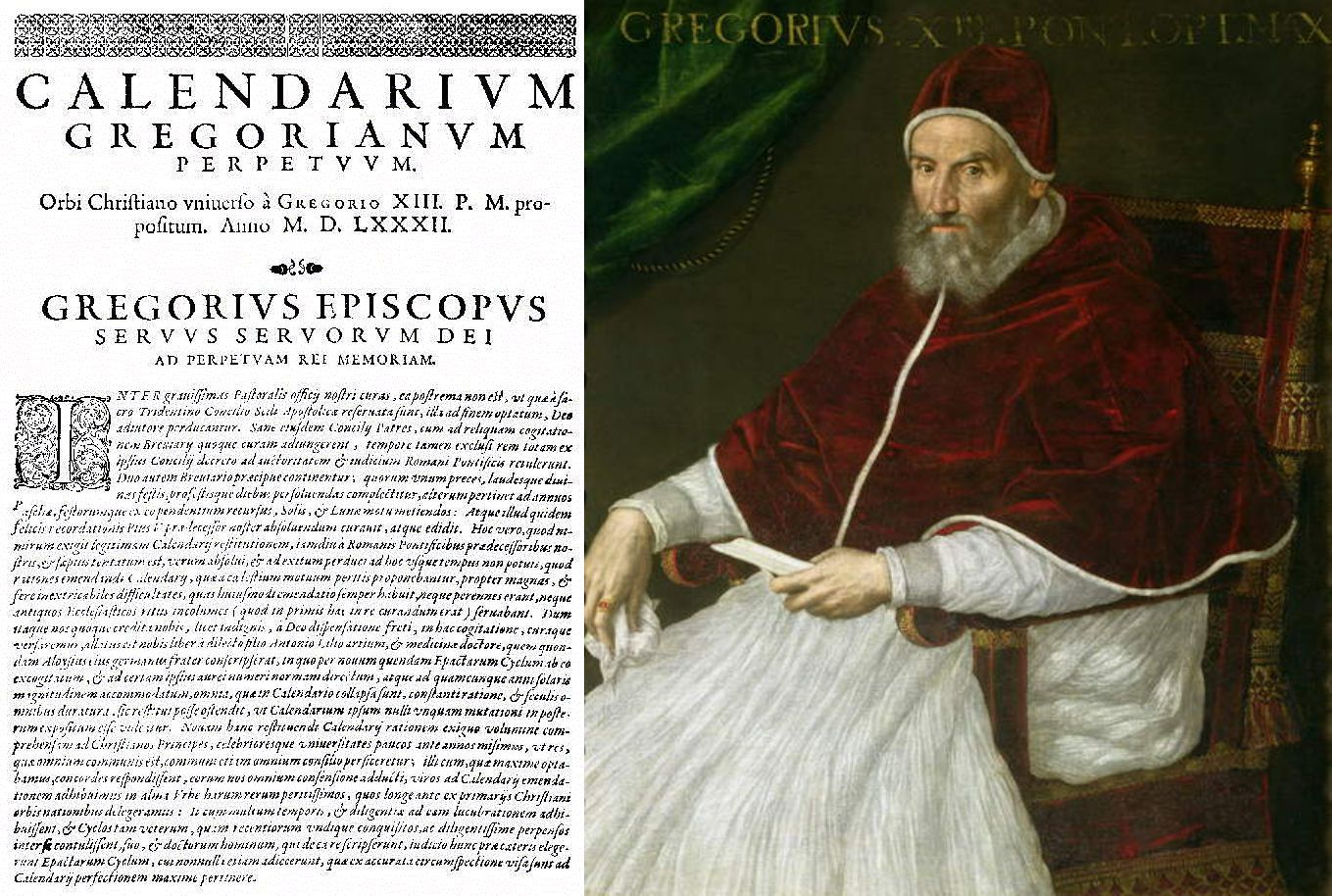
In 1582, Pope Gregory XIII issued a papal bull authorizing the adoption of the Gregorian, or New Style, calendar to correct the drift that had accumulated in the Julian calendar. The main goal was to ensure that Easter was celebrated at the correct astronomical time each spring. To make up for the days that had been added over the millennia, ten days were skipped the first year. In the countries that switched first, October 4 was followed by October 15, so October had twenty-one days that year.
The Roman Catholic states of Europe—Spain, Portugal, France, Poland-Lithuania, and most of the Italian principalities—adopted the Gregorian calendar within a few years of 1582. By the mid-1850s, they were operating smoothly under the New Style calendar. But the Protestant states of Europe, including England and Scotland, were not anxious to accede to a Roman Catholic directive. While many had adopted the new calendar by the early eighteenth century, England, Scotland, and Sweden remained out of sync with the rest of Europe until the middle of the century.
England Holds Out (1582–1752)
England’s Protestant governing establishment was loath to follow a papal directive, so England and its colonies continued to use the Julian calendar. By 1701, English dates ran eleven days behind those of countries that had already adopted the Gregorian calendar. From January 1 through March 24, England’s year number was also one behind most of Europe’s because England kept March 25 as the legal start of the year. In common practice, however, the English celebrated New Year’s Day on January 1. The holdout ended in 1752, when the British Parliament’s Calendar Act of 1750 took effect ( 24 Geo. 2. c. 23). The Calendar Act required that Great Britain (formed by the 1707 union of England and Scotland), and its dominions and colonies worldwide, adopt the Gregorian calendar. (The union of England and Scotland rested on two parallel statutes: the English Union with Scotland Act 1706 (6 Ann. c. 11) and the Scottish Union with England Act 1707 (c. 7).)
This 170-year transition period left a web of confusing dates in English (later British) records, though the extent of the confusion likely varied by place. This article focuses on colonial New England. There, official recorders seem to have been bound by the legal calendar, while others, such as the authors of gravestone inscriptions, were free to choose. Whether people elsewhere in the British world were more disciplined about sticking to the Old Style is a separate question, one this article doesn’t attempt to answer.
Examples of Old Style and New Style Dates from Colonial Rhode Island Records
The Shawomet Deed: Out-of-Sequence Records
The dating of the original deed for Shawomet is an example of the use of the Old Style year and the confusion this has caused. The actual deed is dated January 12, 1642. But records for related events—such as John Greene Sr.’s deed for the land around Occupessatuxet Cove, dated October 1, 1642—show that those events actually took place before the Shawomet Purchase, even though, on paper, they appear to have happened after it (Ely, 1887, 37-38). Without awareness of the transition from the Old Style to the New Style calendar, how would one make sense of that?
In this case, William D. Ely, in his 1887 Report on the Settlement of Warwick, 1642: and the Seal of the R. I. Historical Society, sorted the out-of-sequence dates for us. Using correspondence and writings from the time, he showed that the authors of the Shawomet deed, quite properly, used the Old Style in dating it, and that the modern calendar date is 1643. That finding clarified the whole sequence of dates related to Warwick’s founding (Ely, 1887, 37-38).
Early Tefft Family Records: Double Dating or a Single Date
By the 1670s, two people recording two aspects of closely related historical events—the birth of Peter Tefft and the death of his mother, Sara—took two different approaches to the same dating problem. The recorder of Warwick births hedged, using an elegant colonial solution called double dating: he noted that Peter Tefft, son of Joshua and Sara Tefft, was born on March 14, 1671/2, providing both the Old and the New Style year (Town of Warwick n.d., A1:15).
The author of Sara Tefft’s gravestone inscription made no such hedge. He gave a single date for her interment: March 16, 1672. On its own, the stone offers no clue as to which style that year reflects. But the birth record helps narrow the possibilities. It gives Peter’s New Style birth year as 1672. If the gravestone’s “1672” is also New Style, Sara was buried within days of giving birth. If it is Old Style, her burial falls in the New Style year 1673, a year after Peter’s birth. Because women of this period often died during or within days of giving birth, the reading as 1672 is by far the more probable one, though without further corroboration it is not an absolute certainty.
When the Evidence Runs Out
Peter Tefft’s recorder did future researchers a favor by including both the Old Style and New Style years. Not every recorder did. When a colonial record from New England dated between January 1 and March 24 in any year before 1752 is not double dated, and no other event or record clarifies its date, we cannot know for certain whether its year is Old Style or New Style. In that case, the best approach is to acknowledge the uncertainty and wait. Archives have a way of surrendering their secrets eventually, and the next record may settle what this one can’t.
Bibliography
Anthony, A. Craig. 1998. The Tefft Family & the Narragansett Controversy: A Window to the Creation of Rhode Island & Providence Plantations. Self-published. Held at the South County History Center. Finding aid updated June 27, 2022: www.southcountyhistorycenter.org. https://static1.squarespace.com/static/56f4318d906340eeb78ccce9/t/62b9e3d92968c45a5cec773f/1656349657615/TefftGenealogy_FindingAid_06272022.pdf. Not available online.
Connecticut State Library. Last updated August 20, 2026. “The 1752 Calendar Change.” Colonial Records and Topics. Accessed October 17, 2022. https://libguides.ctstatelibrary.org/hg/colonialreasearch/calendar.
Ely, William D., and John A. Howland. 1887. “Report on the Settlement of Warwick, 1642: and the Seal of the R. I. Historical Society.” Proceedings of the Rhode Island Historical Society. Providence: J.A. & R. A Reid. Accessed January 22, 2022. https://catalog.hathitrust.org/Record/009590927.
Landrigan, Leslie. 2014. “In Colonial New England, the New Year Started on March 25.” New England Historical Society. Published January 1, 2014; updated 2025. Accessed October 25, 2026. https://newenglandhistoricalsociety.com/colonial-new-england-new-year-started-march-25/.
Town of Warwick. Town Clerk’s Office. n.d. Record of Marriages—Warwick 1649, Manuscript Volume A1: 15. Rhode Island Historical Society, Providence, Rhode Island.