

Goodrich-Baker Family Overview

Margaret Jean Goodrich (“Jean,” 1916–2008), was the mother of William Wallace Watson III (Tifft), and Margaret Jean Tifft, and the adoptive mother of Elizabeth Ann Tifft and Beatrice Mary Tifft. Jean was born at St. Barnabas Hospital in Minneapolis, Minnesota, on September 16, 1916. She was the only child of Arthur William Goodrich (“Art,” 1883–1973) and Cora Lee Baker Goodrich (1883–1972). Jean was married twice, first to William Wallace Watson II (“Bill,” 1911–1944), a naval intelligence officer who died in a plane crash in China during World War II, and then to Cyril Richardson Tifft (“Cy,” 1906–2002), a widowed physician and surgeon to whom she was married for nearly fifty-five years.
Jean, as she was called from birth, was raised in North Minneapolis, in a small but comfortable home surrounded by lawns and trees. Her father, Art, was a master printer who earned a solid income for the family. Her mother, Cora, was a thrifty housewife who never let anything go to waste. Between them they managed to create a comfortable, secure home in which to raise their beloved only child, Jean. Though Art had only been able to stay in school through the eighth grade, he earned his high school degree in night school. He was brilliant, especially when it came to words, and continued throughout his life to read and learn. Cora earned a high school degree and was sharp as a tack in more ways than one. I adored both of them. Cora worked for a number of years before her marriage. She too was incredibly smart. Art and Cora valued education above all. There was never any question in Jean’s mind as she grew up, that she had any choice other than to earn a college degree, which she did at age twenty from the University of Minnesota, Phi Beta Kappa and magna cum laude.
I want to express my deep gratitude to my Goodrich second cousins, Susan Scown, Jackie Fergestad, and Jeanie Cormier Scown, and my Baker second cousin Tom Baker and his son, Mike, for their invaluable assistance in researching the Baker and Young families, and for pointing me in the direction of resources that I hadn’t known existed.
Now, let us meet Jean’s ancestors.

Sections
- The Goodrich-Wardwell Family
- The Fesenfeld-Fenn Family
- The Baker-Blackburn Family
- The Young-Flynn Family
The Goodrich-Wardwell Family
At least four Goodridge/Goodrich families settled in New England during the Great Migration of 1630 to 1640. During that period an estimated 20,000 people emigrated from England to New England. Most arrived in Boston and spread out across New England. There seems to be little disagreement among the several “definitive” sources of the history and genealogy of the Goodrich family as to who the founding fathers of the Goodrich/Goodridge families were:
- Richard Goodrich settled in Guilford, Connecticut.
- John Goodrich settled in Wethersfield, Connecticut. His ancestry is “fully established … [and] was the ancestor of nearly all of the name in America” but not ours! (Lafayette Wallace Case, M.D. ed, The Goodrich Family in America, Chicago, Fergus Printing Company, 1889, 19.)
- William Goodrich, John’s brother, settled in Wethersfield Connecticut.
- William Goodridge (in some sources it is spelled Goodrich, Gutteridge, or Guttridge) settled in Watertown, Massachusetts, in 1637. A second John Goodrich (or Goodridge) also settled in Watertown, Massachusetts, in 1637. He is thought to have been the brother of William Goodridge of Watertown. He became a freeman there in 1642, but “is said to have died on the return voyage to England in 1644” and has no known descendants.
All sources agree that William Goodridge of Watertown is the patriarch of our family. He and his wife Margaret were the seventh great-grandparents of my mother, Jean Goodrich, making her a member of the tenth generation of Goodriches in America, and my brother and me, and our second cousins, the eleventh.
William and Margaret Goodridge of Watertown—The First Generation
William Goodridge of Watertown, our ancestor, is believed to have been born in the vicinity of Bury St. Edmunds, England, though no record has been found to definitively document his birth there. Bury St. Edmunds is a market and cathedral town in Suffolk County close to the east coast of England. One of William Goodridge’s biographers, genealogist Merton Taylor Goodrich (1887–1979), developed a much more refined story of our patriarch than had earlier genealogists. In his essay “Whence Came William Goodrich of Watertown,” which may be an excerpt from his unpublished manuscript entitled A Goodrich Family Tree: The American Ancestors of My Children in an American Ancestor Album 1905–1932, Mr. Goodrich rather convincingly presents marriage and baptismal records from another Suffolk town, Wolverstone, “some distance east of Bury St. Edmunds” that would appear to match our William Goodridge, his wife Margaret, and young daughter Mary. These records, discovered in the Wolverstone Parish Register, are for the marriage of a William Goodrich and Margaret Butterfield on August 19, 1631; a baptism record for a son, also William, on October 4, 1632, and a burial record for young William dated April 30, 1633; and a baptismal record for “Maire” (Mary) William and Margaret’s daughter, dated August 21, 1634. After the baptismal record for Mary, “There is no other parish record that clearly refers to a Goodrich. … This indicates that William Goodrich came to Wolverstone from some other parish before his marriage, and that the family left shortly after 21 August 1634.” Merton Taylor Goodrich is certain that these records are for the same William Goodridge, his wife Margaret, and their daughter Mary who settled in Watertown in late 1636 or early 1637. He also notes that in Watertown the family was first called some variant of Gutterridge, which soon became Goodridge, the variation that was used for the next six or seven generations.
Watertown was one of the first four Massachusetts Bay settlements, and the first inland farming town. There William and Margaret Goodridge settled, having been allotted three acres of land (one acre for each “head”—either person or cattle) on February 28, 1637. He was admitted as a freeman in 1642; in the same year, the inventory of his property included not only his original “homestall,” but close to 120 acres scattered around the area, including one large parcel in the “uplands” of Watertown. (Again, according to Merton Goodrich, from whom I have also drawn the facts outlined below.)
In addition to Mary, who was born in England, the Goodridges had three sons, all born in Watertown: Jeremiah in 1638; Joseph in 1639; and Benjamin in 1642. In 1645, just eight or nine years after the family had settled in Watertown, William died, leaving a fair amount of land and household goods to his wife, Margaret. Nevertheless, in May 1645, Margaret indentured her middle son (why not her eldest?), apprenticing him for his “care and maintenance.” In the indenture document, Margaret is referred to as William’s widow, indicating he’d probably died earlier that year. One has to wonder why she needed to take such a step with such a young child when she had both land and household goods to support herself and her children. The fact that Margaret signed the apprenticeship agreement, as well as her own will and other documents, with her “marke” indicates that she was illiterate.
In 1650, Margaret married John Hull of Newbury, Massachusetts, and moved to his home with her children. There is no indication whether Joseph was with the family at that point, though, like his brothers, he did settle in Newbury as an adult. John Hull died in 1670. Margaret outlived him by twelve years, dying in 1682. Nine months before her death she had written a will—a somewhat unusual act for a woman of the time—in which she made very specific bequests of her personal property and her livestock. No land was mentioned in her will or in the inventory taken after her death. In her will, dated August 4, 1681, she bequeathed her possessions to her four children and several grandchildren very unequally. Her daughter Mary and several granddaughters received her clothing, including her “best red petticoat.” Her eldest son Jeremiah received forty shillings, and her second son Joseph received five shillings. (She certainly seems not to have liked him much!) A grandson received a feather bed and bedding, and “a new pewter chamber pot.” After her funeral expenses were paid, the bulk of her estate—valued at about £50 with debts of about £15—went to the executor, her youngest son Benjamin. By way of explanation for this unequal distribution of the estate, Benjamin is credited with having taken care of his mother in her old age. (Edwin Alonzo Goodridge, A.M., M.D., The Goodridge Genealogy, [privately printed, New York 1918], 74-76. Reprint available from Amazon and Google Books). It is unclear where the proceeds of the sale of her land in Watertown went when she married John Hull—perhaps to Hull. It is also unclear who had inherited John Hull’s home and other real estate when he died. He may have had children by an earlier marriage who inherited everything except Margaret’s personal belongings.

In 1885 Benjamin Goodridge, William and Margaret’s youngest son, moved to Rowley, Massachusetts. He was killed along with his wife and at least two children at their home in Rowley in an Indian raid on October 23, 1692. One or two other children were taken by the attackers. (Though Benjamin was not a direct ancestor, this story is well-known in the family and will be the subject of a future post.)
Joseph and Martha Moores Goodridge—The Confusing Second Generation
There are conflicting records of who fathered our third-generation ancestor, Philip Goodridge, a grandson of William and Margaret Goodridge of Watertown. The most widely known and respected genealogy of the family, the aforementioned Goodrich Family in America by Lafayette Wallace Case, identifies Philip’s parents as Jeremiah and Mary Adams Goodridge (Case, 356-357). The Goodrich Family Association accepts Case’s assertion that Jeremiah and Mary Adams Goodridge were Philip Goodridge’s parents, as does the History of the Town of Lydeborough, New Hampshire 1735–1905, published in 1906 by the Lyndeborough town history committee (page 749).
Edwin Alonzo Goodridge, contrary to other sources, identifies Philip’s parents as the second son of William and Margaret Goodridge, Joseph Goodridge and his wife, Martha Moores. But then, a few generations later, Goodridge changes the parentage of Philip’s descendants to Jeremiah and Mary Adams Goodridge. In some Find a Grave records, Philip’s middle name is recorded as Moores, supporting the assertion that he was the son of Joseph and Martha Moores Goodridge. However, none of the family trees reporting the middle name “Moores” provides a transcription of the tombstone, so one has to question the validity of the claim.
I have found a record of Philip’s birth on 13 November, 1669, to Joseph Goodridge in the Massachusetts, Town Vital Collections, 1620-1988 record for Philip Goodridge, which I take to be definitive. While this is not a critical point in the story of our Goodrich ancestry, if anyone can offer a more definitive record of Philip’s parentage it would be most welcome.
Joseph and Martha Moores Goodridge were Jean Goodrich’s sixth great-grandparents.
Philip and Mehitable Woodman Goodridge—The Third Generation
In the third generation, it is certain that our ancestor is Philip Goodridge (1669–1729). He was born in Newbury, Massachusetts, in November 1669, and in 1700, he married Mehitable Woodman (1677–1755) who was also a native of Newbury. Philip and Mehitable Woodman Goodridge had twelve children in Newbury, after which they moved to Lunenburg (now Fitchburg), Massachusetts, where they are said to have built the third house in town in 1724. Philip was one of the founders of the Congregational church in Lunenburg and a deacon there until his death on January 16, 1729, only five years after his arrival. He is believed to have been the first person buried in Lunenburg. Edwin Alonzo Goodridge in his closing remarks about Philip and Mehitable Goodridge provides an exaggerated description of the shared character of all of our ancestors, saying:
He and his wife [Philip and Mehitable] hold a commanding place as the progenitors of one of the best strains to be found in the family. In all the records their descendants are everywhere found actuated by lofty ideals, representing attainment, character and a high sense of moral and civic responsibility. (Goodridge, 85-86)
Whew! That’s quite a burden for their descendants to carry! Because of his over-the-top rhetoric, as well as his sometimes sloppy scholarship, I take Edwin Alonzo Goodridge’s genealogy with a grain of salt, though it is the most thorough inventory of our specific branch of the Goodrich family ancestors that I’ve found.
Philip and Mehitable Woodman Goodridge were Jean Goodrich’s fifth great-grandparents.
Benjamin and Sarah Phelps Goodridge—The Fourth Generation
The eldest of Philip and Mehitable Woodman Goodrich’s children was Benjamin (1701–1773). He was born in Newbury, Massachusetts, in 1701 and moved to Lunenburg with his family in 1724. He is believed to have served as a company commander in the French and Indian War (1754–1763). In 1730 he married Sarah Phelps (1700–1776) of Lancaster, Massachusetts, with whom he had nine children (History of Lyndeborough, 749) Their sixth child was Sewall Goodridge, who was born in Lunenburg in 1747. Benjamin and Sarah Phelps Goodridge were Jean Goodrich’s fourth great-grandparents.
Sewall and Phebe Putnam Goodridge—The Fifth Generation
Sewall Goodridge (1747–1809) graduated from Harvard College in 1764. In September 1768 he was ordained as a Congregational minister and a few months later, in February 1769, he married Phebe Putnam (1752–1832) who was born in Danvers (formerly Salem Village), Massachusetts. She was seventeen, and he was twenty-two when they married. Phebe Putnam was the daughter of cousins Archelaus Putnam and Mehitable Putnam. She was also the cousin of General Israel Putnam who distinguished himself in the Revolutionary War. The Putnam family is thought to have emigrated from England to Salem Village between 1627 and 1634. By the time the Goodridge and Putnam families joined forces, the Putnams were an old and distinguished Massachusetts family.
It appears that Sewall answered the “call” from the town of Lyndeborough, New Hampshire, to become its minister even before he was ordained, and that he began his ministry in Lyndeborough immediately after his ordination. The records of the town of Lyndeborough indicate that the negotiations with the Reverend Goodridge were fierce. After several rounds of increasingly attractive offers, the town and the Reverend arrived at a salary of forty pounds sterling per year until there were seventy families in Lyndeborough, then his salary would be raised to forty-five pounds per year until there were one hundred families, and finally to fifty pounds after the town reached one hundred families. This was a modest starting salary, equivalent to $11,300 today. But Sewall also received a grant of two hundred acres of land which he was allowed to choose himself. He was presumably expected to be a farmer as well as a preacher. Furthermore, he served for many years as the town clerk, and “probably wrote and witnessed more deeds than any other man in town since his day”—a likely way to make more money. As young as he was when he became the minister at Lyndeborough, he quickly became a big fish in a little pond (History of Lyndeborough, 750)
Sewall Goodridge served as the minister of the Congregational Church of Lyndeborough for forty-one years, until his death on March 14, 1809, at age sixty-one. His send-off was impressive. When his death was announced at the town meeting, “the meeting voted unanimously to assist the bereaved family at the funeral, to invite all the ministers of the vicinity to attend, and to provide for their entertainment and to pay all funeral charges. … Among those charges was a bill for ten gallons of genuine West India rum. That was the custom of the day.” Phebe Putnam Goodridge outlived her husband by about twenty-three years, dying in 1832, at the age of seventy-nine. (History of Lyndeborough, 749–750)
Sewall and Phebe Putnam Goodridge had twelve children. Their eldest son Benjamin was born on July 9, 1773, in Lyndeborough. They were Jean Goodrich’s third great-grandparents.
Benjamin and Sarah Clark Goodrich—The Sixth Generation
Benjamin Goodrich (1773–1842) was born and raised in Lyndeborough and lived there his whole life. He served as a selectman, and was a deacon in his father’s church for over thirty years. In his adult years he was referred to as “Deacon Benjamin Goodrich”—in other words, the man who kept the church functioning while the preacher preached. He married Sarah Clark (1778–1873) in 1802. It was probably in this generation that the family changed the spelling of its surname to “Goodrich.” (History of Lyndeborough, 748, 751) Benjamin and Sarah Clark Goodrich are Jean Goodrich’s second great-grandparents.
Benjamin and Sarah Clark Goodrich had eight children, the sixth of whom, Benjamin, was born on March 27, 1814. Benjamin and Sarah Clark Goodrich were Jean Goodrich’s second great-grandparents.
Benjamin and Irene Wardwell Goodrich—The Seventh Generation
Benjamin Goodrich (1814–1857) married Irene Wardwell (1823–1870) in Penobscot, Maine, on June 20, 1843. Irene was born on June 24, 1823, in Penobscot. Benjamin and Irene Wardwell Goodrich were Jean Goodrich’s great-grandparents.
Benjamin Goodrich died on November 27, 1857 of an unknown cause. During their thirteen-and-a-half-year marriage, Benjamin and Irene Wardwell Goodrich had six children. The eldest, Sarah Clark Goodrich, was thirteen when her father died, and the youngest, Benjamin Asbury Goodrich, was six weeks old. Lorenzo Benjamin Goodrich (1854–1939), Jean Goodrich’s paternal grandfather, was three when his father died.
After her husband’s untimely death at age forty-two, Irene Wardwell Goodrich took her six young children to live in Lawrence, Massachusetts, a textile milling town. In the U.S. Census for 1860, Irene, age thirty-seven, is erroneously listed as Jane W. Goodrich but the children living with her are Benjamin and Irene Wardwell Goodrich’s six children, so we can be certain that this is Irene Goodrich Wardwell’s family.
It does not appear that Irene was receiving any help from her family, or that she had inherited much of anything when her husband died. The census record placing the family in Lawrence in 1860 lists her occupation as “House Keeper.” Every other adult woman on the page was listed as “House Keeper” as well, so the term most likely implies that Irene was keeping house for her own family, but it could possibly mean that she was working for someone else as a housekeeper. Her eldest daughter Sarah’s occupation was listed as “Operative,” indicating that she was already working in some capacity—probably as a textile mill worker—outside of her home at the age of fifteen. The census record also indicates that the Goodrich family was living in the same house as another family named Haynes. There is no apparent familial relationship, but Irene could have been working for the family in some capacity in exchange for housing. It is puzzling that Irene would have taken her family to Lawrence rather than staying in Lyndeborough, where she had a farm and her husband’s extended family to support her, or moving closer to her own family in Penobscot, Maine—Lawrence is 220 miles from Penobscot—unless she moved for a job. But the census, as yet the only record for the family when they lived in Lawrence, doesn’t provide any clues as to what drew her to Lawrence.
By 1870, Irene and five of her six children had moved to Bucksport, Maine, according to the 1870 census. Bucksport is about seventeen miles from Penobscot, Irene’s birthplace. Irene’s eldest son, Stephen Wardwell Goodrich, had served in the Civil War, and in 1870, was no longer living with his mother. By this time, Irene was listed in the census as an “invalid.” Her eldest daughter, Sarah, age twenty-five, was keeping house—presumably the Goodrich house. Her next daughter Frances Irene (known as Fannie), age twenty-one, was a schoolteacher. Son Arthur, age sixteen, was a clerk in the post office. Lorenzo, Jean Goodrich’s grandfather, age fifteen, was a farm laborer. The youngest child, Benjamin, age twelve, was listed “at home,” but was presumably still in school.
Many records indicate that Irene died on July 7, 1870, but this census, dated July 23, 1870, says otherwise, unless the census was taken earlier than the date stated on the page. Irene probably did die sometime in 1870, leaving her children as orphans. Only the oldest two were adults. No grave or official record of her death has been found, leaving us to guess at her true date of death.
Benjamin and Irene Wardwell Goodrich were Jean Goodrich’s great-grandparents.
Irene Wardwell’s Family
Irene was in the seventh generation of Wardwells in New England. Her father Stephen Wardwell (1795–1851) was a minister in Penobscot, Maine. Her mother Mercy Hutchins Wardwell (1800–1892) was the daughter of the long-established Hutchins family. Irene came from a well-respected family, but it hadn’t always been so. The Wardwell name had been besmirched by Irene’s third great-grandfather, Samuel Wardwell (1643–1692) of Andover, Massachusetts. He was a carpenter by trade, with a penchant for telling fortunes and dabbling in “folk magic.” Samuel was a widower with a son by his first wife. His second wife, Sarah Hooper Hawkes (1650–1711), was a wealthy widow with a daughter from her first marriage to Adam Hawkes. Samuel and Sarah Hooper Hawkes Wardwell married in 1673 and had six more children together—and they were both convicted of witchcraft in 1692 in Salem.
Accusations of witchcraft had started in Salem during the winter of 1692, and by that summer they had spread to Andover, about eighteen miles from Salem. In August Samuel Wardwell was arrested for witchcraft along with his wife, his stepdaughter, twenty-two year old Sarah Hawkes, and a daughter from his second marriage, Mercy Wardwell, age nineteen. All of them offered “stunning confessions.” Samuel recanted his confession during his trial, but he was found guilty and hung with seven others just a week before the hangings were halted by the Governor. The two daughters were acquitted in a later trial, but Sarah Hooper Wardwell, who had also been found guilty, still remained in jail awaiting execution in February. Again, the Governor came to the rescue, issuing reprieves for the remaining condemned, including Sarah.
Another strange twist in this story is the link that the marriage of Sarah Hooper Hawkes to Samuel Wardwell provides between our mother’s family, the Goodriches, and our father’s family, the Tiffts. Sarah Hooper Hawkes Wardwell—the convicted witch and Jean Goodrich’s sixth great-grandmother on the Wardwell side of her family—was almost certainly the half-sister of John Hooper (1670–?), Cyril Richardson Tifft’s fifth great-grandfather on the Tifft side of his family. My mother would have thought that this connection was hilarious, but I’m not sure how my father would have reacted to being related, no matter how remotely, to a convicted witch—guilty or not.
(Samuel Wardwell and Sarah Hooper Hawke Wardwell’s story, as well as the probable relationship between Sarah and John Hooper, will be the subject of a future post.)
Lorenzo and Mathilda Fesenfeld Goodrich—The Eighth Generation
Lorenzo Benjamin Goodrich, Jean Goodrich’s paternal grandfather, was born in Lyndeborough, New Hampshire, on November 10, 1854. As noted above, after his father Benjamin Goodrich died when he was three, Lorenzo’s mother, Irene Wardwell Goodrich, left Lyndeborough, and took her children first to Lawrence, Massachusetts, and later to Bucksport Maine. By the time he was fifteen, Lorenzo’s mother Irene Wardwell Goodrich was an invalid, and Lorenzo was working as a farm laborer to help support his family. After Irene’s death in 1870, the family stayed together for a few years, but then began to scatter.
In about 1878, Lorenzo left Maine and made his way to California. There he met Mathilde (later Anglicized to Mathilda) Henriette Elizabeth Fesenfeld (1863–1953), a young woman nine years his junior, who had been born in Australia and immigrated to the United states with her family as a child. They married on June 3, 1880, when William was twenty-five and Mathilda was sixteen. (See the Fesenfeld-Fenn Family section below)
After their marriage, Lorenzo and Mathilda Fesenfeld Goodrich settled in San Dimas, originally known as Mud Springs, twenty-eight miles east of downtown Los Angeles. Now considered a suburb of Los Angeles, San Dimas didn’t even exist in the early 1880s. When the Goodrich family moved there it was an unincorporated cattle, horse, and farming area. The late 1880s marked the start of the citrus boom, and in 1887, the Santa Fe railroad built a stop there. Lorenzo and Mathilda had their first three children—Sarah (1881–1955), Arthur (1883–1973), and Norman (1885–1955)—while living in the San Dimas area.
In 1887, just as the boom started and San Dimas was established, Lorenzo moved his family to Perris in San Bernardino County, where they settled on a “dry ranch,”—a ranch without surface water or irrigation. Their fourth child, Elinor (1890–1964), was probably born in Perris, though her birthplace is listed in some family records as San Jacinto, which is twenty miles from Perris. Lorenzo went broke in about 1893, trying to farm in Perris and moved the family to Riverside, where Norman, by then close to eight, started school. It is possible that none of the children had gone to a formal school before then. The family’s movements from 1880 to 1896, are somewhat confusing. In letters, notes, birth records, and informal histories written by various family members, the towns of San Dimas, Perris, San Jacinto, Pomona, and Riverside are mentioned. What is clear is that the family moved fairly frequently, and that Lorenzo was not particularly successful at anything he worked at while living in California.

By 1896, the family was on the move again. This time, though, they gave up on California and moved across the country to Pinehurst, North Carolina, a resort community that was just getting started. Men would have been needed to build the new town and run the businesses required to support one of the first purpose-built luxury resort communities in the country. I’m guessing that Lorenzo saw a newspaper ad for workers to build Pinehurst and to staff its many enterprises and decided that Pinehurst might offer good opportunities in comparison to farming in California. According to his second son, Norman, in Pinehurst Lorenzo “ran a dairy farm and nursery for propagating ornamental shrubbery for the town” (Norman Goodrich, Letter to daughter June, February 23, 1941). In Pinehurst, Lorenzo and Mathilda had their fifth child, William (1896–1918). Unfortunately for our grandfather, Arthur Goodrich, by then thirteen, there was no school for him to attend in Pinehurst. Instead, he became an apprentice printer. Whether this choice of occupation was his idea or his father’s, he must have enjoyed it: he was a master printer until his retirement in 1953.
In late 1899, Lorenzo and Mathilda Goodrich, with their five children in tow, arrived in Minneapolis.They may have moved to Minneapolis at the urging of Lorenzo’s older sister, Fannie (Irene Francis Goodrich Pond, 1850–1927), who had long been settled there. Her husband Samuel Pond Jr. was the son of Samuel William Pond, who, along with his brother Gideon Pond, had established the first mission to the Sioux in Minnesota in 1834. By 1899, when Lorenzo and his family moved to Minneapolis, the Ponds were a well-established family—having been among the first non-Indigenous people to settle in the area. (This interesting Minnesota family will be discussed in a future post.)

Once they’d arrived in Minneapolis, the Goodrich family chose to live in North Minneapolis, moving several times in the first few years. In 1903 they settled into a home at 1217 Fremont Avenue North. Whether the Goodriches rented or owned this home is unknown. Lorenzo became a salesman for Dean and Company, a supplier of agricultural equipment. It seems as though the Goodrich family, with both Lorenzo and his eldest son Arthur working at steady jobs, became financially stable for the first time. One by one the children left home as they grew to adulthood. But then, in 1918, a great tragedy befell the family, when William, the Goodrich’s youngest son, was killed in France in August 1918 apparently at the Battle of Amiens near the end of World War I. For some time his status was “missing in action,” but the U.S. military finally declared him dead and set his death date as August 1, 1918. I don’t believe his death date is actually known, as the Battle of Amiens, which took place at the beginning of the Hundred Days Offensive that ended World War I, did not begin until August 8, 1918. Apparently William’s remains were never identified. William’s death is memorialized at the Aisne-Marne American Cemetery in Beleau, France on the Tablets of the Missing, according to the U.S. Headstone and Internment Records for U.S. Military Cemeteries on Foreign Soil, 1942-1949. Mathilda became a Gold Star Mother, and was able to visit France to see his memorial.

At the time of William’s death, newspaper articles had Lorenzo and Mathilda Goodrich living on Dupont Avenue North still near Art and Cora. Sometime soon thereafter they moved to Monterey Park, California where they are listed in the U.S. Census of 1920. Lorenzo died there on June 11, 1939. It is apparent from photos, that in 1946 shortly after the end of World War II, the four living Goodrich offspring and their spouses gathered in California with Mathilda. Mathilda died in Los Angeles on September 6. 1953.

According to stories told to one of my Goodrich second cousins and me by our mothers, the grandchildren of Lorenzo and Mathida Goodrich, Mathilda neither approved of or liked her daughters-in-law. Both Jeanette Bailey Goodrich, Norman’s wife, and Cora Baker Goodrich, Art’s wife, talked about Mathilda’s harsh treatment of them. I don’t think that Cora, in particular, minded that her in-laws moved to California when Jean was a toddler.
Arthur William and Cora Lee Baker Goodrich—The Ninth Generation
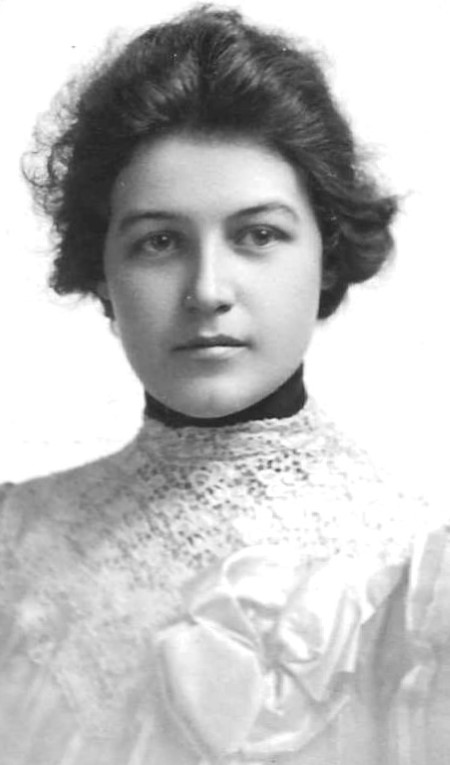
The Baker and Goodrich offspring were of similar ages, and would surely have met soon after the Goodriches arrived in North Minneapolis. The record is unclear exactly when Jean’s father Art and mother Cora began to court. It could have been as early as 1900, when they were both seventeen or eighteen (both were born in 1883) or as late as 1903, when the Goodrich family moved to their home on Fremont Avenue North, just three houses away from the Bakers.
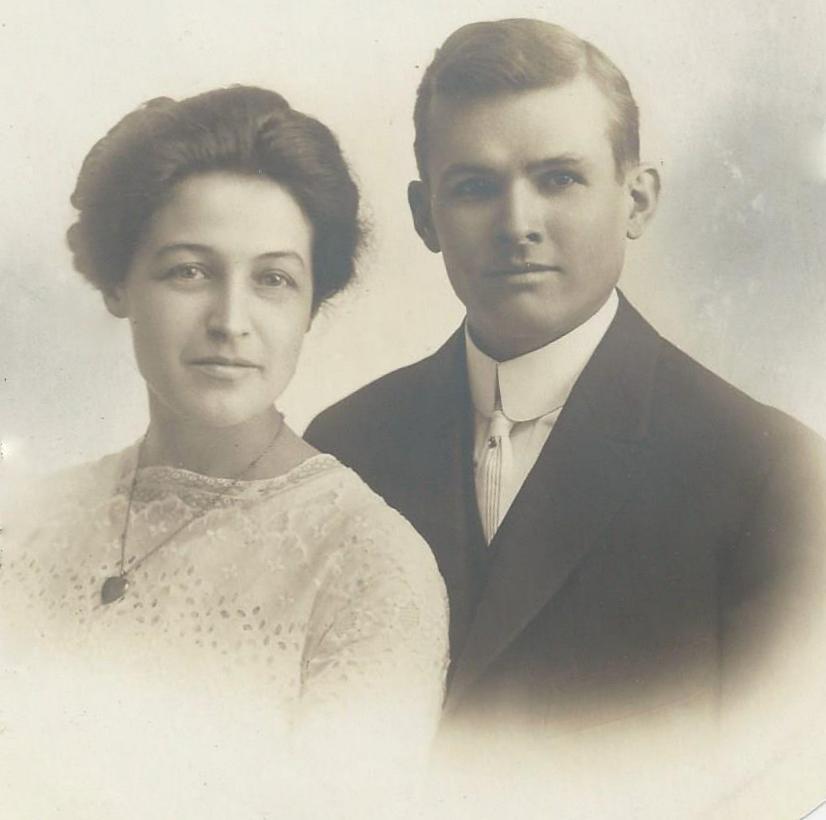
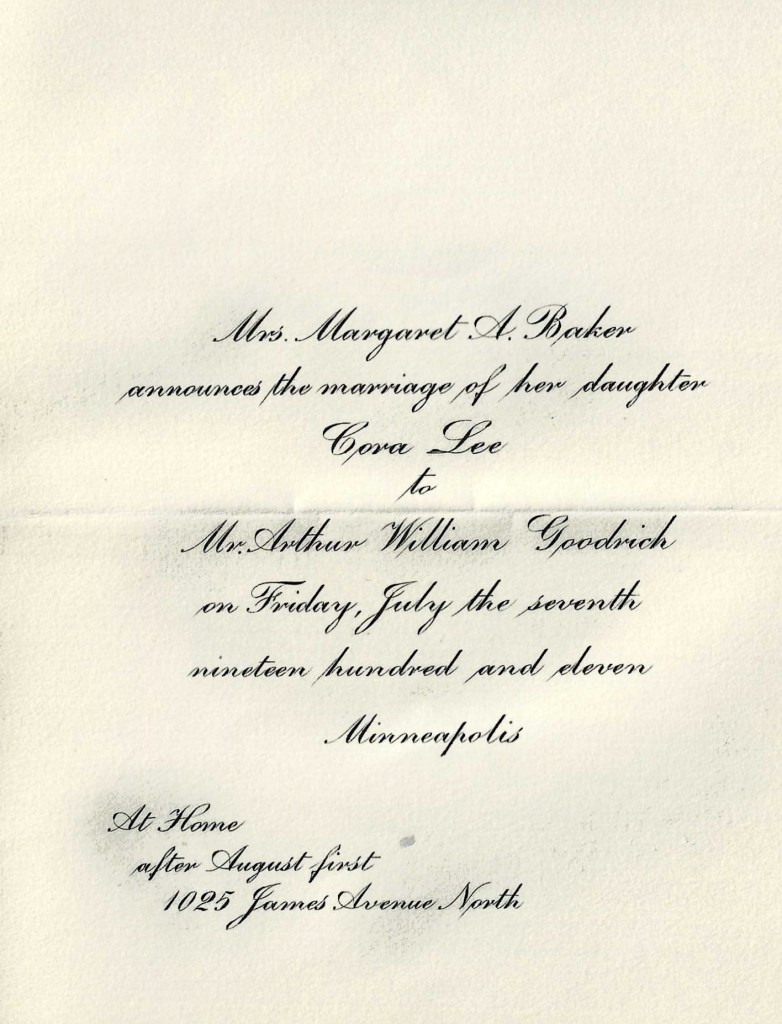
Art was a handsome eligible bachelor with a good job as a printer, and Cora, only a couple of months younger, was an attractive young woman who in January 1903, had finished high school and was employed in downtown Minneapolis as a clerk in a “transfer office” (probably a moving or shipping company). Instead of rushing, Cora and Art courted for at least eight years before they were married. It is my understanding that their sole purpose in waiting so long to get married was to save money for their future together. Throughout their courtship, Art and Cora continued to live at home, almost surely paying their parents for some of their living expenses but saving most of their salaries. They were married on July 7, 1911 by the Bakers’ Congregational minister at Cora’s home.
From various documents, including their wedding announcement and their marriage license, it seems that Art must have rented an apartment shortly before he and Cora were married. It was located at 1025 James Avenue North, about half a mile from their respective family homes on Fremont Avenue North. By September 1916, they had moved to another rented home, probably another apartment, at 1411 18th Avenue North, a distance of about seven tenths of a mile from their family homes. This is the home to which they brought their first and only child, our mother, Jean Goodrich (1916–2008), after her hospital birth on September 16, 1916. Jean was the tenth generation of the Goodrich family in America.
The Fesenfeld-Fenn Family
William Fesenfeld and Sara Fenn—The First Generation
Jean Goodrich represents the fourth generation of the Fesenfeld-Fenn family in the United States. Her great-grandparents, Johan Frederick Wilhelm Fesenfeld (1836–1907), in the United States known as William, and Sarah Johanna Fenn (1837–1916), met as immigrants in Australia. Wilhelm was born in Oldenburg, Lower Saxony in northwestern Germany and immigrated to Melbourne, Victoria, Australia, in about 1857.

Sarah Fenn was born on April 12, 1837, in Margate, Kent County, England, and migrated to Australia when she was twenty-one. Her arrival in Hobart, Tasmania, Australia, was recorded as August 18, 1858, aboard the ship Constance. Her occupation was listed as “housemaid.” According to a newspaper announcement on August 21, 1858, three days after she had arrived at Hobart on the south side of the island of Tasmania, she was “hourly expected to arrive” at Launceston a whaling port and market town for agricultural products, on the north side of Tasmania where she, along with other young women, would be “ready for hire” at the immigration depot.
According to Sarah’s Australian immigration record, her passage from England to Tasmania was sponsored by the Family Colonialization Society, also known as the Family Coloniz(s)ation Loan Society, established in 1849, by Caroline Chisolm (1808–1877), the revered English humanitarian of Victorian Australia. The Society’s mission was to encourage immigration to Australia by offering economic incentives to English youth. It did so by providing half the cost of the immigrant’s fare as a loan. The Society would also help the new immigrant find suitable employment in Australia. After living there for two years, the Society’s agent would collect the repayment of the loan. So, in Sarah’s case, once she was employed in late August 1858, presumably as some sort of domestic worker in Launceston, she would work for about two years, repay her loan of half the cost of her passage, and thereafter be free to seek her own fortune.
There is no record indicating exactly when, where, or how Sarah Fenn and Wilhelm Fesenfeld met, but they were married on July 24, 1861, at St. John’s Church in Melbourne, less than a year after Sarah had finished her two-year period of service. It seems reasonable that Sarah might have moved to Melbourne, Victoria, on the south coast of mainland Australia if she had not already met a man to marry in Launceston—marriage being the only real option for a single woman in Australia at the time.
After they were married, Sarah and Wilhelm settled in St. Arnaud, where Wilhelm was a tinsmith. St. Arnaud is about a hundred miles from Melbourne, and in 1861, when the Fesenfelds settled there, it was a gold mining town. In St. Arnaud, Wilhelm and Sarah had five of their seven children, including Jean Goodrich’s paternal grandmother Mathilde. She was their second child and was born on November 2, 1863, and baptized on November 29, 1863, at Christ Church (Anglican Church of Australia) in St. Arnaud.
According to family records, Wilhelm was found to be insolvent in July 1868. The family left Australia soon thereafter. According to a story told by his great-granddaughter, Jean Goodrich, Wilhelm decided to try his luck back in Germany, but when the family got there, Germany was preparing yet again to go to war. He saw soldiers marching in the streets and decided that Germany was not the place to be, so the family came to the United States. This family story is supported by historical events. In the late 1860s Northern Germany was in a period of political unrest, and the stability of the new North German Confederation was threatened by both internal and external forces. Another war was a distinct possibility and northern Germany was preparing for it.
In late June or early July of 1871, Wilhelm, Sarah and five children—four daughters and one son, all born in Australia—left Bremen, a major port and the largest city in Lower Saxony, and sailed aboard the S.S. Baltimore for the United States. According to the ship’s manifest, they arrived in Baltimore on July 10, 1871. They traveled in steerage, and indicated that their destination was Ohio.
As yet, no records of the Fesenfelds in the United States between 1871 and 1880 have turned up, though Wilhelm is believed to have been naturalized at Anaheim, California, between 1874 and 1878. They had two more daughters after arriving in the United States, one born in 1873 and the other in 1877.


Around 1880 the Fesenfelds and their younger children moved to the state of Washington, where they lived until their deaths—William in 1907 and Sarah in 1916. The Fesenfelds’ life in the United States needs further research.
Lorenzo and Mathilda Fesenfeld Goodrich—The Second Generation
Jean Goodrich’s paternal grandmother, Mathilda Fesenfeld was the second generation of the Fesenfeld-Fenn family in the United States. She married Lorenzo Goodrich on June 3, 1880, in Los Angeles. We have no idea how they met. Jean’s father, Arthur (“Art”) William Goodrich, their second child and eldest son, was born on August 25, 1883, in San Dimas, California.
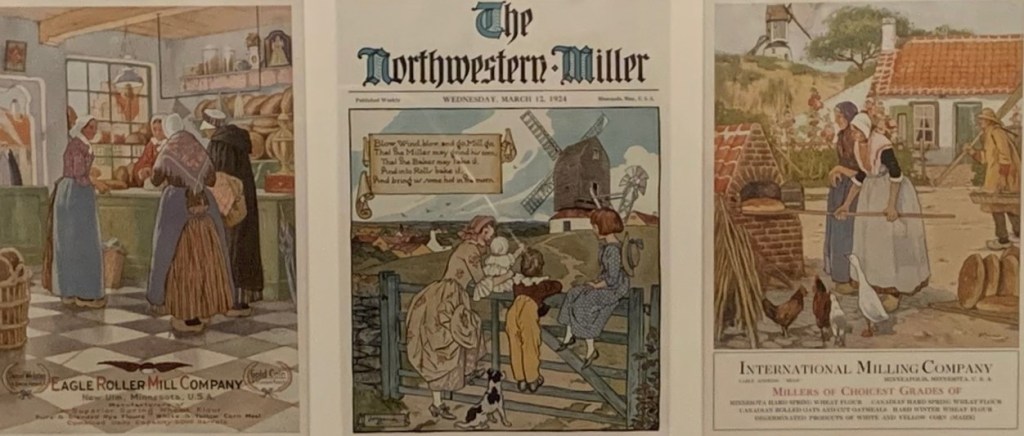
After his family moved to Pinehurst, North Carolina, Art became an apprentice printer. When the family moved to North Minneapolis in 1899, he got a job almost immediately at the Miller Publishing Company, where as a young man he became a master printer, responsible for printing the Northwestern Miller, a trade publication for the milling industry and the company’s flagship publication, noteworthy because of its beautifully illustrated covers. We are fortunate to still have a selection of these covers, lovingly saved for us by Grandpa Art. Art stayed at Miller Publishing until his retirement in 1953. He was a union member and an occasional socialist, having proudly voted for the socialist candidate for President of the United States, Eugene V. Debs, in his run against Woodrow Wilson in 1912.
Arthur William and Cora Lee Baker Goodrich—The Third Generation
Art met Cora Lee Baker (1883–1972) in North Minneapolis. As mentioned above, after an extended courtship during which they both lived at home and worked to save money for their life together, they were married on July 7, 1911. Their only child, our mother, Jean Goodrich, was born on September 16, 1916, in Minneapolis.
The Baker-Blackburn Family
Jean Goodrich’s mother, Cora Lee Baker (1883–1972), was a descendant of one of several Baker families that arrived in New England during the mid-1600s to early 1700s. On her mother’s side, Jean represents the eighth generation of her particular line, descended from Tryal Baker and Elizabeth Tibbetts Baker of Canterbury, Connecticut.

At least five or six Baker families arrived in New England during the Great Migration from England to New England during the period 1630 to 1640. We, unfortunately, can trace our family’s origin back to none of them. The definitive but privately published and distributed genealogy of our Baker family, Some Descendants of Tryal Baker, 1685–1776, A Narrative of a Pioneer Family, was compiled by Ray Jerome Baker—our grandmother Cora Lee Baker Goodrich’s first cousin and a well-known twentieth-century photographer. Ray Baker indicates that the first Baker ancestor to whom we can reliably trace our lineage is Tryal Baker. Baker does not mention the record on which he bases this assertion. This is a problem throughout Ray Baker’s genealogy: it is not clear where he got his information, though in those cases where we have found primary records (birth, death, marriage, census, and other “official” records), the facts Ray Baker presents seem quite accurate. Despite its obvious shortcomings, Baker’s genealogy is the best compilation of information for this family that I’ve located to date. Unfortunately, Ray Baker’s genealogy, privately printed in the late 1940s or early 1950s and distributed only to family members, does not appear to be available to the public in libraries or archives, online or otherwise. Unless otherwise noted, it can be assumed that the details presented here regarding the Baker family genealogy come from Ray Baker’s family history.
Tryal and Elizabeth Tibbetts Baker—The First Generation
Tryal Baker (~1685–1776) first appeared in records when he arrived in Canterbury, Connecticut, in 1712. Ray Baker attributes the lack of records of Tryal Baker’s family of origin to “the unfortunate burning of early records.” Whether this was a fact or a guess on Ray Baker’s part is unknown. Whatever the cause of the dearth of evidence, we really don’t know if Tryal was the son or grandson of immigrants, or an immigrant himself. There is certainly nothing that, to my knowledge, anyone has found convincingly linking him to any of the several Baker families that arrived in New England in the 1600s. Despite the lack of evidence, Ray Baker believes that Tryal was born in about 1685, and implies that he was born in New England. Tryal and Elizabeth Tibbetts Baker were Jean Goodrich’s fifth great-grandparents.
Six years after his arrival in Canterbury, on December 24, 1718, Tryal Baker married Elizabeth Tibbetts, for whom we have no birth or death dates, although we know she was the daughter of Benjamin Tibbetts of Canterbury. They had seven children. Tryal, according to land records, frequently bought and sold land, and may have made his living doing so. Tryal joined the church in 1745. Tryal’s will was dated January 15, 1766. He died on October 12, 1776. In his will, he gave all of his apparently extensive real estate holdings to one of his daughters.
Tryal and Elizabeth had one son, Elijah, who is thought to have been born in Canterbury in 1725, but was not baptized until September 3, 1727. Elijah Baker was Jean Goodrich’s fourth great-grandfather.
Elijah and Lois Rood Baker—The Second Generation
Elijah Baker (1725–1811), son of Tryal and Elizabeth Tibbets Baker, married Lois Rood, daughter of Ebenezer Rood, on September 3, 1750, and settled in Canterbury. They had six children, three daughters and three sons, all born and baptized in Canterbury. In 1780 Elijah and his three sons moved to Pawlet, Vermont. What drew them there in the middle of the Revolutionary War is unknown though Elijah is said to have served “all the way through the Revolutionary War.” It is not clear whether Lois Baker and her three daughters moved with the men to Vermont, or stayed in Canterbury. Elijah died in Pawlet in 1811. Pawlet, a flour milling center, played an interesting role in supplying the Continental Army, so the Baker men perhaps saw a financial advantage in moving there. Elijah and Lois Rood Baker were Jean Goodrich’s fourth great-grandparents.
Rufus and Sybel (no last name) Baker—The Third Generation
Rufus Baker (1751–1838), Elijah and Lois Rood Baker’s eldest son, was born in 1751, in Canterbury, Connecticut. He served in the 3rd Connecticut Regiment under Colonel Israel Putnam—cousin of Phebe Putnam Goodrich, Sewall Goodrich’s wife. After moving to Pawlet, Vermont, with his father and brothers in 1780, Rufus continued to serve in Vermont units of the Continental Army. He married Sybel or Sibel (no last name). They had twelve children.
Ray Baker states that “It is believed that Rufus and his family, already consisting of four children, removed to Canton, New York” in the spring of 1782. There, Baker continues, Rufus was probably a farmer and Rufus and his wife had eight more children. Rufus Baker died in Portage, New York, on September 4, 1838. Rufus and Sybel Baker were Jean Goodrich’s third great-grandparents.
I am suspicious Ray Baker’s assertion that the Bakers moved to upstate New York before 1799. Canton, located on a tributary of the St. Lawrence River about twenty-five miles from the Canadian border, was not settled until 1805, and it was carved out of another town, Lisbon, that was established only a few years earlier in 1799 when the first non-Indigenous inhabitants arrived in the area.
By some accounts, the town is named after Lisbon, the capital of Portugal. However, the 1810 US Census for the town shows the town’s name as Lisburn, which is a city located in Northern Ireland adjacent to the capital of Belfast. Belfast was the birthplace of Alexander Macomb, the prosperous New York City merchant of Loyalist sympathies. Earlier in 1791, he purchased much of Northern New York along the St. Lawrence River and Lake Ontario, which the state had released for public sale after cession of the land by the Iroquois. With partners, Macomb sold the land for development. The Town of Lisbon is in the northern part of the county and is northwest of Canton. …The first European-American settler arrived around 1799. [Emphasis mine] Many migrants arrived in the area from New England and were eager to buy land. Macomb and his partners believed that upstate New York was strategic for prosperous development, as they were depending on the growing trade with Canada across the St. Lawrence River and Lake Ontario. (https://en.wikipedia.org/wiki/Lisbon,_New_York)
Rufus (Jr.) and Cynthia Dewey Baker—The Fourth Generation
According to Ray Baker, Rufus Baker Jr. (1784–1870), a son of Rufus Baker Sr. and his wife Sybel, was born in Canton, New York, in 1784 even though it seems highly unlikely that Rufus and Sybel Baker were there sixteen years earlier than the first recorded non-Indigenous inhabitants. Rufus Baker Jr. married Cynthia Dewey (1790–1871) in 1808, in Vermont. Cynthia was born on July 6, 1790, probably in Dorset, Vermont. Given the timing of the settlement of Canton, I think it is more probable than not that Rufus Baker Jr. and his wife, Vermonter, Cynthia Dewey Baker, were the Bakers who moved to Canton, New York. Little is known of their early married life. The Bakers had seven children, five daughters and two sons, all apparently born in Canton. Rufus and Cynthia Dewey Baker were Jean Goodrich’s second great-grandparents.
Rufus and Cynthia Dewey Baker moved their family of seven children from Canton, New York, to Darlington, Ontario, a distance of about two hundred miles. The year of their move is unknown, but Rufus Baker bought land in Darlington in 1834, so it is probably safe to assume that their move took place around 1834. Ray Baker speculates that they traveled on a barge towed by a lake steamer on the St. Lawrence River, and then on Lake Ontario to get to Darlington.
Little is known about the family’s life in Darlington. Ray Baker speculates that the men and boys were engaged in the lumber business, possibly cutting and shaping timbers for the shipbuilding industry, or cutting and milling lumber for construction and corduroy roads. He also suggests that they would have grown their own food—pigs, chickens, wheat, corn, and apples. He states with certainty that a corner of the Baker property was set aside for a school house where the Baker children received a basic education. “The school house on the Baker homestead was well known for years afterward, and long after the Bakers had departed from the district, it continued to be known as the Baker School house. It was so known in 1948.”
Less than twenty years after settling in Darlington, Rufus Baker Jr. and his wife Cynthia Dewey Baker were on the move again. In the late 1840s, they left several married children and their families in Darlington and traveled back to the United States, settling in Rockton, in Winnebago County, Illinois, on the Illinois-Wisconsin border. By the late 1840s, Rockton was a thriving farming and manufacturing community.
It seems that Rufus and Cynthia Baker followed their daughter Jane, born December 4, 1821, and her husband Charles L. R. Manning to Rockton. Charles L.R. Manning was born in Canada in 1821, and came to Rockton in 1848. Charles Manning was a harness maker for his entire career. He was also a justice of the peace for several years, and was a member of the village board and the school director. The Mannings were members of the Methodist church, and were highly respected in Rockton. He died in Rockton, April 8, 1891. She died in Rockford, August 11, 1896.
The source of the above information about the Mannings is a bit strange. It is a website called Genealogy Trails and contains snippets of information about many of the early settlers of Rockton, along with lists of officials, members of various organizations, men’s names sorted by their occupations, including soldiers, and those associated with churches, schools, and businesses. Sources and dates are rarely indicated. Jane Baker Manning and her husband Charles are frequently mentioned. In these listings, Rufus Baker, Jane Baker Manning’s father, is also mentioned as a “dealer in real estate and [loaner of] money. He built the brick house now owned [no year indicated] by the Methodist church as a parsonage.”
Rufus Baker Jr. and his wife Cynthia Dewey Baker lived long lives. Rufus died on May 24, 1870, at the age of eighty-six, and Cynthia died at age eighty-one on January 17, 1871, both in Rockton. Their daughter Jane Baker Manning had the job of caring for her parents in their old age at their home in Rockton and inherited the home after her parents’ deaths.
Jerome and Rachel Blackburn Baker—The Fifth Generation
One of the children Rufus and Cynthia Baker left behind in Darlington, Ontario, was their adult son, Jerome, born April 21, 1817, probably in Canton, New York. Jerome had married Rachel Blackburn (1820–1856) in the fall of 1939, probably at her family home in Clarke Township, Newcastle, Ontario, a few miles from Darlington. Rachel was born in Barnstable Parish, Yorkshire, England, in about 1820. According to Ray Baker, five of Jerome and Rachel Blackburn Baker’s seven children were born in Darlington, including Elijah, Jean’s grandfather, who was born on July 16, 1842. Elijah was the eldest of three sons. There is little information about the family in Darlington, other than that Jerome was a farmer. Jerome and Rachel Blackburn Baker were Jean Goodrich’s great-grandparents.
Once Rufus and Cynthia Baker, Jerome’s parents, had settled in Rockton, Illinois, in the late 1840s, they apparently encouraged their second son Jerome and his family to follow them. According to Ray Baker:
We know that Rufus [the father] had already settled near Rockton when Jerome arrived in the fall of 1850; that he was well enough pleased with his surroundings to urge his son to come, and that he had selected a farm which Jerome and his family occupied when they arrived. … In October of that year [1850] they left Canada with the team of Canadian ponies, a staunch wagon and such personal effects as they could conveniently bring with them.
Baker continues, describing the journey of Jerome and Rachel Baker and their young children, ages one to ten: “It is very probable that Jerome Baker took his family and belongings directly aboard the boat at Port Darlington, later known as Bowmanville, which was one of the many ports of call for the lake steamers.” He speculates that they would have gone through Lake Ontario, bypassed Niagara Falls via a canal into Lake Erie, portaged into Lake Huron where they boarded another steamer to take them through the Mackinac Straits into Lake Michigan, landing finally in Chicago. Family stories, told to Ray Baker by Jerome and Rachel Blackburn Baker’s surviving grandchildren in the 1930s and 1940s when Baker was doing his research, portrayed it as a rough trip, with several children becoming very seasick, and Rachel exhausting herself caring for them all.
After a brief rest in Chicago, the family continued overland with their ponies, wagon, and household goods along the Chicago-Galena stage route. Before departing, they had heard terrible stories about the clashes between white settlers and the local Indians, so they were relieved that they encountered no Indians out on the prairie. After fording the Rock River on a ferry, they headed north toward Rockton, stopping at Owens Center, now part of Rockton, at the farm that Rufus had selected for them: 160 acres of land—known as a quarter section—on which a small rustic cabin stood. It was wholly inadequate for the family of seven, but it was where they lived for their first winter.
By the next summer, Elijah, the eldest son, (and Jean Goodrich’s grandfather) was nine and began to help his father with the farm work, hauling produce to market and driving the team and plow. In Owens Center, Rachel bore two more daughters in the next five years. A little more than five years after the family’s arrival in Rockton, Rachel, worn down by homesteading and bearing seven children in less than seventeen years of marriage, succumbed to tuberculosis. She died on May 29, 1856, about nine months after her last child was born. Rachel’s death at age thirty-six was the turning point in the family. Jerome couldn’t keep up with the work, and Cynthia, the eldest daughter, couldn’t manage the home and children. Baker describes the sad situation:
With the hopes of keeping the home intact, after about another year [1857], Jerome re-married, choosing a widow with three children of her own. Instead of improving the situation, it became less harmonious. The older boys, Elijah and David, failed to fit into the new order of things and not long after the second marriage, war clouds having begun to appear, they enlisted in the Union Army.
Apparently the Army had set up training camps to prepare boys to enlist in the Union Army. Both Elijah and David were at Camp Grant in nearby Rockford for a time.
David Baker, Elijah’s younger brother and the middle son of the family, was born on May 16, 1844. He enlisted on November 20, 1861, when he was less than eighteen. He was wounded at the Battle of Shiloh in April 1862 and spent some time in a hospital. Starting at the beginning of 1863, David kept meticulous daily diaries of his years in the service. He served in many battles as well as at the siege of Vicksburg. David was mustered out on July 12, 1865, at Louisville, Kentucky.
Jerome Baker died of tuberculosis on May 17, 1862, leaving the farm and his younger children in the hands of his second wife, a woman whom Ray Baker, somewhat pointedly, fails to name. The younger children, left at home with Jerome’s widow, were farmed out to other families. The widow and her children continued to live on the Baker farm for some time.
Elijah enlisted shortly after his father’s death, on September 4, 1862, at age twenty. He served in many battles, but little is known of his years in the service. Before the Atlanta campaign in 1864, Elijah, always good with horses, became a supply train driver. He was in charge of a wagon pulled by a six-mule team. It was a dangerous job. Supply train drivers were easy targets for snipers, and their mortality rate was unusually high. Elijah was finally discharged at the end of the war at Nashville, Tennessee, on June 10, 1865, returning home unscathed at the age of almost twenty-three.
When Jerome’s estate was settled, his widow got the Baker family home and five acres of land. The rest was distributed equally among Jerome and Rachel’s children. Somehow, while Elijah and David were off in the Army, the youngest brother William, born in 1849, and not quite thirteen when his father died and not yet sixteen at the end of the war, had managed to gain control of the family farm. Ray Baker, William’s son, explains what happened this way:
Ultimately, the land was divided in two parts, William taking the part where the buildings [excluding the house apparently] stood and David taking the balance of the land. … Due restitution was made to the other heirs. The old home, however, with the five acres of land remained the property of the step-mother, and William paid her rent for the use of it as long as he lived there.
Ray Baker’s explanation of the division of the land makes sense as far as it goes, but the question remains: How did William, a boy at the time, get control of everyone else’s land and agree to split it with David, but leave Elijah, the eldest son completely out of the equation? According to Elijah’s daughter Cora, by the time Elijah returned from war—a few weeks ahead of David—William had bought all of the sisters’ shares of the land from them and proceeded to cut Elijah out entirely. As young as he was, it seems suspicious that William would have the money to compensate his sisters for their share of the land or could pull off this feat without someone’s help. It’s possible that William had already made an agreement with David before he left the Army to divide the land between them. In any case, William and David divided the land up, paid Elijah for his remaining share (one-seventh of 155 acres—roughly 22 acres—and no buildings) and Elijah left. It was always a source of bitterness in Elijah Baker’s family, but was blithely explained away by William’s son, Ray.
Elijah and Margaret Young Baker—The Sixth Generation
From this point on, we can rely on family records to piece together Elijah and Margaret Ann Young Baker’s life, and need not rely on Ray Baker’s account.
Only three months after he was mustered out of the service, on September 5, 1865, Elijah married his sweetheart, Margaret (Maggie) Ann Young. Elijah was twenty-three and Maggie was twenty-one. We can assume that they’d known each other for some time during the Civil War. It’s possible that they’d known each other as children in Ontario where the Bakers had lived in Darlington and and neighboring Bowmanville where Maggie Young’s family had lived. For the first few years of their marriage Elijah farmed in Rockton. There is some evidence that having lost any right to his family farm, he worked on the farm of his father-in-law, Samuel Young. Neither of the Young’s two sons had returned from the Civil War, and Samuel undoubtedly needed help.

While still living in Rockton, Elijah and Maggie’s first child, Mary Jane (1868–1967) was born in 1868, almost three years after Elijah and Maggie were married. Mary Jane was named after Maggie’s older sister who had died of tuberculosis at age nine. The family then moved to Shelbina, Missouri, where, according to Ray Baker, Elijah continued to farm. Their eldest son George (1871–1962) was born in Shelbina in 1871. From Shelbina, the family moved to Hannibal, Missouri.

In Hannibal, Elijah finally found his calling. He worked as a carpenter for the railroads, first the Missouri, Kansas & Texas Railway, and later at the Hannibal and St. Joseph Railroad. There they had their next four children, including Minnie May, who was born in 1874 and died at age two; another daughter, Alice (1878–1982) who was born in 1878 (and lived until she was 103!); their second son, Frank (1881–1958) who was born in 1881; and Cora Lee (1883–1972), who was born in 1883. The family lived in Hannibal for about fifteen years, then moved to Kansas City, Missouri, where their last two children were born. Their youngest son Fred, born in 1888, lived only about six months. Their last child Edna (1889–1978) was born in Kansas City in 1889. In Kansas City, Elijah ran a dairy for two years, and then returned to the railroad, working as a car builder for two more years. In 1890, the family finally settled permanently in North Minneapolis, Minnesota. Mary Jane, the eldest daughter, had married John Smades in Missouri in April 1890, and did not move to Minneapolis with her parents. Despite the fact that Maggie had five healthy children who lived full lives, she deeply mourned her lost babies, Minnie May and Fred, for the rest of her life.

In Minneapolis, Elijah, by then a respected railroad carpenter and mechanic, had no problem finding a job. He went to work for the Northern Pacific Railroad as a car repairman and became a union member. George, about nineteen when the family moved to Minneapolis, joined his father working on the railroad while the younger children—Frank, Alice, Cora, and Edna—went to school.
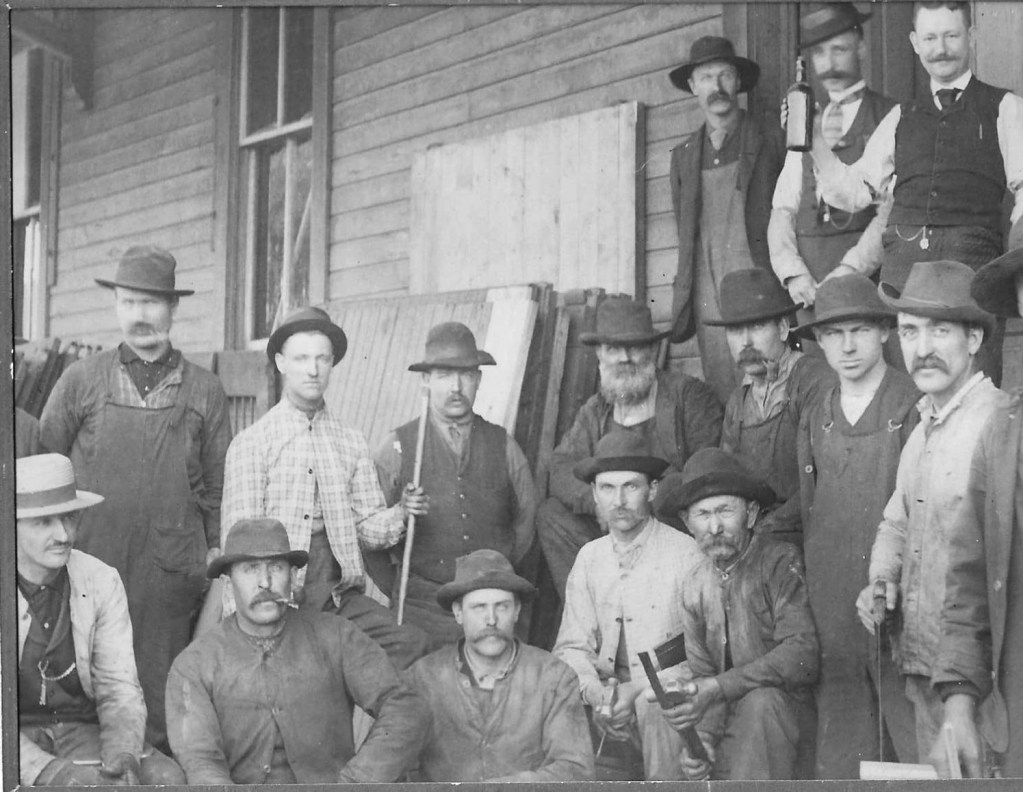
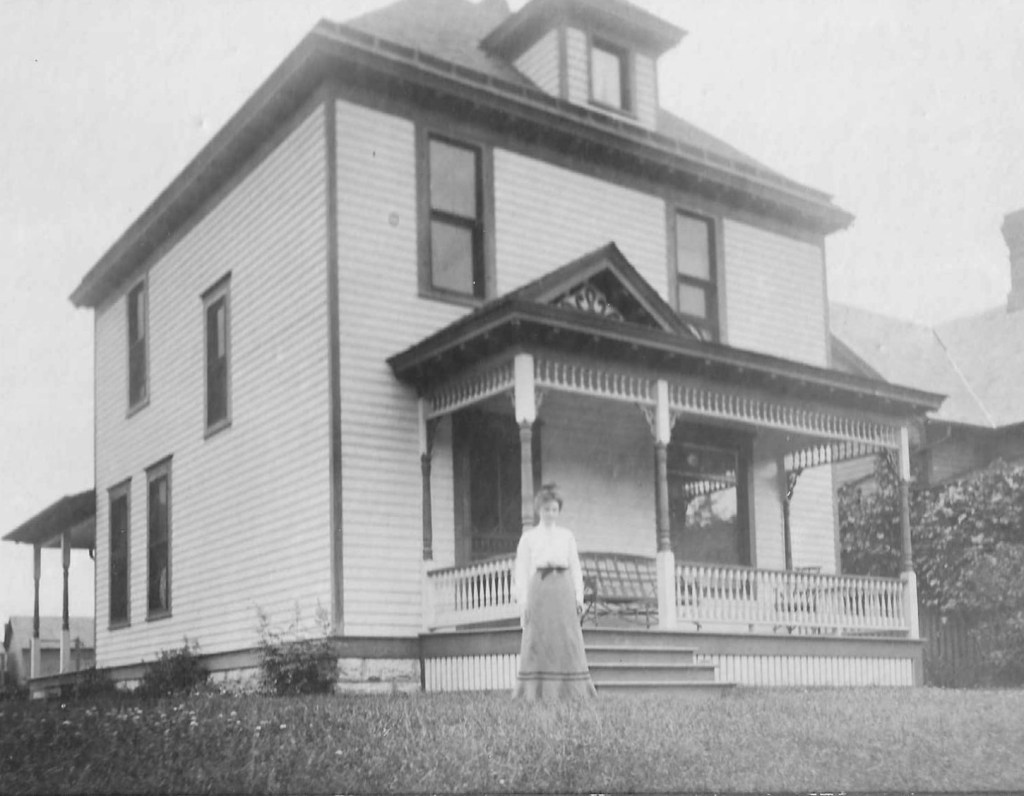
The Bakers seem to have done well during their first years in Minneapolis. They owned a large Victorian home and yard at 1211 Fremont Avenue North. Elijah is said to have always driven a handsome pair of horses, having been a horse lover since his youth. Maggie, an admirer of beautiful things, acquired a silver-plated butter dish and a china set containing twelve place settings and many elaborate serving pieces, which arrived in a barrel from Prussia. I can only imagine the Baker ladies’ excitement when that arrived!
Then, on June 19, 1897, disaster struck. Elijah, working alone repairing a car in the Northern Pacific yard, was underneath it when it was struck by another car. His legs were crushed and he bled to death almost immediately. George was working that day and was present when his father died. Frank, having turned sixteen the previous March, left school and joined his brother working for the railroad. Alice was almost nineteen, Cora was thirteen, and Edna was seven when their father died.
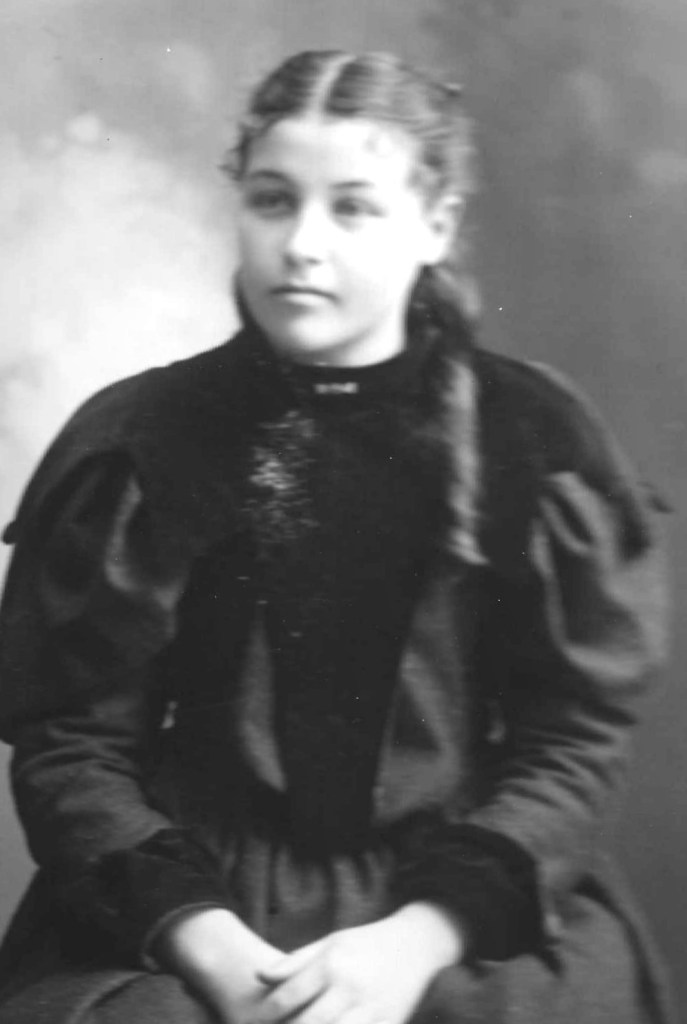
In addition to her sons’ pay, Maggie got both a railroad pension and a Civil War pension and, with those sources of income, somehow managed to support and raise her children. The three girls, Alice, Edna, and Cora, were able to stay in school and graduate from high school and Maggie was able to stay in her home until her death in 1938. Her son Frank never married and lived with his mother at least until her death and may have stayed in the family home for some period afterward.
Elijah and Maggie Baker’s daughter Cora Lee Baker, Jean Goodrich’s mother, was born on October 6, 1883, in Hannibal, Missouri. She was the fourth of the five Baker children who lived to adulthood.
Arthur William and Cora Lee Baker Goodrich—The Seventh Generation
As discussed earlier, Art Goodrich and Cora Baker met as teenagers or young adults sometime between 1900 and 1903 while living with their families in North Minneapolis. From snapshots, it is obvious that they had a large group of friends with whom they socialized. There are many summer snapshots of Cora, Art and their friends on Lake Minnetonka in Excelsior, at the end of the trolley line running west from downtown Minneapolis. Excelsior had public beaches and an amusement park, so it was a perfect place to go in the summer—an enjoyable day-trip that Cora mentioned more than once.
Cora and Art were no-nonsense, no-frills kind of people, as evidenced by their long courtship. They were married on July 7, 1911, at the Baker home. The minister from the Baker’s church, Pilgrim Congregational, performed the ceremony. Their first and only child, Jean Goodrich, a member of the eighth generation of the Tryal Baker family in America, was born on September 16, 1916, at St. Barnabas Hospital in Minneapolis.
The Young-Flynn Family
Samuel Young and Nancy Flynn—The First Generation
Samuel Young (~1808–1880) and Nancy Flynn (~1814–1878) met and were married in Canada. Their birth dates and their wedding date are unknown. However, their eldest child Hiram was born in about 1835 so they had likely been married before or during 1835. Unfortunately, we’ve found no records for the Young family in Canada, so we know little about Samuel and Nancy Flynn Young in their early years together. Their birth years are calculated from their records in the 1850 United States Census, according to which Samuel was forty-two, so his birth year has been estimated as 1808. The census record indicates that Nancy was thirty-six, so her birth year has been estimated as 1814. Their four children are believed to have been born in Bowmanville , Ontario, the inland town adjacent to Darlington. They were Hiram (~1835–1862); William G. (~1840–1864); Mary Jane (~1841–1850); and Margaret Ann (1844–1838), Jean Goodrich’s maternal grandmother, who was born on January 21, 1844.
The Youngs and Jerome and Rachel Blackburn Baker emigrated at about the same time to the same area, Rockton, Illinois, probably via approximately the same steamship and overland routes. Records of mid-nineteenth-century settlers in the Rockton area indicate that quite a few had been born in Canada. One has to wonder if there was a scheme to attract Canadians to settle on the prairies of Illinois.
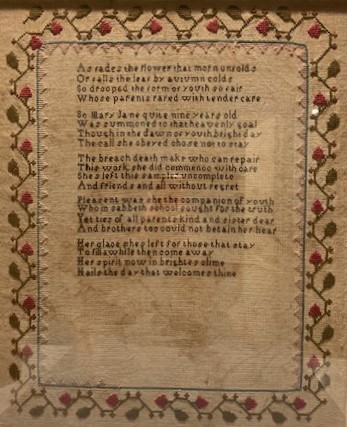
Aside from the approximate birth years of their children, there is only one story from the family’s time living in Bowmanville. Their third child and first daughter, Mary Jane, was born in 1841. By the time she was nine, she was seriously ill with tuberculosis. To occupy her time, she started working on a sampler but she wasn’t able to finish the bottom of the inner border before she died. The minister’s wife took up the sampler and told Mary Jane’s story in verse. It reads:
As fades the flower that morn unfolds
Or falls by the autumn colds
So drooped the form of youth so fair
Whose parents raised with tender care
So Mary Jane quite nine years old
Was summoned to that heavenly goal
Though in the dawn of youths bright day
The call she obeyed chose not to stay
The breach death make who can repair
This work she did commence with care
She’s left this sampler uncomplete
And friends and all without regret
Pleasant was she the companion of youth
Who in sabbath school sought for the truth
Yet ties of all parents kind and sister dear
And brothers too could not detain her here
And then she stopped, leaving space for two more stanzas. According to family lore, the minister’s wife, too, had succumbed to tuberculosis.
Sometime in 1850 shortly after Mary Jane’s death, the Young family emigrated from Ontario to Harrison, Illinois, about seven miles west of Rockton. The presence of Samuel and Nancy Flynn Young and their three surviving children in Harrison was recorded in the 1850 United States Census, taken on October 12, 1850. It was there that Samuel identified himself as a tailor, age forty-two and born in Canada, and Nancy identified herself as thirty-six and born in Ireland. The three surviving children—Hiram age sixteen, William age ten, and Margaret age six—were recorded as having been born in Canada.
When the 1860 Census was taken on August 14, 1860, the family had moved to the town of Rockton and Hiram was gone. Only William, by then twenty, and Maggie, recorded as fifteen though she was actually sixteen, were still at home. Samuel identified himself as a farmer, even though the family had moved to town.
The next we hear of Hiram is in Nebraska City, Nebraska, where he enlisted in the 1st Infantry Division of the United States Army on June 10, 1861, just two months after the declaration of war. We know nothing of his Civil War record other than that he died of disease at Memphis, Tennessee, on July 5, 1862.
The next child to leave home was William. He enlisted on August 1, 1861, at Rockford, Illinois, and served in the 44th Illinois Infantry Division. On January 1, 1864, he reenlisted for another three years. He was wounded on June 27, 1864, at the Battle of Kennesaw Mountain, a major battle of the Atlanta campaign. He was sent to an Army hospital in Chattanooga, Tennessee about 100 miles away, where he died on July 15, 1864, eighteen days later. The cause of death according to his Army record was “cerebral meningitis.”
So, by mid-July 1864, three of the Young’s four children were dead, leaving only Maggie to console her parents. It is possible that the family didn’t know at that point that William and Hiram were both dead. They did know, however, once the war ended in April 1865 and their boys didn’t come home, that something had happened to them. It may have been at that point that Samuel, Nancy, and Maggie consoled themselves with a story—one that Maggie told her granddaughter, Jean Goodrich, fifty or more years later—and that Jean repeated, believing it to be true. According to Jean, Maggie’s two brothers disappeared after the war, going off together to the California gold fields, never to be heard from again. This may have been a story the family made up to explain the disappearance of the two brothers because they’d never received formal notification that they had died; though from records of William’s service, it appears that Samuel was sent a notification of William’s death at least.
Nancy must have taken the loss of her three children hard. According to her death certificate, she died in Rockton on February 5, 1878, of cirrhosis, enlargement of the liver and spleen, and paralysis. In other words, she probably drank herself to death at approximately sixty-two. Nancy was buried in the Rockton Township Cemetery.
The last trace of Samuel is from 1880 when he applied to the U.S. government to receive pensions for the service of his two dead sons. Clearly, by 1880, Samuel knew they were dead, but perhaps he’d kept it from Nancy and Margaret because Nancy was so fragile. A snippet in a compilation of information about early Rockton settlers had this to say about Samuel:
Samuel Young, who came here from Canada, was a settler in the early fifties, if not before, and owned a part of the Blodgett farm. He sold out about twenty-five years ago and moved into town, buying the Robert Penman house on the south side of the river, where he lived till the death of his wife, Feb. 5, 1878. He then went to Shirland or Newark to live with some of his relatives, and died there. They had two sons in the war of the rebellion, William G. and Hiram. William died of his wounds while in service, July, 1864.
Unfortunately, this compilation does not identify the author or date of these bits of information, but overall, this appears to be accurate, and, at a minimum, it provides a confirmation that the Young family actually lived in Rockton, that the townspeople of Rockton knew what had happened to William Young, and that Samuel had left town after his wife died. We have not yet found a record of Samuel’s death.
Elijah and Margaret Ann Young Baker—The Second Generation
Elijah and Maggie Young Baker were married on September 5, 1865, in Rockton, shortly after Elijah was mustered out of the army at the end of the Civil War. Their five children, including Cora Lee Baker Goodrich, Jean Goodrich’s mother, represent the third generation of the Young family in America, and our mother Jean Goodrich represents the fourth.
Arthur William and Cora Lee Baker Goodrich—The Third Generation

My grandmother, Cora, adored her mother Maggie. Cora talked about her mother with admiration her entire life. Cora had much more formal education than Maggie, but I suspect that it was Maggie who instilled in Cora the wisdom and backbone that she always exhibited to her daughter Jean and her four grandchildren. And Maggie also taught Cora everything she needed to know to be a good housewife herself.
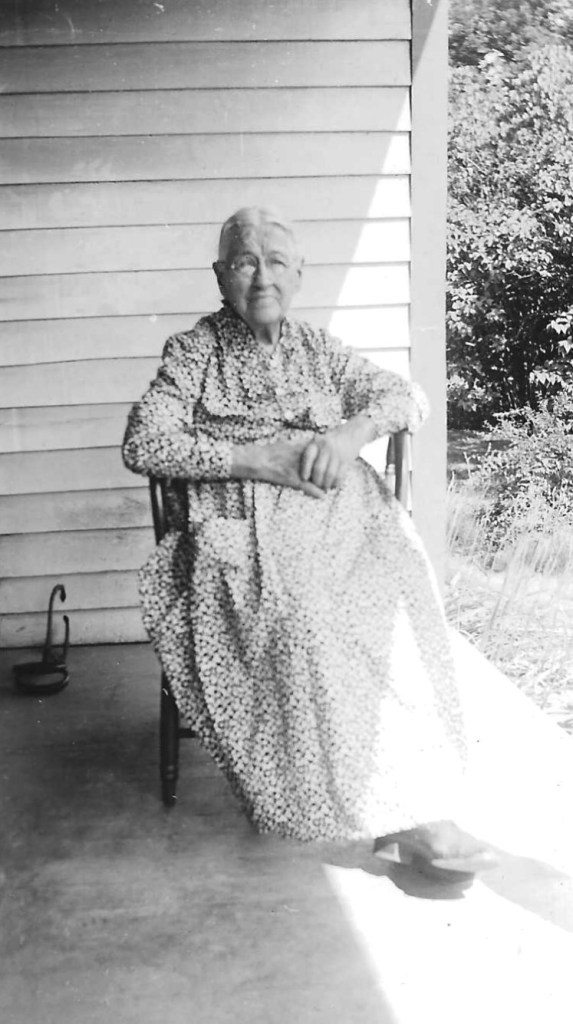
Until long after Maggie passed away in 1938, Cora and Art chose to live within walking distance of Maggie’s home in North Minneapolis, regularly taking walks on weekends and summer evenings with Jean to visit Maggie, often stopping at a nearby drugstore to pick-up ice cream to share with Maggie. In Jean’s telling, they would sit on the porch, Maggie in her favorite rocking chair, to eat it. Afterward Maggie would exclaim: “Oh, that cooled me right out!” Art was an engaged and doting son-in-law, so I can only assume that Maggie approved of him, and he of her.
When I was a teenager and starting to date, Cora told me something I’ll never forget. When I asked her why she chose Grandpa Art her reply was: “All the boys I’d known smelled of horse manure. Art didn’t.” Clearly it was love at first whiff! Leave it to Grandma Cora to take the romance out of her courtship. Nevertheless, they were compatible and happily married for almost sixty-one years, until Cora’s death on March 16, 1972 at the age of eighty-nine. Art lived a little more than a year after Cora passed away, dying on April 18, 1973, a few months shy of his ninetieth birthday.
Margaret Jean Goodrich—The Fourth Generation
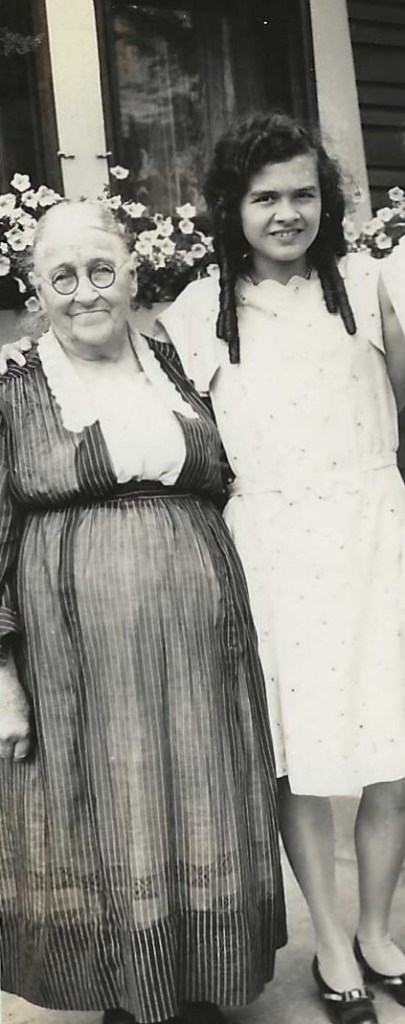
Jean’s widowed grandmother, Maggie Baker, was Jean’s favorite grandparent. Maggie lived to the ripe old age of nearly ninety-five, dying on December 14, 1938, when Jean was twenty-two. Jean lived her entire childhood within walking distance of Maggie’s home. Maggie told Jean wonderful stories of her own childhood—fascinating to Jean, even if some may not have been entirely accurate. And Jean, being a raconteur herself, remembered her grandmother’s stories, repeated them, and perhaps embellished them. What is certain and comes through clearly, is that Maggie was smart, shrewd, frugal, and loving. Clear, too, is that many of Maggie’s talents and character rubbed off on Cora, and a lot rubbed off on Jean too—most of them good, and a few not so good.
Visit our Ancestry.com family tree here.