
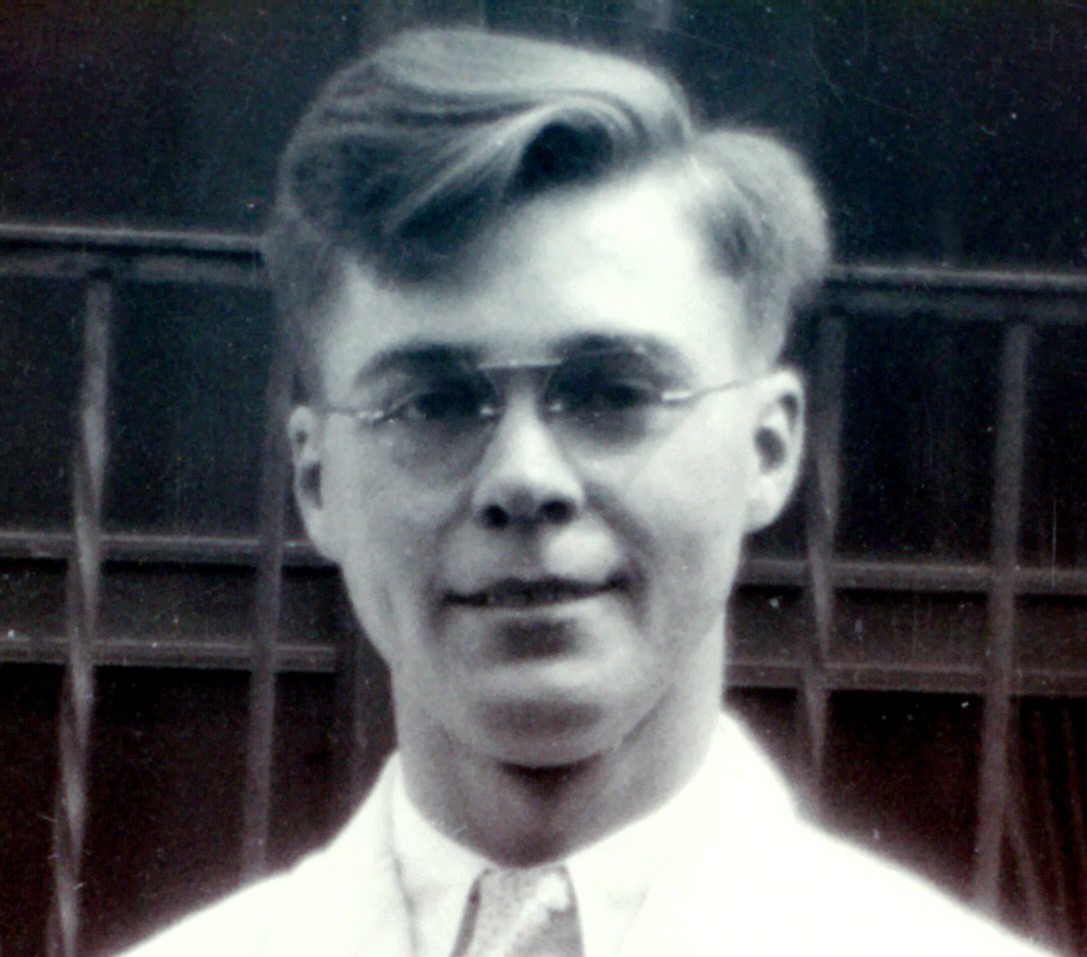
Tifft-Richardson Family Overview

Cyril Richardson Tifft (1906–2002) was the father of Elizabeth Ann Tifft, Beatrice Mary Tifft, and Margaret Jean Tifft, and the adoptive father of William Wallace Watson Tifft. Cyril was born at home in Glencoe, Minnesota on November 27, 1906. He was the youngest of four children born to his parents, Cyril M. Tifft (1865–1937)and Lillian Mae Richardson Tifft (1867–1955). Cyril and Lillian’s first child, a son, was stillborn in 1895. Their daughter, Lydia Lillian Tifft (Lillian) was born in 1897, and their elder son, Samuel Lowell Tifft (Lowell) was born in 1898.
“Little Cyril” as he was called, to distinguish him from his father, was born into a comfortably middle-class family. His father was a judge in Minnesota’s Eighth District, which covered south central Minnesota. His mother was a homemaker and a genteel, petite, sweet lady. She had been deaf in one ear since childhood. Because of her difficulty hearing, she did not finish high school. Instead, she studied painting, and became quite an accomplished artist. She passed her talent on to Cyril, Cyril’s daughter, Elizabeth, and at least one of his great-granddaughters. Cyril grew up surrounded by doting parents, siblings, and a vast network of aunts, uncles, and cousins, many of whom lived in Glencoe or in nearby Hutchinson and Bird Island. He was secure, well-loved, and well cared for.

With few exceptions, Cyril’s ancestors were from England, and arrived in the New England colonies in the mid- to late-1600s. In many branches of Cyril’s ancestry, my generation is ten or more generations removed from our original immigrant ancestor. It is the Tifft family and many of its branches that gives this website its name, Tengens: mine is at least the tenth generation of Tiffts to call the New England colonies and then the United States, home. Ancestry was such a source of pride in my father’s family that it is impossible to discuss him and his heritage without going back to the earliest ancestors who came to the New World in the colonial period or shortly after the founding of the United States.
I would be remiss if I didn’t note that we know a great deal about the history and genealogy of the Tifft Richardson family and its many branches thanks to the extraordinary research of my cousin (a first cousin once removed), Laurence Overmire. It is also through Overmire’s work that I discovered the work of Rhode Island historian A. Craig Anthony, who has done extensive research on the first four generations of the Tefft family in Rhode Island. When I started working on our family history, I contacted Anthony, and was able to buy a copy of his monograph, The Tefft Family & The Narragansett Controversy ~ A Window to the Creation of Rhode Island and Providence Plantations, which he had privately printed in 1998. Much of the factual material I present here about the first four generations of the Tefft family is drawn from Anthony’s monograph. (Subsequently, I tracked down and verified most of his sources and incorporated my own findings into this narrative as well, but the guidance Anthony’s work provided has been invaluable.) Anthony’s monograph is no longer publicly available, but a few years ago, he donated his papers, including the Tefft monograph, to the South County Historical Society in Narragansett, Rhode Island. (Note that the monograph is not available digitally.)
I want to express my deep gratitude to Laurence Overmire and A. Craig Anthony for their excellent and extensive research into our family, as well as to my sisters, Mary and Liz, and brother Bill, as well as cousins who have supplied photos, stories, and documents about the Tifft Richardson family over the years.
For more information, visit our Ancestry.com family tree here.
Now, let us meet Cyril’s ancestors.

Sections
- The Tifft-Knapp Family
- The Selts-Douglass family
- The Richardson-Rideout Family
- The Reed-Bisbee Family
The Tifft-Knapp Family
The Tifft family originated in England; there is some recent information indicating that they came from Appleby, Lincolnshire, but I have not been able to verify this. Some early genealogists believed that the surname was originally Thevet and the family was French Huguenot (Protestant), escaping to England in the aftermath of the St. Bartholomew’s Day Massacre of 1572. The true origin of the surname is unknown, but my father maintained that the name was originally Welsh and spelled Thyfft, meaning “thatched roof.” The name has been or is now spelled Teffe (archaic), Teft, Tefft, Tift, and Tifft by the many branches of the family in the United States.
Regardless of how it is now spelled, the surname is attributed to two brothers, William Teffe and John Tefft, both of whom arrived in New England in the late 1630s or early 1640s. No record of William or John’s arrival in New England has been found (even though there are ship’s records for a vast majority of arrivals starting in 1630), so we can only guess at their arrival date, if in fact, they arrived together—and there is good reason to doubt even that. Much more will be posted about these early generations of the Tefft/Tiffts, but for now, here is a summary of what we know.
It is clear from civil and church records from Boston that William Teffe, his wife Anne, and their adult daughter Lydia established themselves in Boston, where William was “admitted to inhabit” in December 1638. In New England, being admitted to inhabit was essentially a license to live within a specific jurisdiction, and in Boston and other cities, the requirement of admission to inhabit was strictly enforced. The town fathers wanted to minimize their Christian duty to care for indigents and ne’er-do-wells and avoid allowing troublemakers to inhabit Boston and its environs. Any man or single woman who tried to live in the Massachusetts Bay Colony for even a few months needed to be vetted when it came to both character and finances. For this reason, I suspect that the Teffe family had not settled there much before the date of William’s admission in 1638, and because there is no record of John Tefft in Boston, that he never settled there—but neither of these suppositions can be proved. Where and when each of the brothers and their families arrived remains unknown. Further research into the family’s English origins may shed light on many of these questions about our early Tifft ancestors.
The records of William and Anne’s life in Boston indicate that they were willing to toe the line in ultra-Puritan Boston. Church records indicate that they joined the Puritan church in 1640, which was no easy accomplishment. Joining the church required a public statement of faith and revelation as well as, of course, a strong Puritan moral character—as judged by one’s fellow Puritans.
Suffrage was not a universal right in Puritan Boston, even for men. Puritan Boston (like the colonies that followed) did not automatically grant men the right to vote when they arrived in Boston. They first had to be admitted to inhabit Boston, then they had to be accepted into the church, and acquire property, after which they could become freemen. William accomplished this feat in June 1641. Many never won the right to vote. Becoming a freeman was the ultimate badge of acceptance.
The record of William’s admittance to inhabit Boston also reveals that he purchased a property on that same day and that he was a tailor. Other civil records reveal that over the years he bought and sold several properties.
William also left a will, written on his deathbed and dated March 1, 1646. William Teffe’s will identified only three beneficiaries: his wife Anne inherited his properties and his household goods; his daughter Lydia inherited twenty pounds—a tidy sum equivalent to about $5,600 today; and the “eldest child of my brother, John Teffe” was bequeathed William’s youngest male calf (“my least steere Calfe”).
From these bequests, we can surmise that William had no living sons to carry on the family name, and that his brother John lived close enough to Boston when William wrote his will that it would be possible for a calf to be delivered to John’s eldest child—in other words, that John was in New England though not necessarily in Boston. Unfortunately, William’s will sheds no light on the identity of John’s first child. It seems likely that it would have been a son to whom he would bequeath a calf, but there is strong evidence that John Tefft’s first child was a girl.
While William’s will implies that he had no sons, records for his brother John indicated that John and his wife, whom we know only as “Mary,” had four children, two sons and two daughters, all of whom had children. John and Mary are, therefore, without a doubt, the founders of the Teft/Tefft/Tift/Tifft family in North America.
John and Mary Tefft—The First Generation
John Tefft is believed to have been born in England between 1611 and 1614, and to have died in Rhode Island in 1679, though many genealogists have asserted, incorrectly in my opinion, that he his date of death was January 1676. (This issue will be discussed in a future post.) John and Mary Tefft were Cyril Richardson Tifft’s sixth great-grandparents. (Note that I use the name Rhode Island loosely. By doing so, I am referring to the area known as Rhode Island and the Providence Plantations, both before and after it became an English colony.)
We know a bit about the family from civil records. John Tefft first appeared in Portsmouth, Rhode Island records on March 1, 1643, when the town of Portsmouth granted him a few acres of land. Awarding land to new residents served several purposes. First, it was tantamount to being “admitted to inhabit,” which itself does not seem to have been a formal practice in Rhode Island—as it was in the Massachusetts Bay Colony—at this early date though it does begin to appear as a requirement a few decades later. Second, providing residents with acreage ensured that the family could feed itself and would not become a burden to the community. Third, it reinforced the socio-economic pecking order. John received a paltry amount of land in comparison to settlers who had come only a few years before and were supporters and allies of the founders of Portsmouth. That indicates that, while John was welcome as a yeoman farmer, he was of relatively low status. But still, the town elders must have believed that the Tefft family had potential.
We know little about Mary. She is only mentioned once by name, and that is in John’s will, which can be found in the Rhode Island State Archives. John Tefft’s will is entitled “Will – John Tift, wife Mary Tift: sons, Samuel and Joshua; daughter, Tabiatha; son-in-law Samuel Wilson, November 30, 1674. Witnesses, William Heffernan, Alexander King.” In his will, John had ensured that Mary would inherit the family’s livestock and household goods so that she could support herself.
John’s wife Mary and his younger daughter Tabitha “proved” or accepted his will on October 19, 1679 which would normally be done shortly after the testator—in this case John Tefft—so that the estate could be distributed quickly for Mary’s support. Based on the date, October 19, 1679, I believe that John died in 1679, rather than in 1676 as some historians have suggested.
No primary record such as a marriage certificate exists, which might give Mary’s maiden name, but some genealogists maintain that it was Barber. With no immigration record for John, we don’t know whether John and Mary came together from England, or if they were married in Rhode Island or elsewhere in New England. And there is no record indicating if John arrived in Portsmouth in 1643 with Mary, or with any children in tow. Given other historical events, it seems likely that John, Mary, and one or two small children may have arrived together in late 1642 or early 1643, since it is believed that their oldest child—also named Mary—was born in about 1640, based on the record of her own marriage to Samuel Wilson in 1657. Of course, she could have been born after her father was first recorded in Portsmouth in 1643, but that would have made her a very young bride. Since no earlier records have been found for the Teffts, we can only speculate about these details. (The lack of vital records in early Rhode Island will be the subject of a future post.)
The fact that there is no record whatsoever of John having attempted to settle in Boston or anywhere else in the Massachusetts Bay Colony or Plymouth Plantation, the bastions of Protestant orthodoxy (and early record-keeping), and that he was welcomed into the town of Portsmouth, Rhode Island, a bastion of anti-Puritan sentiment, tells us something very important about John Tefft: he was not a Puritan. In fact, there is no evidence that the Teffts of Portsmouth were particularly devoted to any specific faith, though it is almost certain that they were Protestant.
Let me digress here with a brief and admittedly simplistic explanation of the founding of Rhode Island and the Providence Plantations (Rhode Island) and the colony’s significance in colonial New England. Until the winter of 1636, when Roger Williams, a Puritan clergyman, was banished there from the Massachusetts Bay Colony for his unorthodox views, the area now known as Rhode Island was inhabited exclusively by Indigenous people, except for one or two maverick Englishmen who had chosen to settle in the wilderness a few years earlier. Plymouth, first settled in 1620, Massachusetts Bay, first settled in 1630, and several towns in Connecticut, first settled in 1633–1635, were almost from their inception intolerant of religious dissidents; unorthodox (by Pilgrim and Puritan standards) thinkers; non-Puritans; and other “undesirables” (like Jews and Quakers), but it took a few years to hit upon banishment from the settled colonies as a solution to the growing problem of heterodoxy.
Roger Williams was banished from Massachusetts Bay Colony for preaching what the Puritan elders considered heresy. Among other ideas, he favored the separation of church and state; religious tolerance; and paying the Indigenous inhabitants for their land. Of course, Williams didn’t question whether the inhabitants considered the land theirs to sell, or whether they wanted to move off of it to make way for English encroachers, nor could the original Indigenous occupants be paid what the place they lived was worth to them—but still, the concept of treating the Indigenous population with respect was baked into Rhode Island’s relation to the Indigenous people of the area—unlike in Puritan New England.
After he was banished, Williams headed south out of Massachusetts Bay on foot in the dead of winter. He was taken in for the rest of the winter by a group of Narragansett Indians near what became Providence. In the spring he was joined by his family and a small band of followers. By the summer of 1636, they had established a settlement called Providence on the west side of the Seekonk River. Providence soon became a destination for those banished from the other colonies, and those who chose, for whatever reason, not to toe the Puritan line.
There is no evidence that John and his wife Mary were banished from the more established colonies, but the mere fact that they chose what is now Rhode Island as their home may indicate that they preferred to live outside of Puritan constraints. Choosing to settle anyplace in Rhode Island without means or family connections was a gutsy move. There were only a few outposts of “civilization” in Rhode Island in 1643 when John Tefft arrived there. Providence, Portsmouth, and Newport were small but established towns, with both religious and civil leadership. The fourth town, the tiny settlement of Warwick (called Mill Creek at the time), was established in late 1642 by fewer than a dozen men. Their families had joined them by the summer of 1643, but the outpost would be destroyed in a skirmish with Massachusetts Bay in October 1643 and not reestablished until 1646. (Because of the gradual transition from the Julian to the Gregorian calendar during the early colonial period, it is difficult to reliably pin down the dates of some important events, particularly those occurring in the period between January 1 and March 25. This vexing problem will be set out in detail in a later post.)
According to population estimates made by the U.S. Census Bureau for the colonies, there were only eight hundred non-Indigenous people living in all of Rhode Island and the Providence Plantations by 1650; there is no estimate in 1640 but it could not have been more than five hundred. [Link here to the Colonial Population post.] While John and Mary chose a settled town rather than the wilderness as their home, it was still very much the edge of the civilized world as they knew it.
John and Mary Tefft raised four children in Portsmouth: Mary, Samuel, Joshua, and Tabitha. We do not know their exact birth order, but it is believed that Mary was the eldest and Tabitha was the youngest. Joshua and Samuel are thought to have been born between about 1642 and 1646, but we don’t know for certain who the elder of the two was.
No records have yet been found indicating when John Tefft became a freeman. Though a list of all freemen in Rhode Island by town in 1655 exists, indicating that Tefft was a freeman of Portsmouth, he was probably made a freeman years earlier. In Rhode Island, the requirements for becoming a freeman were much less rigorous than in the Massachusetts Bay Colony: a man only had to prove that he had a modest net worth. I suspect however that the town fathers considered whether or not the candidate was an upstanding citizen when they made their decisions about granting freeman status.
Until 1660, John continued to appear in Portsmouth records periodically: when he was named as a member of a jury; when the town paid him for the care of an indigent elderly man; and when he participated in various land transactions. Then, in 1661, John served as a witness to several deeds of purchase for land across Narragansett Bay. These deeds were between the Narragansett sachems or chiefs (the sellers) and a group of men from Portsmouth and Newport. All of the purchasers were much wealthier than John Tefft. The area that the Englishmen purchased was initially called the Pettaquamscutt Purchase. It encompassed much of what is now known as southern Rhode Island, including Narragansett, South Kingston, Kingston, and other villages, reaching almost as far north as Wickford.
Fortuitously for John and Mary, one of the Pettaquamscutt purchasers was Samuel Wilson, who had married the elder Tefft daughter Mary in 1657. It appears that Samuel, in an effort to help his wife’s family gain a toehold in the newly opened Pettaquamscutt Purchase, may have given his father-in-law John the task of witnessing the deeds. As a result, John and Mary acquired, either by gift or purchase, a twenty-acre town lot in the area then known as Tower Hill, which is now part of the town of Narragansett. Later they acquired another five hundred acres from Samuel Wilson in the unsettled wilderness near the Great Swamp, which is near the modern town of Kingston. (Much more information about these early Teffts will appear in future posts.)
Joshua and Sarah Tefft—The Second Generation
Joshua Tefft, Cyril’s fifth great-grandfather, is one of the most fascinating individuals in our entire ancestry. In December 1675, Joshua was caught up in the Great Swamp Fight, the biggest battle of King Philip’s War. King Philip’s War was an existential fight between the Indigenous people of New England and the Puritans and Separatists of Massachusetts, Plymouth, and Connecticut. The Great Swamp Fight took place at the fortified winter camp of the Narragansett in a swamp bordering the Tefft farm—the same five-hundred-acre farm given to John Tefft by Samuel Wilson and subsequently passed on by John to his sons, Joshua and Samuel. The Puritans were the aggressors, choosing to invade mostly neutral Rhode Island to annihilate the Narragansett population and grab land along Narragansett Bay to provide greater access to the ocean.
Joshua was inside the Narragansett fort when the Puritans attacked. The Puritans claimed that Joshua had fought on the side of the Narragansett. Joshua, however, in his testimony—given when he was captured a month after the battle and transcribed by Roger Williams, the revered founding father of Rhode Island and the Providence Plantations—claimed that he had been kidnapped by Narragansett warriors the day before the fight and forced to work for the Narragansett sachems during the battle. On January 18, 1676, just four days after his capture, Joshua was executed by the grisliest means possible: he was hanged, drawn and quartered––the only Englishman to receive such an extreme punishment in the history of the New England colonies. The punishment was later deemed to have been illegal under British law, and there were even intimations that the accusations against Joshua were questionable. He was tried and convicted, without the ability to defend himself, by a military tribunal. No record of the trial still exists—if there ever was one—so it is virtually impossible to know what really happened. (Joshua Tefft’s story will be examined in detail in future posts.)
Joshua was married to a woman named Sarah. They had one son named Peter who was born on March 14, 1672, a fact that is clearly documented in a Warwick birth record. It is believed that Sarah died within two days of Peter’s birth and that she was buried on land belonging to the prominent Rhode Island statesman, John Greene Jr. of Warwick. The location of Sarah’s grave on John Greene’s land has led Rhode Island historian A. Craig Anthony to speculate that Sarah was John Greene’s daughter—though not one of his legitimate children. Anthony further speculates that her mother may well have been an Indigenous woman, but this has not been proven. (Sarah and her identity are the subject of a monograph, “The Sarah Tefft Gravestone ~ A Mystery Carved in Stone,” that I expect to publish in 2024 and will recap in a future post.)
The Next Three Generations—Rhode Islanders All
Peter Tefft Sr. (1672–1719), Joshua and Sarah Tefft’s son, and Cyril’s fourth great-grandfather, was able to overcome the stigma of his father’s disrepute and become a landholder. He was married twice. With his first wife, Sarah Witter (1679–1704), he had two children, one of whom was Peter Tefft Jr. (1699–1775). Peter Tefft Jr. was Cyril’s third great-grandfather. The two Peters, through various land purchases on the border between the Connecticut and Rhode Island colonies, helped establish a permanent border in that disputed region.
Peter Tefft Jr. married three times and had at least fourteen children. Cyril Richardson Tifft’s second great-grandfather, Samuel Tefft (1755–1806), was one of Peter Jr.’s youngest children by his third wife, Sarah Callum (1722–1775). We know almost nothing of Samuel Tefft’s life, other than that as an adult he lived in Johnston, Rhode Island. Samuel Tifft married Sarah Leach (1756–1836) with whom he had ten or more children, one of the last of whom was John Hooper Tifft (1783–1834), Cyril’s great-grandfather. (There will be more about these early Tiffts in future posts.)
The Next Two Generations—Wanderlust
John Hooper Tifft was apparently mentioned rather frequently during Little Cyril’s childhood. Cyril seemed fascinated by this great-grandfather, and he continued to mention him often when I was a child. Even as a teenager I found the middle name “Hooper” unusual, and it stuck with me. When I discovered, again thanks to Laurence Overmire’s research, that John Hooper Tifft’s maternal grandmother was Sarah Hooper (1729-1813), the name finally made sense.
This genealogical trivia about the name Hooper is interesting for a different reason. While working on my maternal grandfather Arthur Goodrich’s genealogy, I discovered that Samuel Wardwell, a convicted and executed Salem witch, was one of his ancestors, and that Samuel Wardwell’s wife was another Sarah Hooper (1650-1711) When I dug even further back, I discovered that the two seventeenth-century Sarah Hoopers, one a Tifft ancestor and the other a Goodrich ancestor, were related! More to come on that connection.
John Hooper Tifft married Elizabeth Knapp (1788–1875) in Rhode Island on January 1, 1809. She was the daughter of David Knapp (1744–1830) and Miriam Remington (1758–1835). Sometime between 1812 and 1814, John Hooper Tifft and Elizabeth Knapp Tifft and their eldest child became the first of our Tifft ancestors to leave Rhode Island when they moved, along with John’s younger brother Laban (1786–1882), to Campton, New Hampshire where they lived for close to twenty years.
Around 1834 (as established by the record of John Hooper Tifft’s death in Illinois in 1834), they again moved their family—this time to what was to become DeKalb County, Illinois, some sixty miles west of what is now Chicago. The Tifft family probably traveled from New Hampshire to Illinois through the lakes, primarily by boat. Chicago was a fledgling town, having been incorporated in August 1833 when the population was 350 people. Formal lake traffic from the east started in July 1834 when a schooner from New York docked in Chicago’s harbor. From Chicago, the Tifft family probably travelled overland to Sycamore township, which became an established village in 1836. By 1839 Sycamore had become the county seat of DeKalb County. John Hooper Tifft died in 1834 at the age of fifty-one in Sycamore shortly after they’d arrived. His wife Elizabeth outlived him by forty-one years, dying at the ripe old age of almost ninety-three.
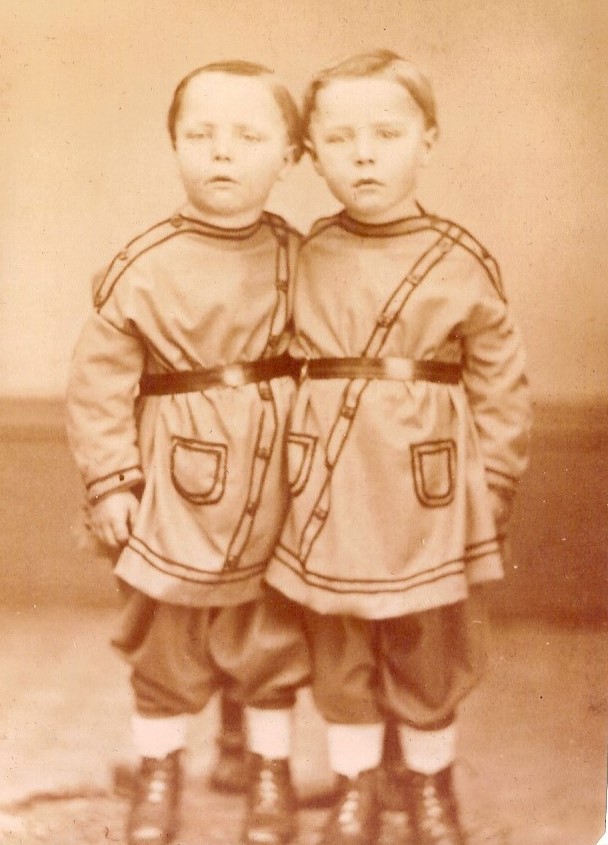
John and Elizabeth Tifft’s son, Samuel Lonard Tifft (1824–1902), was Cyril Richardson Tifft’s grandfather. He was born in Campton, New Hampshire on March 15, 1824, and moved with his family to Sycamore, Illinois as a young child where his father died when he was ten. Samuel married Charlotte Abigail Selts (1834–1908) in Illinois in 1850. Samuel and Charlotte Selts Tifft, Cyril’s grandparents, had five sons and three daughters, all of whom were born in DeKalb County. Cyril’s father Cyril M. Tifft (1865–1937) and his identical twin, Merrill C. Tifft (1865–1957), were born on April 23, 1865. As far as I can tell, the twins’ middle initials were only that—initials. They do not seem to have stood for Merrill and Cyril, as has often been suggested—or at least neither of them ever spelled out a middle name.
Merrill and Cyril were about fourteen when Samuel and Charlotte Selts Tifft moved their family by covered wagon from DeKalb County to Hutchinson, McLeod County, Minnesota, in 1879. Family lore has it that Cyril and Merrill both rode horseback on the long journey from Illinois to Minnesota. There are records indicating that Cyril and Merrill’s elder brothers, John Selts Tifft and Alberto Pitcher Tifft, had left Illinois sometime in 1878, and moved to Minnesota ahead of the rest of the family.
Samuel was undoubtedly a farmer, but he was also a land speculator and possibly a horse trader. We have a few deeds showing that he was buying and selling land in Minnesota years before he moved his family there, but we don’t know a great deal more about him than that. Based on the education their children received, we can speculate that by the mid-1880s the Tifft family was already well-established in Minnesota and comfortably well-off. The four older children, who were already in their late teens or early twenties when the family moved from Illinois to Minnesota, received no higher education, and may not have finished high school. The four younger children, all of whom grew up in Minnesota, graduated from high school, and the three boys went on to receive university degrees. Cyril M. and Merrill C. Tifft became lawyers, and their younger brother Wallace became a dentist. The Tiffts’ youngest daughter Marcia also graduated from high school.
After graduating from Hutchinson High School in 1885, Cyril and Merrill went directly to law school at the University of Michigan, from which they both graduated in 1888 at the age of twenty-three. Shortly after graduating, they both began to practice law in Glencoe, Minnesota, the county seat of McLeod county. After a short time, Cyril went off to the wilds of Spokane, Washington Territory, for a few years to practice land law, after which he returned to Glencoe and joined forces with R. H. McClelland to establish the law firm, McClelland and Tifft. Merrill and Cyril both served as probate judges in Glencoe. Merrill was elected in 1890 and served until early 1902. Cyril was elected probate judge in 1901 and replaced his brother. Cyril served in that capacity and practiced law until 1916, when he was elected as Judge of the Eighth District Court of Minnesota, a position he held until his death in 1937 at the age of seventy-two. He also served as Glencoe’s mayor for two years.

Cyril met Lillie Richardson soon after he started practicing law in Glencoe in 1888. She waited for him for several years while he worked in Washington Territory. After Cyril returned to Glencoe, he and Lillie married on June 1, 1893, when Cyril was twenty-eight and Lillie was not quite twenty-six.
The Selts-Douglass Family
Charlotte Abigail Selts, Cyril Richardson Tifft’s paternal grandmother, was born in 1834 in Yates, Orleans County, New York, on the shore of Lake Ontario, near Rochester. Charlotte’s parents were John Selts (1793–1859) and Mary Warner Douglass (1796–1875), Cyril’s great-grandparents.
John Selts and Mary Warner Douglass married in 1816, probably in Shoreham, Vermont, where Mary’s parents, Joseph (1763–1829) and Hannah Simonds Douglass (1774–1839) lived. Charlotte’s great-grandparents Domini (1732–1807) and Mary Warner Douglass (1743–1819) had settled in Shoreham a few years after the end of the Revolutionary War, along with most of their adult and teenage children.
We know very little about John Selts except the date and place of his birth, September 20, 1793, in New York, and death, May 23, 1859, in Sycamore, Illinois. We know nothing about his origin. Though genealogists have found other Selts families in New York state, nothing has been found to tie our John Selts to them. It could be that he was a member of an immigrant family with a somewhat different surname. He may have anglicized his name when he was an adult, making his origins difficult to trace.
In 1846, when John and Mary Douglass Selts’ daughter Charlotte was about twelve, the family moved to Illinois. The 1850 census shows John and Mary Selts living in Mayfield Township—adjacent to Sycamore Township—in DeKalb County, Illinois, with their five youngest children, including Charlotte, who was then sixteen. The 1850 census also tells us that John Selts was fifty-six and a carpenter. The most interesting fact revealed in this census, though, is that Samuel Tifft, age twenty, was living with the Selts family, probably as a farm hand. The 1850 census also reveals that the Selts family was living next door to Samuel Tifft’s older brother, John, and that John’s wife was Lucy Douglass, a sister of Charlotte’s mother, Mary Douglass Selts. It is something of a mystery where and when John Tifft—who grew up in New Hampshire and had been living in DeKalb County since about 1834—had met and married Lucy Douglass, who had grown up in Vermont. However it happened, there is little doubt as to why John and Mary Selts settled in Mayfield Township—they wanted to live near Mary’s sister Lucy. Nor is there a question as to how Samuel Lonard Tifft and Charlotte Abigail Selts met—they were living the same house. Samuel Lonard Tifft and Charlotte Abigail Selts were married in 1850, in Mayfield. Samuel was about twenty at the time of his marriage to sixteen-year-old Charlotte.
Charlotte’s mother Mary Warner Douglass was the granddaughter of William Domini Douglass, known as Domini, who was an immigrant from Ireland. Domini Douglass’ story is a very curious one. He was born, it is believed, in 1732 in Belfast, (Northern) Ireland. He arrived in New England as an orphaned child of about eight, in the company of the captain of the ship on which he had traveled. Legend has it that upon arrival Domini was dressed in clothing suitable for a gentleman’s child and that the captain had money for his keep and placed him in the care of a school. When the money ran out, he was apprenticed to a farmer, in whose home he grew up. For a long time, it was believed that he was the bastard child of the Scottish Earl of Douglass and that, after his father died, his brothers had sent him off to America to be rid of him, but recent DNA testing doesn’t bear that out. However, no other explanation has been found for why a lone child would have had his passage paid to America.
While traveling through New Milford, Connecticut, Domini met Mary Warner, whom he married in 1760. They settled on a farm in New Milford, where all their children were born. As an adult Domini served in both the French and Indian War and the Revolutionary War. During the Revolutionary War, Domini lost most of his property. (Domini Douglass and the Douglass clan will get more attention in future posts.)
Paragraphs here.
The Richardson-Rideout Family
Joseph Richardson was my father Cyril Richardson Tifft’s maternal grandfather. My generation represents the tenth generation of the Richardson family in the Americas. The first Richardson ancestor to settle in New England was William Richardson, Cyril Richardson Tifft’s sixth (and my seventh) great-grandfather. He was born in England in about 1620, and settled in Newbury, Essex, Massachusetts Bay Colony in about 1640. When he was only about thirty-eight he died, leaving his wife Elizabeth Wiseman Richardson and two sons and an estate consisting of a house and four acres of land. For the next four generations, our Richardson ancestors lived in Newbury and Gloucester, Massachusetts. Sometime in the early 1800s, the Richardsons began to migrate to Maine—though until Maine became a state in 1820, the counties of Maine were still part of Massachusetts.
In the sixth generation of Richardsons in America, Joseph Richardson—son of Benjamin Allen Richardson (1754–1835), and Abigail Lufkin (1759–1835)—married Jane Rideout (1793–1848) in 1816. Jane was born in Cumberland County, Maine. She was the daughter of Nicolas Rideout and Deborah Blanchard, and was descended from Mayflower passengers Richard Warren, Isaac and Mary Allerton, and their daughter Mary Allerton Cushman. Joseph and Jane Rideout Richardson had one son, Orin, before Joseph’s untimely death in November 1818.
Within about nine months of Joseph’s death, Jane married for a second time, to her first husband’s younger brother, Bradbury Richardson (1795–1878). Bradbury and Jane Rideout Richardson had eight more children, at least seven of whom lived to adulthood. Six were boys, the eldest of whom was Joseph Richardson (1822–1906), Cyril Richardson Tifft’s maternal grandfather. Joseph was born in New Gloucester, Cumberland County, Maine, on June 4, 1822, but the family relocated to Oxford County, Maine during Joseph’s childhood. As a young man Joseph learned the brick-making trade.
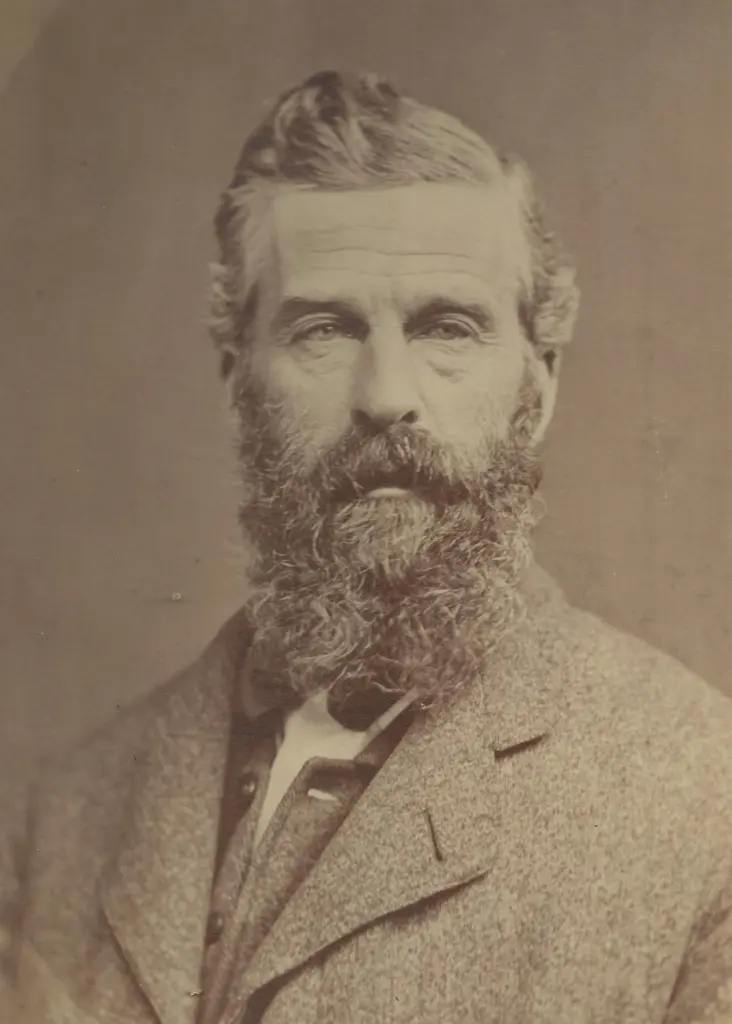
According to the 1850 census Bradbury and Jane Richardson and their children were living in Hartford, Oxford County, Maine, possibly near the Reed farm where Joseph’s future wife, Lydia Phelps Reed (1826–1900), Cyril Richardson Tifft’s maternal grandmother, was born on November 11, 1826. The proximity of the Richardsons and the Reeds in Hartford, Maine, undoubtedly accounts for Joseph and Lydia meeting. And it is also very likely how Lydia’s twin sister Hudah Bisbee Reed (1826–1912) met her future husband, Bradbury Richardson (1830–1896), Joseph Richardson’s younger brother.
Joseph Richardson and Lydia Phelps Reed married on December 11, 1852, when Joseph was thirty and Lydia, twenty-six. After their marriage, Joseph and Lydia lived briefly in Boston, and then moved to Brighton, New York, outside of Rochester, where Joseph became the superintendent of a brickworks. They lived in company housing at “Brighton Twelve Corners” near the brickworks for the next twenty years. There they had seven children, six of whom lived to adulthood.
Joseph was a bit of a wheeler-dealer. While employed in the brick making industry, he became involved in the Vacuum Oil Company in Rochester. His relationship to the company is unclear, but he was probably an early investor. One of the founders of Vacuum Oil held a patent for refining crude oil for use in lubricating leather harnesses and tack. Joseph’s involvement with the lubricating oil trade later became quite a sore point in the Richardson family. The nature of the conflict that ended Joseph’s association with the enterprise is unclear, but a very convoluted—and probably greatly exagerated—story of how he was bilked out of a potential fortune by John D. Rockefeller, was retold and embellished for decades by Joseph Richardson’s devoted family. I remember my father, Joseph’s grandson Cyril Richardson Tifft, telling at the family dinner table when I was about fifteen. (This story will be fully explored in a future post.)
Our father, Cyril Richardson Tifft, occasionally mentioned his grandfather Joseph Richardson’s Civil War record—or lack thereof—with some embarrassment. By the beginning of the War in 1860 Joseph was about thirty-eight and had three children. The United States was using conscription for the first time, and Joseph was drafted. About two percent of the 2.1 million Union soldiers were draftees but another six percent were men who had been paid by draftees to take their place. That was the route Joseph Richardson chose to take. According to Dad, Joseph paid a substantial sum in gold to some fellow to go in his stead. Who could blame Joseph for buying his way out of soldiering? Though still a young man, he was too old to endure the rigors of being a foot soldier in the Civil War. He had a family to support, and a job that apparently paid well and provided free or subsidized housing. Buying his way out was the only way he could escape the draft—and apparently it was legal.
In 1872, Joseph sold his business interests, including whatever stake he had in the Vacuum Oil Company, and moved with Lydia and their six surviving children, ages three to eighteen, to Glencoe, Minnesota. At the time of the move, Dad’s mother, Lillian (Lillie or Lilla) Mae Richardson, the second youngest child, was about five, having been born in born in Brighton, New York, on June 19, 1867. Lillie had one younger sister, Emma; two older brothers, Walter and Axel; and two older sisters, Ella and Lydia.

Joseph and Lydia were drawn to Glencoe by their family connections. Lydia’s twin sister, Huldah Bisbee Reed, who had married Joseph’s younger brother Bradbury Richardson Jr. in 1855, were already there, as were several of Joseph’s other brothers, and Lydia and Huldah’s younger brother Axel Hayford Reed. In Glencoe, Joseph joined Axel’s mercantile business, and later started his own store in nearby Bird Island. He and Lydia bought eighty acres on the outskirts of Glencoe and built what many sources have indicated was a commodious and elegant home. In Glencoe they joined the Methodist Episcopal Church.
Their children attended the local public schools, and their eldest son Walter went on to Carleton College in Northfield, Minnesota, then Amherst, and in 1885 graduated from the college of Physicians and Surgeons of New York. Their third daughter, Lillie, married Cyril M. Tifft, a lawyer, in Glencoe on June 1, 1893.
The Reed-Bisbee Family
Lydia Phelps Reed Richardson (1826–1900) was Cyril Richardson Tifft’s maternal grandmother. She was descended from Reeds (the name was spelled “Read” until Lydia’s generation) stretching back at least four and possibly more generations before her, making my generation at least the ninth in the Reed line. Who exactly the first few male Reads in our line were is still unclear.
Axel Hayford Reed, Lydia’s brother and my father’s great-uncle, was the much-revered scion of the Reed family when my father was growing up. Indeed, he was not only a prosperous businessman in Glencoe; he was a politician, a banker, and a promoter of the roads and railroads that ultimately linked Glencoe and McLeod County to the Twin Cities of Minneapolis and St. Paul, the railroad hub of the state. Axel Reed was also a soldier. He volunteered for service with a Minnesota regiment in August 1861 and was not mustered out of the Union Army until July 1865 when the Civil War was over, despite losing an arm at the Battle of Mission Ridge in November 1863. When he was mustered out of the Army at the end of the war, he was a lieutenant. In 1898 he was awarded the Congressional Medal of Honor for his Civil War service, one of only 3,536 people to have received the United States’ “highest award for military valor in action” through 2023. Sometime after Axel Reed left the Army, he received a promotion to captain. I have not yet figured out how or when this happened, but it is verified by Axel Reed’s citation for the Congressional Medal of Honor. In any case, Axel Reed was known far and wide as “Captain A. H. Reed”—at least in Glencoe, Minnesota.
In addition to his many political, military, and business achievements, Axel Reed accomplished something else, this time for his family. In 1915 he published The Genealogical Record of the Reads, Reeds, the Bisbees, the Bradfords of the United States of America. This extensive compilation of data about the Read/Reed family and related branches is the source of much of the information that we have about this sprawling family. Though it contains some errors, it is nevertheless a treasure trove that is still available as a reprint from Amazon Books.
Although Axel Reed indicates in his genealogy that the Read family was established in New England by Esdras Read, who arrived in Boston from England in 1635, modern research has not been able to confirm that link. According to the Genealogical Register of the First Settlers of New England, (John Farmer, 2009, 241) there were no fewer than ten documented adult male Read/Reade/Reed immigrants in Massachusetts Bay Colony in the 1630–1650 timeframe. As with the brothers, John Tefft and William Teffe, whose arrivals were undocumented, there could be more Reads whose arrivals were also not recorded. Any of them could have been our ancestors as the research has not yet been done to link our line with these early settlers. I will, therefore, ignore the first few generations of Reads in New England, and start this history with the birth in 1716, of Joseph Read (1716–1795). Joseph married Ruth Underwood in 1737, and in 1740 Joseph and Ruth Underwood Read moved to Westford, Massachusetts, in the north central part of the state. They were Cyril Richardson Tifft’s fourth great-grandparents. According to Axel Reed’s genealogy, Joseph was one of the participants in the Boston Tea Party.
Joseph and Ruth Read had five sons, all of whom served in the Revolutionary War. The youngest was Sampson Read (1754–1777), Cyril Richardson Tifft’s third great-grandfather. Sampson married Lydia Phelps in Westford on February 13, 1773. Lydia was also born in Westwood in 1754. Sampson and Lydia were both about eighteen when they married. Their eldest child, Sampson Read Jr. (1773–1827), was born June 1, 1773, in Merrimac, Massachusetts. Sampson had two younger sisters. Sampson the elder died in 1777, though apparently not as a result of his Revolutionary War service, which was quite limited. (Reed, 16–17)
Lydia Phelps Read, a young widow with three young children, remarried. Her second husband was John Ames, a blacksmith who was a widower with six children by his first marriage. Lydia and John Ames then had seven more children, bringing the total number of children in the family to sixteen. In the winter of (about) 1796, the whole family moved from Hollis, Massachusetts, to Hartford, Oxford County, Maine, when the counties of Maine were still part of Massachusetts. One of the Ames children described the wilderness that they moved to, saying, “Once in a while some one would have a log house. The only roads were spotted (blazed?) trees. There were bears that used to get into father’s corn field.” (Reed, 17–18) It was indeed the wilderness before 1800—but not for long. Sampson Read Jr. was about twenty-three when the Ames family made their move to the wilderness. From his stepfather Sampson had learned the blacksmithing trade, and together the men set up a blacksmith shop on the homestead.
The same year that the Read-Ames family moved from Hollis, Massachusetts, to Hartford, Maine, Sampson Read Jr. married Jane Ellis, who was a fourth great-granddaughter of William Bradford. William Bradford, of Mayflower fame, was the second governor of Plymouth Colony. He was elected in the winter of 1621 following the death of his predecessor John Carver, and served as governor until his death in 1657. Jane Ellis’ second great-grandmother was Mercy Warren, who was also a Mayflower descendant. The connection to the first settlers in Plymouth Plantation makes my father Cyril Richardson Tifft a twelfth-generation American.
Sampson Read Jr. and Jane Bradford Ellis Read had nine children. Their eldest son was Sampson Read III. He was born in Hartford, Maine, on March 14, 1799. Sampson married Huldah Bisbee (1803–1842) in 1819. Sampson and Huldah Bisbee Read moved to their own farm after their marriage, but in 1822, when Sampson’s younger brother, Bradford, died, they moved back to the Read family farm to care for Sampson’s aging parents. According to his son Axel Reed, Sampson Read III “improved the homestead very much by buildings and otherwise until it became the center of attraction for the whole township.” He also dealt in cattle for more than twenty years, visiting farms all over Oxford County to buy cattle, then driving his herds to markets near Boston and Portland. Huldah died of consumption on July 11, 1842, at the age of thirty-nine, having born eight children, seven of whom lived to adulthood. Sampson died on April 6, 1877. (Reed, 23)
According to Axel Reed, his older brother Elisha Bisbee Reed changed the family surname from Read to Reed in 1848. Most of his siblings followed suit. Elisha died at age thirty-one of “quick consumption.” His younger brother Lewis Bradford Reed (1822–1895) stayed in Maine and took over the Read family homestead. The other five children all lived, at one time or another, in Glencoe and three—Lydia Phelps Reed Richardson (1826–1900); Emily Mandeville Reed Child (1823–1920); and Axel Hayford Reed (1838–1917)—lived out their lives there. (Reed, 23–55)
Axel Reed indicates that his mother’s family, the Bisbees, arrived in New England in the spring of 1634 in New England led by the family patriarch, Thomas Besbedge. The family arrived in Scituate Harbor, Plymouth Colony, aboard the ship “Hercules.” Thomas Besbedge was Cyril Richardson Tifft’s seventh great-grandfather. Arriving in New England with Thomas, the records indicate, were his wife, six children, and three servants. The family lived in Duxbury, Marshfield, and Sudbury. Here, Reed makes a comment about early colonial record-keeping: “In those early days the wives and mothers seemed to be considered of so little consequence that no record was kept of them by many families.” How true and how frustrating! (Reed, 68)
The family name was probably changed to Bisbee by Thomas Besbedge’s only son, Elisha. Elisha settled in Scituate where he kept a ferry and a tavern. Elisha’s son, grandson, and great-grandson lived in Pembroke. Charles Bisbee (1726–1807), Elisha’s great-grandson, married Beulah Howland (about 1737–1813). They continued to live in Pembroke until the end of the Revolutionary War. Charles, who was about fifty at the beginning of the War, nevertheless, took part, as did at least two of his sons, Elisha and Charles Jr. (Reed, 68–69)
It is in this fifth generation of Besbedge/Bisbees in America that we begin to get an idea of what the family was like—by then a hardy bunch with an adventurous spirit. After the Revolutionary War, Charles and Beulah Howland Bisbee were part of the wave of “extensive emigration from the Old Colony towns in Massachusetts to the wilds of Maine.” Charles bought land in Maine sight unseen in a township first called Sharon, then Butterfield, and finally Sumner, in what is now southeastern Oxford County, Maine. Sumner had been settled the year before, in 1782 by Revolutionary War veterans.
Charles Bisbee Sr. visited the land first in the summer of 1783, chose a building site, and “built a cheap tenement for his family to occupy later.” He then went back to Pembroke for the winter. Charles and Beulah and many of their nine children—among them seven sons—set sail from Scituate Harbor in the spring of 1784 and landed at Yarmouth Harbor. They then proceeded on horseback “through the wilderness” and arrived in Sumner in early June 1784 about twelve years before Sampson Read, the first Read to settle in Oxford) County, arrived there. Axel Reed quotes a characterization of Charles (and by implication Beulah) by Dr. William B. Lapham, secretary of the Maine Genealogical Society: “He had selected his land with good judgment, and with the aid of his seven stalwart sons he soon cleared him up a good farm. He suffered all the privations and hardships incident to a pioneer life, lived to see his children comfortably settled around him and enjoy much of the fruit of his toil.” Charles died on June 3, 1807, at the age of eighty-one, twenty-three years after arriving in Sumner. Beulah died on September 1, 1813, at the age of seventy-six.
Elisha Bisbee (1757–1826), the eldest son of Charles and Beulah Bisbee, was a Lieutenant in the Continental Army during the Revolutionary War. In 1779, he married Mary Pettingill (about 1760–1811) of Duxbury. They moved with the elder Bisbees to Sumner in 1784, when the area was still part of Massachusetts. (Remember the counties of Maine did not become the state of Maine until 1820.) Elisha and Mary Pettingill Bisbee settled on the Bisbee family homestead with the elder Bisbees. Huldah Bisbee (1803—1842), Cyril Richardson Tifft’s maternal great-grandmother, was born to Elisha and Mary Pettingill Bisbee on the “old homestead” in Sumner on November 11, 1803. Huldah was the youngest of ten children. Her mother died at age fifty-one when Huldah was eight years old. (Read, 23)
Apparently believing that he could not care for such a young child, Huldah’s father sent her to live with a blacksmith’s family but she did not like living there. Ultimately, she settled with her elder sister, Sally, and her husband Gad Hayford in Hartford, the same town where her future husband Sampson Read III grew up. Huldah lived with Sally and Gad Hayford until she was married. Clearly, Huldah was close to her brother-in-law Gad Hayford: she named her son Axel “Hayford” Reed after him. An elderly relative described Huldah as “a very pretty girl and woman and of a mild and lively disposition, always ready to sacrifice her own happiness for that of others. She had a very red [and curly] head [of hair] when she was young, but at maturity turned an auburn.” Huldah Bisbee and Sampson Reed III married in 1819. (Reed, 23, 71–72, 81)
It was in the towns of Sumner and Hartford, located in the more populated southeastern part of Oxford County, Maine, that the Bisbee, Read, Richardson, Hayford, and Child families came together in the early 1800s, forming a huge network of family members, many of whom would, later in the century, end up in Glencoe and Minneapolis, Minnesota. Oxford County itself is large. It forms most of the western border of Maine, sharing borders with New Hampshire and Quebec. It was officially established by the Massachusetts General Court in the Maine District on March 4, 1805. In 1810, the population of the entire county, comprising some 2,176 square miles (slightly larger than Delaware), was 17,630, or a population density of eight non-Indigenous people per square mile. In comparison, Delaware had a population of 72,674 in 1810.

Of the seven surviving children of Sampson and Huldah Bisbee Read, at least four were important figures in the childhood of my father, Cyril Richardson Tifft. My father’s maternal grandmother, Lydia Phelps Reed Richardson (1826–1900) was talked about fondly and frequently throughout his childhood, although she had died in 1900, six years before Cyril was born. Dad felt that she was very much part of his childhood.
Another Reed, Lydia’s twin sister Huldah Bisbee Reed (1826—1912), married Lydia’s brother-in-law, Bradbury Richardson, in 1855, a little over two years after Lydia Phelps Reed and Joseph Richardson had married. Two years later Huldah and Bradbury moved to Glencoe, Minnesota, a new town on the Minnesota frontier established in 1855. There they built one of the first houses in Glencoe, a log cabin. During the Dakota War of 1862 (also known as the “Great Sioux Uprising”), Huldah “was forced to flee from her home, taking her three small children with her through the so-called ‘Big Woods’ [made famous by Laura Ingalls Wilder] thirty miles to Carver, Minn, in the night time.” (Reed, 44) Her husband, Bradbury Richardson, along with other Glencoe men, stayed behind to defend their fledgling town. In the end, Glencoe was not attacked. Huldah’s brother-in-law, Eliphalet Richardson, was killed on August 22, 1862, while riding from Glencoe to Fort Ridgley, about forty-five miles distant, for help from the soldiers stationed there. Huldah and Bradbury Richardson and Bradbury’s brother Eliphalet were held up as paragons of bravery to Cyril when he was a child.
Another Reed, Lydia and Huldah’s older sister Emily, or “Aunt Emily” as she was known in the family, was Cyril’s great-aunt. In 1844 she married Lewis Washburn Child, of Turner, Maine, a town about ten miles from the Reed family home in Hartford. They had nine children, seven of whom were boys. When they became adults, the Childs’ seven sons migrated to the west from Maine. Several settled in Minneapolis and Glencoe. In 1885 Emily and Lewis followed, making their home in Glencoe, where several of their sons lived, as did Emily’s sister Lydia Reed Richardson, and brother, Axel Hayford Reed. Though Lewis died in 1887, Emily lived until 1920. Her home was next door to Lillie and Cyril Tifft’s home. Young Cyril was a frequent visitor to Aunt Emily’s home as a child and would fondly remember the house and Aunt Emily all of his life.
Emily’s granddaughter Ida Child, thirty-five years older than Cyril, was his second cousin. She was also his aunt, having married his father’s younger brother, Wallace Tifft, in 1897. Aunt Ida and Uncle Wallace significant figures in Cyril’s childhood.
Another of Aunt Emily’s granddaughters, Marjorie Child Husted, was the brain and the voice behind the marketing revolution known as “Betty Crocker.” Marjorie was the daughter of Emily and Lewis Child’s son, Sampson Reed Child, and his wife, Alice Webber. Sampson attended Bowdoin College, graduating in the class of 1884. He then married, and they moved to Minneapolis, where Sampson studied law, joined the bar, and practiced law. Marjorie was born in 1892. (Read, 35) She attended the University of Minnesota where she majored in home economics. In 1921, she went to work for the Washburn-Crosby Milling Company in Minneapolis, which later became General Mills. In 1924, when Washburn-Crosby began airing the Betty Crocker School of the Air on radio, she became the voice of Betty Crocker. She continued to broadcast into the early 1950s, when the show moved to television. Though she and Dad were not close, he was proud that she was his second cousin. (Marjorie Child Husted, better known as Betty Crocker, will be the subject of a future post.)
Lydia, Huldah, and Emily Reed’s younger brother, Axel Hayford Reed, was also an important figure in young Cyril’s life. Given his military service, his loss of an arm, his Congressional Medal of Honor, and his many political and business accomplishments (and his rather large ego), it is no wonder that he was the subject of little Glencoe boys’ hero worship. Cyril admired “Uncle Axel” and talked about him in the most reverent tone throughout his life. (Axel Hayford Reed will be the subject of a future post.)
Another of Cyril’s great-uncles, Sampson Reed, ultimately settled near Glencoe in Bird Island, Minnesota where Joseph Richardson owned and operated a mercantile and grain business, but he died in 1890, sixteen years before Cyril was born. I don’t recall my father ever talking about him, but his story is curious enough to retell here. According to Sampson’s younger brother Axel Reed, Sampson was an unusual character. In 1848, when he was nineteen and free to leave home, he went to Boston where he stayed until 1850. From Boston, he sailed to Australia to search for gold. Then he went to Tasmania, New Zealand to continue his search for gold. Neither his sweetheart nor his family had heard from him for nearly twenty years, when he showed up back at the Reed home in Hartford, Maine. His sweetheart had been waiting faithfully for him. Sampson married her and took her first to Glencoe, where they spent the year of 1869, then to California, and then Boise, Idaho. In Boise, he had a job and a home, but his wife died in about 1887, so he returned to Minnesota, settling at Bird Island where he “entered the hardware business,” probably at Joseph Richardson’s store. He died there in 1890. (Reed, 47)
My father Cyril’s family was tight knit and stayed in close touch even as adults. Throughout his life, Cyril saw many of his cousins several times a year and they continued to hold Tifft/Richardson/Reed reunions into the early 2000s.
Visit our Ancestry.com family tree here.