
Finding Your Swedish Ancestors: A Guide
In Swedish families, where the surname often changed with every generation before the twentieth century, tracing one’s ancestry back beyond two or three generations can be frustrating. Fortunately, the Church of Sweden, the national church to which almost all Swedish citizens belonged until the middle of the twentieth century, began recording parishioners in the mid-seventeenth century. These records provide the key to finding your Swedish ancestors. In this guide, we will explain how the patronymic naming system works and how Church of Sweden records can be used to connect ancestors from one generation to the next, enabling you to not only find your Swedish ancestors but to learn about their lives. But first, it is important to understand how Swedish surnames were derived before the twentieth century.
How Swedish Surnames Evolved
Mononyms
Before the Middle Ages, there were few Swedish surnames. A Swedish man might refer to himself only by his given (first) name. This is called a mononym. In a man’s own small village, using a mononym posed no problem because everyone knew everyone else. But if the man traveled outside his village he might encounter many men with the same name. In that case, he might add the name of his village to his given name. For example, a man named Jon who came from the small village of Utterbyn, might call himself “Jon i Utterbyn” when he left home, to distinguish him from the many other Jons he might find in another town.
Patronyms
The mononymic system was no longer adequate for a growing population, so in the early Middle Ages Swedish families began to give themselves surnames (last names or family names). Most often, Swedish surnames were patronymic: the family derived its children’s surnames from the father’s first or given name plus a suffix of “son” for a boy and “dotter” for a girl.1 If a man’s name was Nils Larsson, he would have gotten his surname from his father Lars, but we can’t even guess what Lars’ surname might have been. However, we know that Nils’ children would become Nilssons and Nilsdotters. Nils’ children would drop the name Larsson entirely, or they might be given it as a middle name. In this way it became customary for Swedish surnames to change with each generation.
Until 1901, the majority of Swedish families used the patronymic naming system. If your ancestors were Swedish, you simply can’t assume the surnames of your ancestors based on your own surname, or those of your parents or grandparents.
Patronymic Surnames in Our Swedish Grandmother’s Family
Our Swedish grandmother Anna Elisabet Jonsdotter Hallberg’s birth family provides a good example of the working of patronymic surnames. Anna was born in Utterbyn, Värmland in 1881. We knew her parents’ names, but that was just the start of tracing her paternal lineage. Using Swedish church records we traced Anna’s paternal line from her father Jon Persson, to her grandfather Per Nilsson, to her great-grandfather Nils Persson, and to her second great-grandfather Per Svensson. While we can guess that Per Svensson’s father’s given name was Sven, we’ve found no records for him, and therefore have no idea what his surname was. With “Sven the surnameless” we lost the ancestry thread for our grandmother’s paternal lineage, but at least we were able to trace it back four generations beyond her by following the clues in available church records.
Other Sources of Surnames
Not all Swedish surnames were patronymic. They developed in other ways too. Sometimes the family surname referred to the occupation of the father, and sometimes to the place the family lived. When men joined the army, officers gave men unique surnames frequently based on personal characteristics in order to distinguish among several men with the same surname. The clergy chose their own surnames, often giving them a Latin twist, and noble families chose names that included a designation that told everyone else that they were high-born.
Families that derived their surnames in other ways could also change their surname from one generation to the next. For instance, in one generation, a man could choose a name related to his birthplace, for instance Björklund, meaning “birch grove.” His son, originally named Olof Björklund (because the father liked the name), might become a clergyman, and pick a Latin-sounding surname, for instance Olauf Björklundus. Or he might pick a completely different surname. Like patronymic surnames, these non-patronymic surnames could also change from generation to generation. The use of a non-patronymic surname will be demonstrated in two of our family examples below—the Lundells and the Hallbergs.
More on Swedish Surnames
Tracing a Swedish family that used the patronymic system is not simple because the family surname changed with each generation. There are only a few dozen common Swedish given names, so at any given time, in any village, there could be many Jonssons, Olssons, Nilssons, and Perssons (or any other name based on Swedish male given names). Some may be the researcher’s ancestors; many will not be. This was the situation from the Middle Ages all the way up to 1901.
In 1901 the Swedish government, recognizing that allowing family surnames to change from generation to generation was no longer practical, passed the Names Adoption Act. Through the Act, the government required every family in Sweden to adopt a stable family name that would be passed down from one generation to the next. But the 1901 law only changed the system going forward; it did not fix the confusing Swedish surname system of the past.
So, what is a person who is trying to research their Swedish ancestry to do when dealing with the Swedish patronymic naming system?
Finding Your Swedish Ancestors Through Their Lutheran Heritage
Given the generation-changing nature of Swedish surnames from the Middle Ages through the nineteenth century, finding Swedish ancestors may sound daunting, but genealogical researchers need not despair. Thanks to the Swedish Reformation (1527–1593) virtually everyone living in Sweden up until the mid-1900s belonged to the Church of Sweden.2 And Swedish Lutheran parishes, in accordance with church edict, kept careful records of their parishioners.
From the early 1600s until the mid-1900s, only small groups of people living in Sweden were not Lutheran. It was not until 1951 that one was allowed to leave the Church of Sweden “without providing any reason.” As late as 2021, Lutheranism was still the predominant religion in Sweden. Of the 10.5 million people living in Sweden in 2021, more than half still belonged to the Church of Sweden, and almost thirty-eight percent were unaffiliated or belonged to an unidentified religion. All other religions, both Christian and non-Christian, accounted for only nine percent of the population.3 Many of the unaffiliated group were likely lapsed Lutherans, in which case, their ancestors would have been recorded in church records.
So, unless you find that an ancestor was from some background other than native Swedish (for instance Dutch Reformed, Walloon, Roman Catholic, Jewish, Muslim, or Anglican), you can be almost certain that your Swedish ancestors were members of a Lutheran parish at least until the 1950s and that there are parish records for them—even if they were not practicing their religion. Understanding what kinds of church records exist, and where they can be found, is therefore critical to a Swedish descendant’s genealogical research. These Swedish church records make finding your Swedish ancestors, despite ever-changing surnames, much easier.
The Church Law of 1686 and the Records It Required
In 1686, the Church of Sweden directed all parish pastors (also known as priests) to keep records of all the members of the parish. Though this edict became effective in 1688, many parishes had kept records much earlier in the seventeenth century. So researchers might be lucky, and find church records predating 1688. Because virtually everyone living in Sweden from 1688 until the middle of the twentieth century was Lutheran, virtually everyone was recorded in Lutheran church records.4
It is very likely that anyone searching for Swedish ancestors can find them in parish records, particularly if one begins with the knowledge of the names and parishes of a few ancestors who lived in Sweden. The quality and accuracy of the records, of course, depended upon the skill, diligence, and penmanship of the pastor in carrying out the important task of keeping records on all of the residents of the parish.
Ministerial Books
The most basic records kept in any parish dealt with birth and christening, engagement and marriage, and death and burial. One might also find occupations and other information in these records, as well as a good deal of other related information (such as the parents of a child in a baptismal record, or the name of both the husband and wife in a marriage record). These parish records are collectively known as the “ministerial books.”
Moving In and Out Records
Starting in 1688, the Church also required the parish priest to record parishioners’ moves in and out of the parish in records called “Inflyttnings och Utflyttningslän” or “moving in and out records.” These records include the date on which the individual left their parish and their planned destination.5 Before the 1840s these records would have primarily documented moves within Sweden from one parish to another. But starting in the 1840s, when mass migration to North America began, most of the moving in and out records documented emigration out of Sweden. These are invaluable, particularly for Canadians and Americans researching their Swedish roots.
The House Inquiry
Beginning in 1688, the Church of Sweden required an annual “husförhör”—a “house inquiry” or household examination. The parish priest would conduct a meeting with a group of parishioners—most often a household—at a designated time and place. The Church expected the priest to examine each household member (though probably not the young children) to determine their knowledge of the Bible and catechism, as well as their literacy. Often the religious information that was recorded was limited to the dates that the individual had taken communion. The list of individual items that might be included in a typical household examination is extensive.6

showing the parish priest conducting the annual household examination.7
During the inquiry, the priest or perhaps a parish clerk updated numerous vital statistics, including birth, death, and marriage dates of everyone living in the household, including servants and boarders.The annual household examination served the purpose of registering everyone living in the parish and provided an opportunity for the priest to check the accuracy of information in the ministerial books.
Household examination records are key to tracing one’s Swedish ancestry back through time. Because all of the members of the household are listed, one often finds three or more generations in one household—children, parents, and grandparents—and perhaps aunts, uncles, and other relatives. One might also find a missing relative who is a boarder with another family. Multigenerational household examination records can provide full names, birth, death and marriage dates, and other information that can enable the researcher to ferret out possible family relationships, despite the fact that surnames are different.
In 1894, a royal ordinance required that the husförhör—the house inquiry or household examination—be replaced by a new record, the “församlingbok” the congregation book or parish book. Though the parish book, like the household examination book still indicates if a person was christened and confirmed, the results of the religious examination were no longer recorded. Both the older husförhör and the more modern församlingbok group household members together. Birth, marriage, and death records are included, which is invaluable when tracing Swedish ancestry.
Deciphering Household Examination Records—What They Can Tell Us About Our Swedish Ancestors’ and Their Surnames
A few examples from our research into our Swedish roots will provide a better sense of the insights the household examination record can yield.
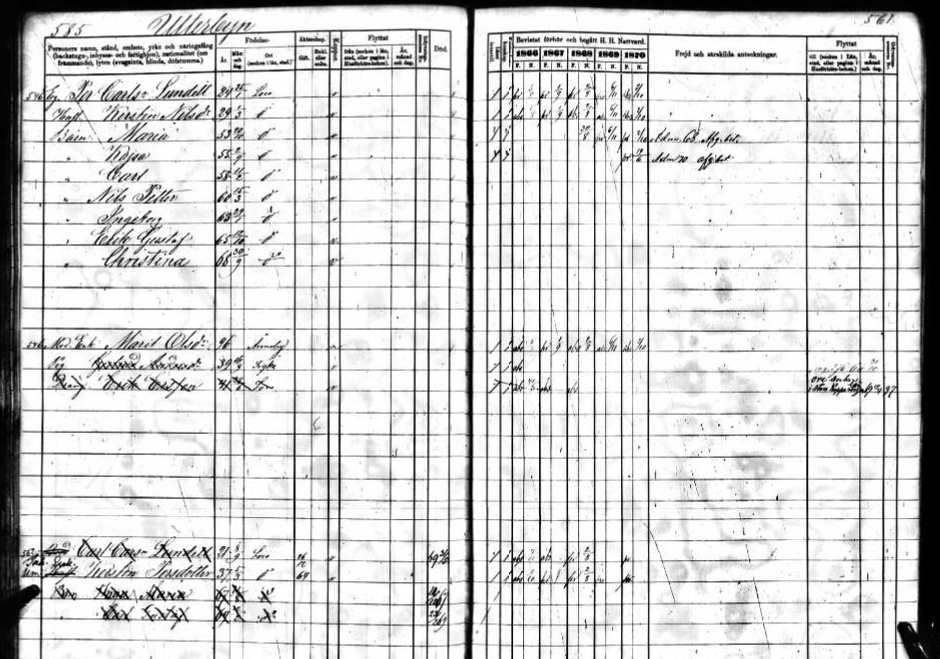
An Example of a Swedish Surname That Didn’t Change—The Lundell Family
Our first example is the 1865–1870 household examination record for the Lundell family—the birth family of our Swedish great-grandmother, Maria Lundell—the mother of our grandmother, Anna Elisabet Jonsdotter Hallberg.
The name Lundell is taken from nature. The literal translation is “grove valley.” It probably reflects where the family lived centuries ago. The first person to use the name was our fifth great-grandfather Nils Nikolous Lundell who was born in 1689.
In this household examination, “Barn” (or child) Maria appears along with her siblings. Maria appears to be the eldest child of Per Carlsson (or Karlsson—the spelling varied from record to record) Lundell and Kerstin Nilsdotter. Kerstin kept her maiden name.
Next to Maria’s name, her date of birth appears, noted as 53 (for 1853) 20/10 (for October 20 in the European style, noting the day then month), indicating that Maria was about seventeen in 1870 when the last household examination on this page took place.
To the right of center we see notations for the years 1866 through 1870. In the last three years of this record the columns are filled in with dates that indicate when Maria took communion. The notation to the right of the dates indicates that she was confirmed in 1868. As indicated in the column heading above the five years, Maria and the rest of the household members were “bevistat” (literally “proven”) by H.H. Nattvard who was likely the pastor. There is no guarantee, however, that the pastor himself recorded all of the details; it could have been a clerk.
Recorded below the young Lundell family is a woman named Marit Olsdotter. According to this record, she was born in 1796. And would therefore be old enough to be Per or Kerstin’s mother. But, because her last name is patronymic, we can’t tell who she is related to, if anyone in the household. If we were to search for Marit Olsdotter by her name, we would find earlier household examinations showing her to be Per Carlsson Lundell’s mother, and the widow of Per’s father Carl Gustav Persson Lundell.
Below the record for Marit Olsdotter is a group of four entries, only one of which is not crossed out. It is for Kerstin Persdotter, who was born in 1837. Scratched in to the left of her name is an abbreviation “Enk” which is the abbreviation for Enka, or widow. The entry above Kerstin’s is crossed out, indicating that the person left the household or died during the five years this page was used. The entry reads “Carl Carls. Lundell.” To the right of his name in the column entitled “Död” (meaning dead) is the date that he died, May 31, 1869. Kerstin’s two children, Inga and Carl, are also crossed out. According to this record both children died in the same year that they were born—Inga in 1867 and Carl in 1869.
From this household examination record we can deduce that both brothers, Per and Carl, used the patronymic, Carlsson, as a middle name. In both listings “Carls.” is written between the given name and the surname. Carls. is the abbreviation for Carlsson. It is noteworthy that this particular record does not appear if one searches for Per Karlsson Lundell as his name is spelled in later records. Therefore, it is worth trying different spellings of names to find records for specific individuals when they seem to be missing.
An Example of a Patronymic Swedish Surname—The Persson Family
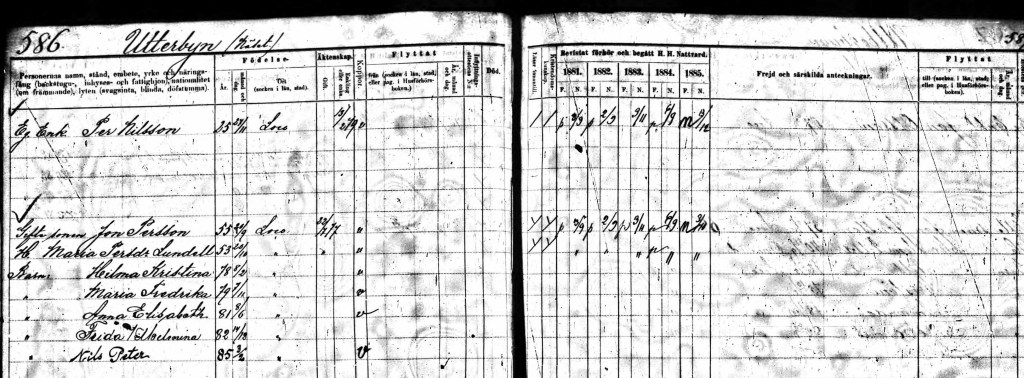
Our second example is the 1880–1885 examination of the household of Jon Persson and Maria Persdotter Lundell, the parents of our grandmother, Anna Elisabet Jonsdotter Hallberg.
This record shows that Maria, Anna’s mother, continued to use Lundell as her surname like many women of her time. Another common practice demonstrated by Maria’s name is the use of the patronymic “Persdotter” as her middle name when it wasn’t used as the surname. This use of a patronym as a middle name provides a clue as to Maria’s father’s given name (if we didn’t already know it because of the first example). Maria’s middle name, “Persdotter” tells us that she was the daughter of Per Lundell rather than one of Per’s brothers.
Though Anna’s parents, Jon and Maria, used the male and female versions of the same patronymic—Persson and Persdotter—they were not blood relations. Nor, apparently, was Maria’s aunt, Kerstin Persdotter, who lived in the Lundell household when Maria was a child. These three Persson/Persdotters were all members of different birth families. They were simply the children of three men named Per, all living in the tiny village of Utterbyn in the latter part of the nineteenth century.
In the column headed “Ӓktenskap” or “Marriage” the date of Jon and Maria’s marriage is recorded as “22/7 77” or July 22, 1877. As of 1885, the last year that this particular parish register was used, Jon and Maria had five children. Each child was listed with a first and second name. In this family, common given names such as Kristina, Elisabet (or Elisabeth), and Peter were used as second or middle names.
Per Nilsson, shown on the top line of this page, is the father of Jon Persson though the relationship is not spelled out in this record. We can deduce that fact thanks to understanding the patronymic naming system. Per Nilsson’s children became Perssons and Persdotters. In 1885, when the last household examination recorded on this page occurred, Per was about sixty as indicated by his birth date November 27, 1825 (written as “25 27/11”).
An Example of a Self-Selected Swedish Surname—The Hallberg Family

Our third example is the 1880–1885 record of a household examination that spans three generations. It is for the family of Karl Larsson (Hallberg) and Mathilda Olofsdotter, the parents of our Swedish grandfather Karl (later changed to Carl) Hjalmar Hallberg. In the last year of this record—1885—Karl is about three, living with his parents and two sisters in the village of Utterbyn.
“Enkl” (widower) Olof Persson appears above the Larsson family. Because of his given name, and his age—about sixty-three—we can be fairly sure that Olof is Mathilda Olofsdotter’s father. But his given name is crossed out, indicating that Olof is no longer living in the household. Why? Because in the column titled “Död” or “Dead” we see the notation “85 6/12” or December 6, 1885 indicating the date that Olof died. Above Olof Persson on the record are two other elderly men, Lars Hakansson and Jon Jansson, who do not appear to be related to the family. They too were widowers (Enkl) and were probably boarders.
Karl Larsson is listed without using the surname Hallberg; a surname that that had been chosen by his father, Lars Anders Andersson Hallberg. Evidently the priest wasn’t convinced that Hallberg was really Karl’s surname. On the right side of the page there is the notation “Calls himself Hallberg.” Karl’s father Lars, for whatever reason, had chosen not to use his father’s surname “Kollfelt” another non-patronymic surname. Our grandfather, Karl Hjalmar, chose to stick with the surname his grandfather had chosen and his father had used—Hallberg.
Another useful clue provided in the household examination records is places of birth. The Hallberg–Olofsdotter family members were born in a variety of places. Mathilda and her youngest daughter were born “Loco” or “Loca” which means something like “locally.” Mathilda’s father Olof was born in nearby Stommen. Karl Larsson Hallberg was born in Fensbol a few miles from Utterbyn. But two of Karl and Mathilda’s children were born much farther afield. Erika was born in Jämtland considerably to the north of Utterbyn, and our grandfather Karl was born in Gävleborg County, in the eastern part of Sweden. These births in different parts of the country indicate that the Hallberg-Olofsdotters were traveling during the early years of their marriage—a clue leading to the discovery of an interesting story.
The ministerial books, the moving in and out records, the household examination, and the later household examination or parish book, all provide a wealth of information on almost any ancestor who ever lived in Sweden, and will allow the researcher to begin to piece together multiple generations of family history. But how is a researcher to find these records?
Finding Records for Swedish Ancestors in the Face of Ever-Changing Surnames
Swedes have been great record-keepers for many centuries. They’ve also kept up with modern technology, so genealogical researchers are likely to find the Swedish ancestors they’re seeking. In the article Sweden Church Records, FamilySearch.org has provided an extensive discussion of the types of records that are available for researching Swedish ancestors and tips for using them. The article indicates where physical or microfiche records are kept in Sweden, as well as what types of records can be found on ancestry websites and online databases, both in English and in Swedish. Here are a few things to know:
- Starting in 1860, basic vital statistics for individual parishioners including births, marriages, and deaths, were extracted from the church records and sent to the Central Bureau of Statistics for each province (Statisktiska Centralbyrån). According to FamilySearch.org, though these are not as complete and detailed as the original parish registry, they are a good primary source of data on ancestors.
- Original church books dated before 1895 are now kept in regional archives rather than individual parishes. Researchers can see a listing of all the books and records belonging to a parish record collection by doing a search in the Swedish National Archives’ online catalogue, Nationell Arkivdatabas.
- In Sweden, there is no single source of data equivalent to the U.S. Census. Therefore, FamilySearch.org advises that, “rather than using the term ‘census’ for your source citation in Swedish research, consider using the name of the Swedish record instead. This way others will know exactly what you looked at.”
- While there were some Swedes who were not members of the Church of Sweden and will not be listed in church records, many other data sources are available to identify them, such as directories, civil registration records, birth, death, and marriage records, legal actions, and military service records.
Reading and Understanding Swedish Ancestry Records
Translated summaries of Swedish records are often available on English-language-based genealogy databases such as Ancestry.com and FamilySearch.org. But the original records, particularly household examination records, will provide a much richer context, containing clues to other generations that enable the researcher to continue their journey back through time.
Finding Original Swedish Records Online
Though one can often find images of original Swedish records on English-language databases, finding them takes some tenacity. On Ancestry.com, one can look at hints for an individual, and sometimes find these records on other family trees. But the “search” function on an individual’s profile may prove more useful. Search allows one to find images of original records pertaining to that individual. Sometimes it is necessary to use different spellings of a name to find records. These records can be saved to multiple individuals on your online family tree.
Reading, Translating, and Understanding Swedish Records
The Swedish church records that one can find in databases are microfiched or scanned images of very old, hand-written record books. They can be difficult to read and to understand. One can expand the image using the +/- function to make the record easier to read. But being able to clearly read what is written is only half the fun; it is still in Swedish, and many of the notations are abbreviated. FamilySearch.org comes to the rescue, providing an extensive list of abbreviations that are found in church records, with both the Swedish and English translations. These include useful terms such as occupations, categories of land ownership and tenancy, titles, and county names.
Researchers can translate Swedish records using the FamilySearch list of abbreviations and terms, and the tools provided by Google Translate. A very helpful Google Translate tool is the camera function, Google Lens, which allows one to translate on the fly. This video provides a quick and easy tutorial for the use of Google Lens.
Conclusion
Finding and understanding records for Swedish ancestors may seem like a daunting task, because Swedish surnames could and often did change every generation. Fortunately, virtually the entire Swedish population belonged to the Swedish Lutheran National Church until the mid-1950s. The Church has required extensive record-keeping since the late 1600s. These records, for the most part, have been carefully preserved and are extremely useful in tracing ancestors back through generations. Both the original church books, and microfiched or scanned copies are available at regional and national archives. And many of these records can be accessed online, both in Swedish archives, and in English-language databases.
Sources
1. “Sweden Naming Customs,” FamilySearch.org, 2024, https://www.familysearch.org/en/wiki/Sweden_Naming_Customs#.
2. “Reformation in Sweden,” FamilySearch.org, 2024, https://en.wikipedia.org/wiki/Reformation_in_Sweden.
3. “Religion in Sweden,” Wikipedia.org, 2024, https://en.wikipedia.org/wiki/Religion_in_Sweden.
4. “Sweden Church Records, FamilySearch.org, 2024, https://www.familysearch.org/en/wiki/Sweden_Church_Records#.
5. “Swedish Moving In and Out Records (Inflyttnings och Utflyttningslängder),” FamilySearch.org, 2024, https://www.familysearch.org/en/wiki/Swedish_Moving_In_and_Out_Records_(Inflyttnings_och_Utflyttningsl%C3%A4ngder).
6. “Sweden Household Examination Records,” FamilySearch.org, 2024, https://www.familysearch.org/en/wiki/Sweden_Household_Examination_Records.
7. “House interrogation,” Swedish Wikipedia.org, 2023, https://sv.wikipedia.org/wiki/Husf%C3%B6rh%C3%B6r.