Colonial Population Analysis
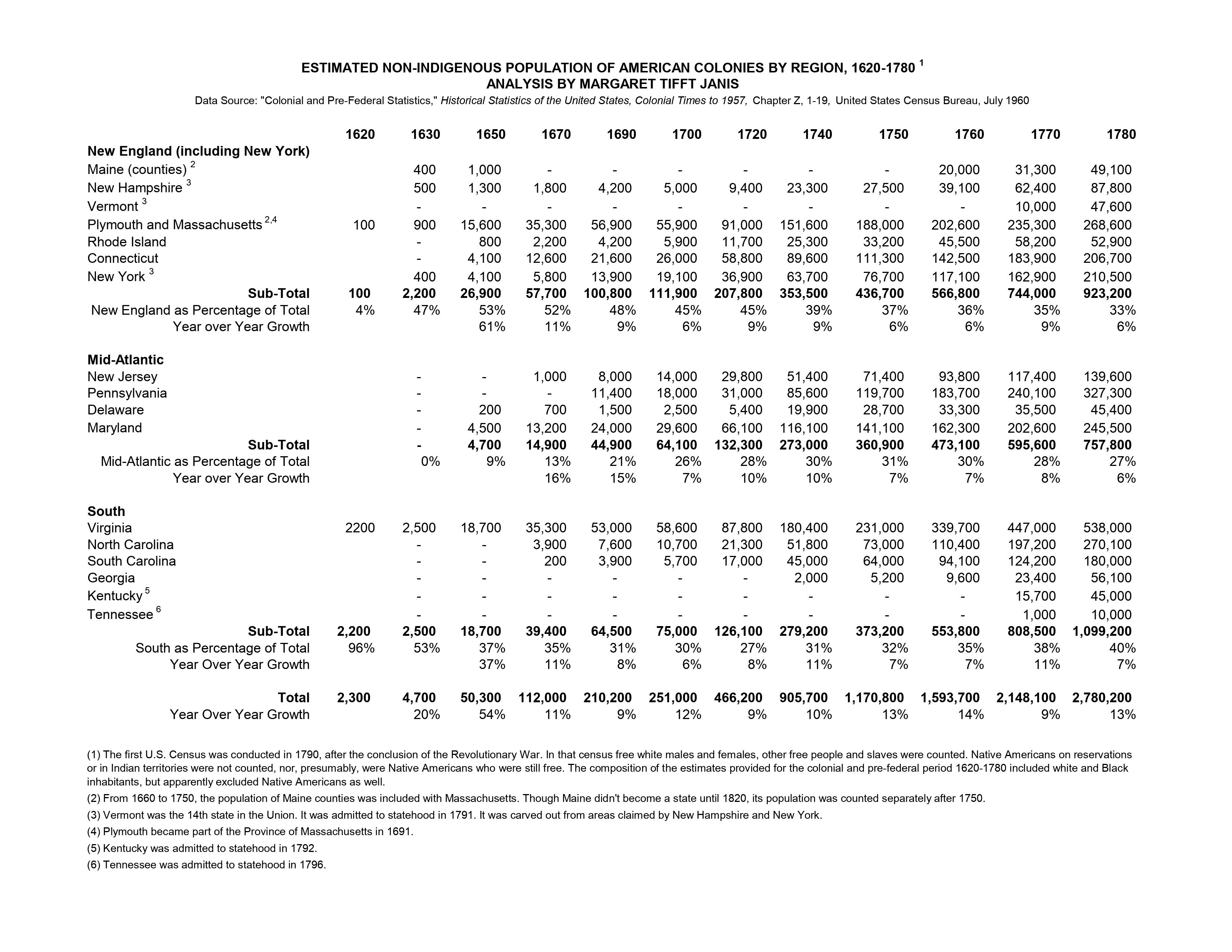
this analysis of population growth by colony and region throughout the colonial period is based on U. S. Census Bureau data published in 1960 for the colonial and pre-federal era—1620 to 1780. The source data set can be found in Historical Statistics of the United States, Colonial Times to 1957, Chapter Z, 1-19 (page 1168).1
Differences Between the Source Data and This Analysis
The Census Bureau data set is based on compilations from a variety of sources rather than the census enumerations now done every ten years. Those simply didn’t exist during the colonial period. Despite the meticulous methodology used to produce the Census Bureau data set, the results are still estimates. Nevertheless, the Census Bureau chose to present precise numbers for the later years. At the risk of losing a bit of precision, I have chosen to round the estimates to the nearest one hundred to simplify this analysis.
A second and more significant difference between the Census Bureau data and this analysis is the grouping of the colonies by region. The Census Bureau groups Connecticut, Rhode Island, New York, New Jersey, and Pennsylvania together as a Mid-Atlantic group. In contrast, I have grouped Connecticut, Rhode Island, and New York with the New England colonies. Traditionally, Connecticut and Rhode Island are thought of as part of New England. They were populated by the offspring of the earliest settlers of Massachusetts Bay Colony and Plymouth, as well as new immigrants to New England. Their early populations were generally English and Protestant and entered New England through the port of Boston.
I have also included New York in the New England grouping, but for a slightly different reason. New Netherland, as New York was called in the early 1600s, was established by the Dutch West India Company in 1621 on behalf of the United Provinces of the Netherlands. By 1630, the population was still only about 400, nearly 300 of whom were living in or around Fort New Amsterdam on the island of Manhattan. Most were French Walloon, rather than Dutch. By the mid-1600s, roughly half of the population was not Dutch, but rather English, German, Swedish, and Finnish. About 2,000 were English colonists from New England who lived on the eastern end of Long Island and along the Connecticut border. In 1650, the English and Dutch negotiated a border agreement giving that part of Long Island to the English colonies. Finally, in 1664, New Netherland became an English colony, and was renamed “New York.”2 Later, many New Englanders moved west into what is now known as “upstate New York” for more land and economic opportunities. For these reasons, I have included New York in New England, even though it is not traditionally considered to be part of New England.
With the exception of Rhode Island, which was a colony of non-conformers and outcasts at its founding and throughout much of the colonial period, most of the northern colonies were first populated by Puritans and Separatists. Many of them later became Congregationalists or joined other Protestant denominations.
Movement of New England’s Non-Indigenous Population During the Colonial Period
As early as 1650, the first two New England colonies, Plymouth and Massachusetts Bay, were becoming too crowded. Not only were they experiencing significant immigration, but the settlers were also raising large families. By the second generation, Plymouth and Massachusetts Bay Colony were running out of space near the coast to house and feed their burgeoning populations.
The English settlers quickly found ways to take over Indigenous territory within the boundaries of their own colonies. But there was still limited land, hemmed in as the colonies were by the Atlantic ocean. To gain breathing room, the English population soon started to push north into what was to become New Hampshire and Maine, south into Connecticut and Rhode Island, and later west into upstate New York. Part of New York, as well as part of New Hampshire were later to become Vermont. Though Vermont was never a separate colony, it became the fourteenth state in 1791.
As the English spread out, they pushed Native Americans west. In the process, they killed off a substantial portion with the diseases they had brought to the New World. King Philip’s War (1675–1676) all but completed the process in Massachusetts Bay, Plymouth, Rhode Island, and Connecticut. Historians suggest that the English population almost replaced the Indigenous population in the New England colonies during the colonial period.
From the mid-1700s to early 1800s, our family’s forebears left Massachusetts, Rhode Island, and Connecticut for greener pastures in Maine, Vermont, New Hampshire, and New York, where there was more economic opportunity and more land. Within a few more decades, some had gone west to Ontario, and by the mid-1800s, others had gone further, to Illinois and Minnesota, and even to California.
The movement of colonial settlers from the rock-ribbed shores of the first New England colonies, to places south (Connecticut and Rhode Island), north (New Hampshire, Vermont, and Maine), and west (New York), is more meaningful when we group Connecticut, Rhode Island, and New York, together with Massachusetts, Maine, New Hampshire, and Vermont as “New England.”
How the Census Bureau Developed Colonial Population Estimates
According to the U.S. Census Bureau’s 1960 publication, prior to 1790 each colony and territory enumerated its population when and how it thought fit. Often colonial enumerations were done at the behest of the British Lords Commissioners of Trade and Plantations. Sometimes the colonial officials documented their methodologies and sources, but oftentimes they did not. The rules that colonial officials followed and the years in which they conducted census enumerations differed. The 1960 data set took into account all of the data sources that were available at the time—much more than had been used in the past.
In it’s 1960 publication, the Census Bureau summarizes the methodology:
In the past, statistics for the colonial and pre-Federal period were largely dependent on compilations made during the 17th and 18th centuries by historians such as Whitworth and Macpherson. Present-day scholars, however, no longer rely solely upon such compilations. They are ferreting out statistical information from original records hitherto left unused in archives and reconstructing statistical series of their own from other sources. Several of the series presented here are appearing in print for the first time.
In the colonial censuses, all Europeans were counted whether they were free or indentured. The Black population was also counted, whether enslaved or free. It appears though that Indigenous people were generally not included. Unfortunately, the Census Bureau publication does not address enumeration of the Indigenous population in its 1960 publication.
An internet search for colonial population data will yield an earlier but undated Census Bureau analysis,3 but it should not be confused with the Census Bureau’s 1960 analysis used here. This data set is now more than sixty years old, but it is still the most refined estimate of the American colonial population that is available.
A Few Insights from the Colonial Population Analysis
This analysis will provide many interesting insights into how the population of the American colonies grew. For instance:
- While New England grew more than eightfold from 1700 to 1780, the south grew fifteenfold. Why? Quite simply, because the slave trade took off during that period.
- In 1643 when our ancestors, the Tefft family, arrived in Rhode Island it was not yet recognized as a colony. Rhode Island’s population was tiny. Fewer than 800 settlers were spread out among four towns. Was it courageous or foolhardy for the Tefft family to settle in a place where so few English people had settled before them? This question will be explored in future posts about the Teffts in colonial Rhode Island.
- In 1630, when the “Great Migration” from England to Massachusetts began, there were only 2,200 people in all of New England. This included 400 in New York, most of whom were in New Amsterdam.
- By 1680, the population of New England, including New York, was 100,800, nearly a fiftyfold increase. No wonder English settlers as well as other Europeans were already pushing to the west and north.
This analysis will be referenced in many Tengens.net posts dealing with the colonial era.
Sources:
1. “Chapter Z: Colonial and Pre-Federal Statistics,” Historical Statistics of the United States, Colonial Times to 1957, United States Census Bureau, July 1960, accessed April 29, 2024, https://www2.census.gov/library/publications/1960/compendia/hist_stats_colonial-1957/hist_stats_colonial-1957-chZ.pdf.
2. Louis Jordan, “A Brief Outline of the History of New Netherland,” The Coins of Colonial and Early America, Department of Special Collections, University of Notre Dame, 1997, accessed April 30, 2024, https://coins.nd.edu/colcoin/colcoinintros/nnhistory.html#.
3. “Population in the Colonial and Continental Periods,” United States Census Bureau, (source document and date of publication unknown), accessed April 24, 2024, https://www.census.gov/history/pdf/colonialbostonpops.pdf.