

About Beatrice Mary Tifft Froelicher

I was born on December 10, 1943 in St. Paul, Minnesota. My mother, Beatrice Anna Mathilda Hallberg Tifft, died suddenly of a heart condition in February 1946, when I was just two years and two months old and my sister Elizabeth (Liz) was just nine. It was the end of World War II but our father, a doctor, was still away in the service at the time of our mother’s death. He was stationed at a U.S. Army Air Forces hospital in Gander, Newfoundland, having previously served as the chief surgeon at the U.S. hospital at the joint U.S. and Canadian Air Force Base at Goose Bay, Labrador. He came home immediately after our mother’s death, but it wasn’t at all clear that he would be allowed to stay with us. He was released from service in March, but had no one to help him take care of us while he was reestablishing his medical practice. He started to look for a housekeeper who could take care of Liz and me, and the house, but all he could find were people who were willing to stay at most for a few days or a few weeks. We went through six of these women before he finally hired a woman named Emma Sauter to care for us. Emma provided us with the constancy, stability, and nurturing that Liz and I so sorely needed. She joined our family in the summer of 1946 and stayed until about 1952, several years after my Dad had married our second mother, Jean, and our little sister, Margaret, had been born.

During that horrible uncertain period and for the rest of my childhood, I gravitated toward our late mother’s parents, Anna and Carl Hallberg. They provided me with the love that I so badly missed after our mother passed. Grandma and Grandpa Hallberg were immigrants from Sweden, but they gave us little information about the families they’d left behind when they came to the United States in the early twentieth century. They learned English, and they became thoroughly, and proudly, American. Though they didn’t talk much about the “Old Country,” they loved Swedish food: lefse, lutefisk, and, of course, fancy cookies. They also enjoyed Swedish customs. Grandma always had a huge pot of coffee on the stove, and she ground her own beans in an old-fashioned wooden grinder turned with a wrought iron handle. She also spun her own yarn, a chore I sometimes got to help her with. I loved going to their Edina home and staying for a few days. It was warm and cozy and they loved me unconditionally.
My Childhood
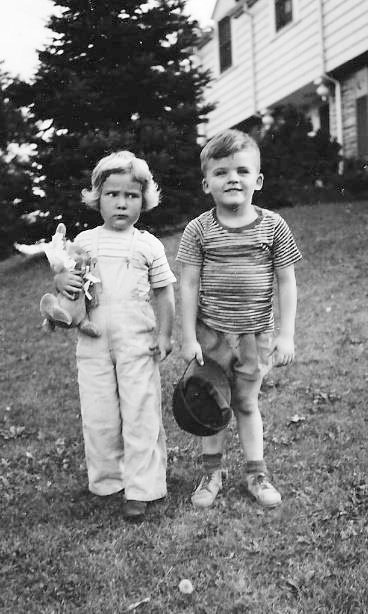
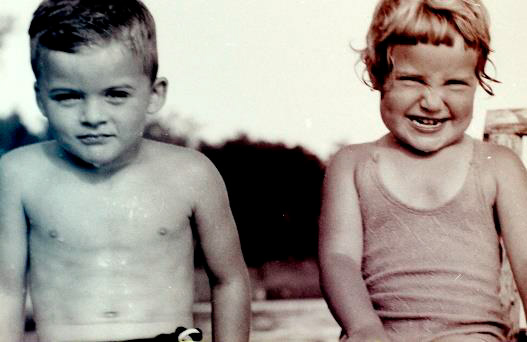
In the spring of 1947, Dad started to socialize again. Through a fellow doctor and his wife, he met Margaret Jean Goodrich Watson (Jean), a World War II widow with a son, Billy, who was about six weeks younger than me. They had their first date in May, and by June, they were serious enough to introduce all of us. By the end of August, they’d married, and began to knit our damaged families together. Bill and I became instant buddies, and we grew up almost like twins. And in April 1949 my new mother, (whom I called Mom) and Dad had one more child, my half-sister Margaret (Margy). That same year, 1949, Mom legally adopted Liz and me, and Dad adopted Billy. Mom and Dad also made sure all of our seven living grandparents (Grandma Tifft, the Hallbergs, the Goodriches, and Billy’s father’s parents, the Watsons) were included in our many family gatherings once they had married. I think Mom and Dad felt that they’d done what they needed to do to build one big blended and extended family family, but it wasn’t always easy for any of us. Nevertheless, I had a good childhood.
When Billy and I were about five and one-half Mom and Dad took us on our first memorable family vaction—to the Black Hills of South Dakota. One hot day, we went to a small pond to cool off. Billy and I had had swimming lessons that summer and were paddling about when I got tired and tried to put my feet down on the bottom to rest. But there was no bottom and I sank about eighteen inches below the surface. I saw a shaft of light above me and felt rather peaceful when suddenly a bent arm reached around my neck and pulled me up. It was Dad who then did the 1940s version of “artificial respiration” by placing me on my stomach and raising my arms like wings. I recovered. My father had saved my life.
We had a great neighborhood. Every summer evening after supper the dozen or so of us from five homes gathered to play group games till the sun went down. One evening it didn’t go so well for me—that was in the spring of seventh grade. The boys had been enjoying track and field events at school so they created a broad jump area along with a pole vaulting set-up in the field adjoining our house on Arcade Street and Highway 36. Mom and Dad had gone downtown to a play, “Teahouse of the August Moon,” and we were old enough to be without a babysitter. I asked the boys if I could try the broad jump but wasn’t aware of the pole vault hole. My right foot got caught in the hole just as I was about to make my winning jump. I heard a snap and was down for the count. I had broken my leg. It was eight-year-old Margaret who wisely said we needed to “Call Dr. Jackson!” who was Dad’s medical partner. Someone ran across the street for an adult who called for an ambulance and even rode in it with me to St. John’s Hospital. That was Dad’s primary hospital, so the doctors that evening wouldn’t do anything until they could speak to Dad. Of course, in those days there was no cell phone in Dad’s pocket. So, during the next several hours the hospital staff used scissors to cut my blue jeans up to my crotch and took an x-ray revealing that I had fractured my tibia and fibula, and then waited for Dad to get home to give the orders. This was a life-changing event for me, as it meant I couldn’t be confirmed with the rest of my church group that Sunday. And for three months I had to wear a full leg cast and use crutches until I was healed enough for a walking cast with a rubber heel.
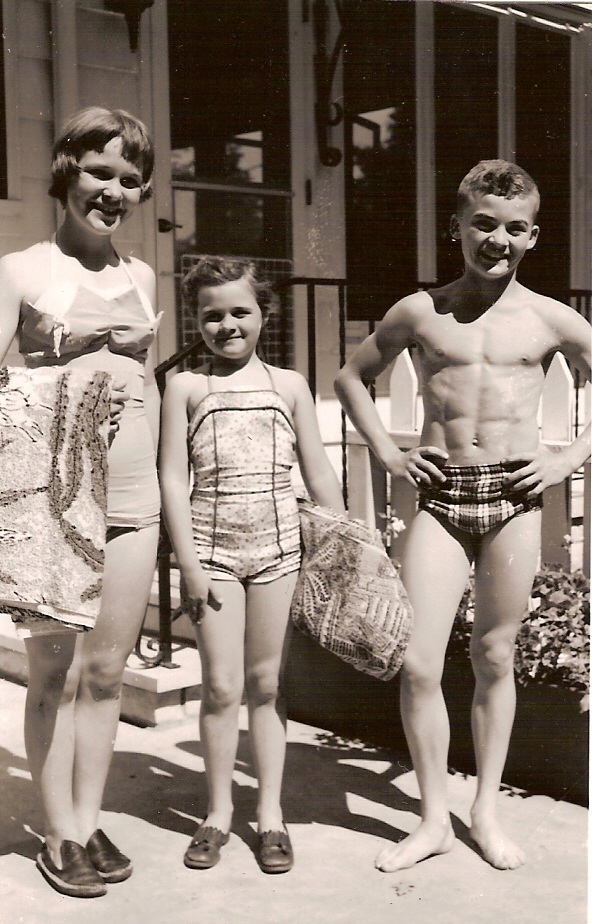
For our family vacation that summer we went as usual to Bearskin Lodge, a rustic resort on Bearskin Lake “up the Gunflint Trail” near the Minnesota and Ontario border. That year Mom and Dad allowed Bill and me to take our rented motor boat out by ourselves to fish for walleyes at our “Y rock”—a favorite fishing spot where there was a big rock with a crack shaped like a “Y.” Oh yes, we wore the 1950s version of life vests (orange cotton cloth filled with kapok) but I certainly would have sunk to the bottom if we had capsized the boat, since I still had my cast on! That fall, when I entered eighth grade with a newly revealed skinny, hairy right leg, I felt very self-conscious. According to the physical therapist, I was supposed to use a cane, but, at thirteen that was way too embarrassing for me, so I just tried to hide my limp.
My little sister Margy came to my rescue once again the next summer when we were back at Bearskin. Mom’s parents, Grandma and Grandpa Goodrich, were in one bedroom, our parents were in the other bedroom, and Margaret and I were sleeping on the lumpy pull-out couch in the main room, a combination living room, dining room, and kitchen. Margaret woke up feeling nauseated and went to the bathroom. I followed her to help. After she vomited, I didn’t find a cup in the bathroom so I went to the kitchen for one. I collapsed in front of the refrigerator, which was leaking freon gas. Margaret got up, went to our parents’ room, sat on Dad’s bed and said, “I’m sick, Mary’s on the floor, and I don’t know …” Then she passed out. Dad immediately got up to find me, carried both of us outdoors, woke everyone else up, and we all went quickly outdoors in the very early morning. My father had saved me and the whole family.
My School Years
We entered grade school when Billy and I were still a few months shy of five. It was a Lutheran parochial school because kindergarten wasn’t offered in the public schools yet. This school had one classroom for all grades, kindergarten through sixth. My experience there was not particularly happy: most of the students were boys; I was bullied by one little girl; and I felt humiliated by the male teacher on several occasions. In addition, I didn’t like having to memorize the catechism, so I usually hid on the stairs to the sanctuary as the teacher was checking us in.
Thankfully, by third grade Mom and Dad enrolled me in our local public elementary school, Little Canada. There was a much better ratio of girls to boys, plus female teachers with whom I felt more comfortable. Since our neighborhood had no girls my age, changing to a public school proved to be much better for me because I was able to make friends with girls, some of whom are still my friends today. In retrospect, though, I do have brother Bill to thank for helping the other boys in the neighborhood accept me in their baseball games and other activities.
The fall Bill and I entered seventh grade at a new junior-senior high school, we were startled by a voice over the loud-speaker broadcast to all classrooms, “Will Bill and Mary Tifft please report to the office immediately!” The school counselor loomed over us and interrogated us, asking us how our birthdates could be so close (December 1943 and January 1944), why were we in the same class, and had one of us failed? We both felt so embarrassed. No one had ever questioned us or ridiculed us about who we were. Finally, one of us said, “We came from different mothers.” When we told Mom about it at home that afternoon, she immediately phoned Mr. Wilson, the counselor, and gave him a piece of her mind, as our mother hen often did when one—or in this case two—of her chicks had been hurt by a thoughtless adult!
Otherwise, my junior and senior high school years were happy ones. I enjoyed many friends and participated in many school activities. I was active in Y-Teens, the Girls’ Athletic Association, was elected as the president of the Pep Club—probably due to my loud cheering voice—and I was a member of the National Honor Society. I graduated thirteenth in my class of over four hundred students. Brother Bill was number one—so much for Mr. Wilson thinking one of us had failed a grade. He and I also were voted by teachers and fellow students as “outstanding senior girl and boy.”
During senior high, I regularly attended Young Life gatherings once a week and really enjoyed singing those peppy songs of faith. When I was sixteen, my folks even allowed me to go to Young Life Camp in Colorado with my best friend. I relished that experience even though the first morning, while standing in the breakfast line, I passed out from the high altitude and ended up in the infirmary overnight for observation. That was embarrassing for me.
My College Years
When I received my letter of acceptance letter from St. Olaf College and its nursing program, I felt so honored and excited. I think from a very young age I wanted to be a nurse. St. Olaf, located in Northfield, Minnesota, had an excellent nursing program, one of a handful in Minnesota. Northfield seemed a natural setting for me too, because one set of our grandparents, the Watsons, had lived in Northfield when Bill and I were young so we had visited there often and were familiar with the town. Thanks to my parents paying all my college expenses—something like $1,500 per year—I received a great liberal arts education as well as nursing education and graduated with no college debt in the spring of 1965 with a Bachelor of Science, cum laude.
When I finished my junior year in college, I went to Europe with two college friends. We decided to visit Sweden, as well as eight other countries during our six week trip. I only knew the name of the main town, Torsby, which was near where Grandma and Grandpa had grown up, so we had little to go on. While visiting Torsby, we asked a few people if they knew of my grandparents, and lo and behold, we found not only records of my grandparents’ departure in the old records of the parish church, we found my mother’s first cousins, and several of our second cousins. That trip, paid for with $1,000 of my small inheritance from Grandpa and Grandma Hallberg, proved to be the beginning of a relationship with my Swedish family that has now lasted nearly sixty years. I like to think that Grandma and Grandpa would be pleased with how I used their gift. It certainly led me to become fascinated by the history of our Swedish family.
My Marriages
While taking a pharmacy course at the Minneapolis VA hospital during college, I met my future husband S. Bruce Benson, who was teaching the course. After I graduated in 1965, we married and moved to Maryland where Bruce worked for the National Institutes of Health as a hospital pharmacist while serving as a member of the U.S. Public Health Service, in order to meet his military service obligation during the Vietnam War. Bruce and I had one child, a daughter. Our marriage ended in divorce in 1977.
I met my second husband Frederic Sharpless Froelicher (Fred) when we attended group counseling together. Fred and I married in 1981, and I acquired five more grown and almost grown “children.” Fred and I were married for nearly forty-one years when he passed away at age ninety-four in 2022. I am blessed to have six terrific children, seven grandchildren, and two great-grandchildren.
My Career
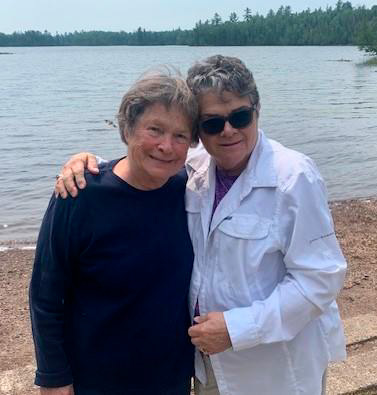
I worked full time as a nurse for forty-five years, including the years when my daughter was small—which was somewhat unusual in those days. For the first thirty-five years of my career, I worked primarily as a public health nurse for the Montgomery County Health Department in Maryland. I worked at senior centers, senior nutrition sites, senior housing, nursing homes, libraries, and churches where I provided small group education, conducted blood pressure clinics, and led weight loss groups. I also assessed patient health and living situations for adult protective services. Later, when Fred and I moved to rural Montana, I provided home health and home hospice care and was a case management nurse. As a nurse in Montana, some days I drove 150 miles visiting patients. I met elderly ranchers and their wives, heard many stories of Montana in bygone days and relished providing “hands-on” care to homebound patients. I learned a lot about life and death as a nurse and I considered serving the elderly and their families a privilege. If someone asked what I did during my working years, I’d say “I helped solve human puzzles.” What a great ride nursing was for me!
I now live in Minnetonka, Minnesota, with my schnauzer, Nissa (a Swedish name), close to my sisters, Elizabeth and Margaret. Several years ago, Margaret asked me to work with her on our joint family history. I’d been working intermittently on our Swedish genealogy for years, and was happy to take on the Hallberg family history as my special contribution. Now tengens.net gives me a way to share my work.